
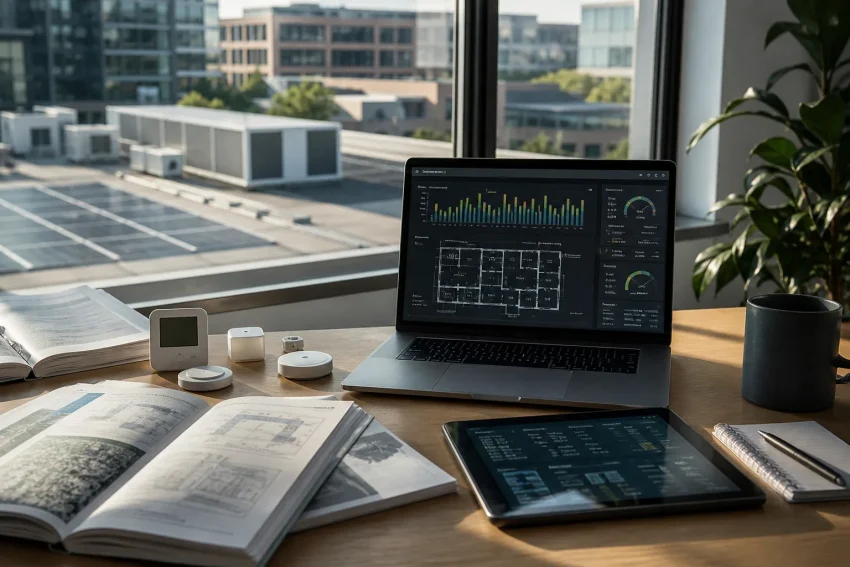
Facility teams waste thousands in energy costs every month because their monitoring software shows data but hides insight. You’re drowning in dashboards that track consumption without revealing why usage spikes at 3 AM or which systems are silently bleeding money. The right energy monitoring platform doesn’t just collect numbers, it translates them into actionable intelligence your team can act on immediately.
Lifee’s AI-powered automation systems, for example, turn raw building data into custom energy efficiency strategies tailored to real estate operations, not generic templates. This guide walks you through the must-have features that separate true energy intelligence from glorified spreadsheets, so you can Lastly make decisions that cut waste and prove ROI.
Introduction to Energy Monitoring Software
Energy monitoring software helps building owners and facility teams collect, organize, and interpret information from meters, building management systems, HVAC equipment, lighting, occupancy sensors, and other connected assets. In 2026, the strongest platforms go beyond displaying kilowatt-hours. They connect consumption with operating schedules, weather, occupancy, tariffs, equipment status, and carbon factors so teams can understand what is driving performance and decide what to do next.
The Evolution of Energy Monitoring
Earlier monitoring tools mainly recorded utility data and produced periodic reports. Modern platforms combine cloud connectivity, sub-metering, automation, machine learning, and natural-language interfaces to identify anomalies and recommend corrective action. A facility manager investigating a 3 AM consumption spike can now trace the event to a specific air-handling unit, compare it with occupancy and temperature data, and create a rule that prevents the same waste from recurring.
This shift matters because regulatory expectations are also moving toward continuous measurement and controllable building systems. The revised European Energy Performance of Buildings Directive requires national implementation by 29 May 2026 and introduces stronger provisions for building automation, electronic monitoring, data access, and indoor environmental quality. The directive also supports the Smart Readiness Indicator, which evaluates how effectively buildings use technology to optimize energy performance, respond to occupants, and interact with the grid.
- From measurement to explanation: A useful platform does not stop at showing that consumption increased. It connects the increase to equipment, schedules, weather, occupancy, or operating conditions so teams can identify a plausible cause.
- From reports to continuous action: Automated alerts and control recommendations allow operators to respond during the event instead of discovering waste at the end of the billing cycle.
- From isolated buildings to connected portfolios: Cloud software lets owners compare sites, normalize performance, and apply proven operating strategies across offices, retail properties, campuses, and residential buildings.
How Energy Monitoring Software Works
Energy monitoring software usually follows a connected data loop. Devices capture information, integration layers transport it, analytics interpret it, and dashboards or control systems turn the result into an operational decision. The quality of the final recommendation depends on the quality, frequency, context, and consistency of the underlying data.
- Data capture: Smart meters, submeters, sensors, controllers, and existing building management systems record electricity, gas, heating, cooling, water, temperature, humidity, occupancy, and equipment status. Before deployment, teams should verify meter accuracy, timestamps, units, and the availability of interval data.
- Data normalization: The platform converts information from different manufacturers and protocols into a consistent structure. This step prevents a portfolio dashboard from comparing incompatible units or treating missing readings as zero consumption.
- Analysis and diagnosis: Rules, statistical models, and AI compare current performance with historical patterns, schedules, weather, occupancy, and benchmarks. The result should be a prioritized explanation rather than a long list of unexplained alarms.
- Action and verification: Operators receive an alert, recommendation, or automated command. The software should then measure whether the intervention produced the expected result, creating a feedback loop for savings verification.
Integration with Building Systems and IoT
Integration is one of the most important selection criteria because a visually impressive dashboard is not useful if it cannot access the systems that influence consumption. A practical platform should support relevant building management systems, submeters, Internet of Things devices, utility data, weather feeds, occupancy systems, and business applications through documented interfaces or secure gateways.
Teams should map each data source before signing a contract. For example, a university may need whole-building meters for benchmarking, floor-level submeters for accountability, HVAC points for fault detection, and occupancy data for after-hours control. Lifee can use this type of building-specific data model to design automation strategies around the facility’s actual equipment, operating rules, and energy objectives rather than applying a generic template.
Role of AI in Predictive Energy Management
AI is most valuable when it reduces investigation time and improves the timing of an intervention. Models can forecast demand, detect unusual equipment behavior, estimate the effect of weather, and identify situations such as simultaneous heating and cooling. However, facility teams should ask whether the system explains its recommendations, displays confidence or uncertainty, and allows operators to approve, adjust, or reverse automated actions.
Lifee’s approach combines AI-powered LLM automation with contextual rules and custom energy-efficiency solutions. That combination can help translate a raw anomaly into a practical workflow, such as checking a stuck valve, changing a schedule, reducing ventilation during verified vacancy, or escalating an issue to maintenance.
| Stage | Facility question | Software capability to verify |
|---|---|---|
| Capture | What is using energy right now? | Reliable interval data, device connectivity, timestamps, and meter validation |
| Interpretation | Why did consumption change? | Baseline comparison, weather normalization, occupancy context, and anomaly detection |
| Action | What should the team do? | Prioritized recommendations, workflows, approvals, and control integration |
| Verification | Did the intervention work? | Measurement and verification, savings tracking, and audit-ready records |
Key Features to Look For in Energy Monitoring Software
The right platform should help different users make better decisions without forcing everyone to interpret the same technical dashboard. Executives may need portfolio cost and carbon trends, facility managers may need prioritized faults, and technicians may need equipment-level readings and work-order context.
Must-Have Features Checklist
- Real-time dashboards and usable data: Dashboards should show consumption, demand, cost, carbon, and performance by site, building, system, and time period. Look for drill-down views, weather normalization, export options, and clear handling of missing or estimated data.
- Customizable alerts: Alerts should be based on operational context rather than fixed thresholds alone. A useful rule can distinguish between a legitimate hot-day demand increase and an abnormal overnight load, while routing each event to the correct person.
- Predictive analytics and fault detection: The software should identify developing problems such as equipment running outside schedule, degraded efficiency, sensor drift, or simultaneous heating and cooling. Ask vendors to demonstrate how the platform ranks faults by energy impact, urgency, and confidence.
- Automation with human oversight: Automation can adjust schedules, setpoints, lighting, ventilation, or demand response settings, but safeguards are essential. Require permissions, approval workflows, operating limits, rollback controls, and a complete record of every automated change.
- Interoperability: The platform should connect with existing BMS infrastructure, utility feeds, smart meters, IoT devices, maintenance platforms, and reporting tools. Open APIs, documented protocols, and exportable data reduce the risk of becoming dependent on a closed ecosystem.
- Cybersecurity: Building systems are connected operational technology, so security must cover identity, device onboarding, network segmentation, encryption, patching, backups, logging, and incident response. Ask for evidence of security controls rather than accepting a general claim that the product is secure.
- Scalability and portfolio management: A multi-site owner should be able to add properties, meters, users, and use cases without rebuilding the data model. Consistent naming, role-based access, and portfolio benchmarks are essential when comparing buildings with different sizes and operating profiles.
- User experience and accessibility: Facility teams need clear priorities, mobile access, understandable explanations, and role-based views. A platform that requires a data scientist for every investigation will struggle to produce consistent operational savings.
Importance of Cybersecurity and Future-Proofing
Energy monitoring software should be assessed as part of the building’s technology and operational risk environment. A compromised monitoring account may expose occupancy patterns, equipment information, or control pathways, while poor data governance can undermine compliance and savings claims.
Minimum safeguards should include multifactor authentication, least-privilege permissions, encrypted communications, secure device provisioning, vulnerability management, audit logs, tested backups, and a documented incident response process. Future-proofing also means asking how the vendor handles changing tariffs, carbon factors, regulations, data ownership, API access, and the addition of new building systems.
- Security ownership: Define which responsibilities belong to the vendor, building owner, IT team, controls contractor, and device manufacturer. Ambiguous responsibility often creates gaps during upgrades or incidents.
- Data governance: Confirm who owns raw and processed data, how long records are retained, how data can be exported, and what happens if the contract ends. These terms matter for audits, benchmarking, and future system changes.
- Safe automation: Separate monitoring permissions from control permissions. Begin with recommendations or supervised actions, then expand automation only after the team has validated the model and established operating limits.
Benefits of Energy Monitoring Software
Energy monitoring creates value when it changes decisions, not simply when it creates more charts. The strongest business cases combine direct utility savings with maintenance improvements, better comfort, reduced carbon emissions, compliance support, and clearer capital-planning decisions.
Cost Control and Operational Efficiency
Teams can use interval data to identify baseload, demand peaks, schedule drift, and equipment that runs when spaces are empty. A building that discovers a ventilation system operating throughout an unoccupied weekend can correct the schedule, verify the reduction, and use the documented result to justify broader controls improvements.
Comfort, Maintenance, and Reliability
Energy data becomes more useful when linked to indoor environmental quality and asset condition. A platform that correlates temperature complaints, occupancy, valve position, and energy use can help distinguish a comfort problem caused by control settings from one caused by failing equipment. This reduces reactive maintenance and helps teams protect occupant experience while lowering consumption.
Carbon Accounting and Compliance
Accurate consumption records support emissions reporting, energy benchmarking, sustainability disclosures, and building-performance requirements. Under the revised European framework, digital building data, access to systems data, continuous electronic monitoring, and smart-readiness capabilities are becoming increasingly relevant to owners and managers operating in the European market.
Evidence-Based ROI
Claims such as “up to 25 percent savings” should never be accepted without context. Results depend on building condition, baseline quality, tariffs, operating hours, climate, controls access, maintenance practices, and the depth of implementation. Facility teams should establish a baseline, define the intervention, record non-energy variables, and verify the result after the change.
- Financial metrics: Track energy cost, demand charges, avoided maintenance, implementation cost, subscription fees, and payback period. Separate gross savings from savings that depend on changing tariffs or occupancy.
- Operational metrics: Track after-hours runtime, unresolved alarms, comfort complaints, response time, and preventive maintenance completion. These measures show whether the platform is improving day-to-day facility work.
- Sustainability metrics: Track energy intensity, emissions, renewable-energy use, peak demand, and the quality of supporting evidence. Reliable records make sustainability reporting more defensible.
| Metric | What it reveals | Useful management question |
|---|---|---|
| Energy intensity | Performance adjusted for floor area or activity | Which buildings perform poorly after differences in size and use are considered? |
| Peak demand | Contribution to demand charges and grid stress | Which loads can be shifted or controlled during expensive periods? |
| After-hours consumption | Schedule-related waste and unnecessary baseload | Which systems remain active when occupancy is low? |
| Fault response time | Operational value beyond utility savings | How quickly does the team move from detection to resolution? |
New Operating Requirements for Smarter Buildings
Continuous Monitoring Is Becoming a Compliance Capability
For European building owners, the revised Energy Performance of Buildings Directive creates a stronger connection between monitoring, control, data access, and building performance. It provides for continuous electronic monitoring that measures system efficiency and notifies owners or managers when performance changes significantly or servicing is needed, where technically, economically, and functionally feasible.
Smart Readiness Requires More Than a Dashboard
The Smart Readiness Indicator evaluates capabilities across technical domains including heating, cooling, hot water, ventilation, lighting, electricity, electric-vehicle charging, and monitoring and control. A software platform should therefore be evaluated on whether it can support interoperable data and responsive operation, not merely on how attractive its charts look.
Data Portability Should Be a Procurement Requirement
EU rules also emphasize access to building systems data and national energy-performance databases. Facility teams should require clear ownership, export formats, API access, retention terms, and documented data lineage. These safeguards help preserve the value of historical data when a property changes vendors, systems, tenants, or operating models.
Comparison of Leading Solutions and Lifee’s Unique Value Proposition
Facility teams may compare Lifee with established building-technology providers such as Schneider Electric and Honeywell. The most useful comparison is not a generic feature count. It is a test of how each platform handles the building’s actual data sources, control boundaries, user roles, security requirements, and verification process.
| Evaluation area | Lifee | Schneider Electric | Honeywell |
|---|---|---|---|
| Automation approach | AI-powered, contextual automation designed around custom energy-efficiency strategies | Strong controls and industrial automation capabilities, with configuration depending on the deployment | Strong building controls and HVAC-oriented automation within supported environments |
| Integration priority | Designed to combine BMS, IoT, cloud, and operational data into a building-specific model | Broad ecosystem and strong compatibility across many enterprise and legacy environments | Deep integration with supported Honeywell building platforms and selected third-party systems |
| Customization | Custom project design, contextual workflows, and strategies aligned with property goals | Modular configuration suited to complex portfolios and technical deployments | Configurable templates and controls focused on building operations |
| Operator experience | Role-based, insight-oriented workflows intended to turn anomalies into actions | Powerful professional tools that may require specialist configuration and training | Operator-focused interfaces within the broader controls environment |
| Security evaluation | Assess encryption, access controls, update practices, logging, and deployment architecture during procurement | Assess enterprise security controls, product scope, and site-specific responsibilities | Assess platform security, device governance, updates, and integration boundaries |
Lifee’s differentiator is its focus on combining intelligent automation, custom energy-efficiency solutions, and technology designed around human decision-making. Facility teams should still validate every product claim through a pilot using their own meters, schedules, equipment, operators, and success metrics.
How to Evaluate and Select the Right Software
Selecting energy monitoring software is a building-operations decision, an IT decision, and a financial decision at the same time. A structured evaluation prevents teams from buying a dashboard that cannot connect to their systems or produce measurable action.
Step-by-Step Evaluation Checklist
- Define the business case: Set specific goals such as reducing after-hours consumption, lowering demand charges, improving comfort, supporting compliance, or prioritizing capital upgrades. Assign a baseline, target, timeframe, and accountable owner to each goal.
- Inventory the building: Map meters, BMS points, submeters, sensors, network constraints, tariffs, occupancy schedules, and control permissions. Identify data gaps before comparing vendors because missing points can limit the value of even the most advanced analytics.
- Prioritize use cases: Select two or three high-value workflows for the first phase, such as HVAC scheduling, fault detection, peak-demand management, or portfolio benchmarking. This keeps the pilot measurable and prevents teams from being overwhelmed by unnecessary features.
- Test data quality: Request a sample data review that checks interval length, timestamp consistency, units, missing values, meter hierarchy, and estimated readings. A vendor should explain how the platform detects and handles bad data rather than silently filling gaps.
- Evaluate security and governance: Review authentication, permissions, encryption, device onboarding, patching, logging, backup, incident response, data ownership, retention, and export. Include IT and cybersecurity stakeholders before granting any system control access.
- Run a controlled pilot: Use a representative building or zone and compare the platform’s findings with operator knowledge. Measure detection quality, response time, false alarms, user adoption, comfort, energy performance, and the effort required to maintain the system.
- Calculate total cost of ownership: Include software subscriptions, meters, gateways, installation, integration, commissioning, training, support, cybersecurity work, and future expansion. Compare these costs with verified savings and operational value, not with a headline license price alone.
During a Lifee evaluation, facility teams can focus the pilot on a custom energy-efficiency objective, such as reducing overnight HVAC waste or improving automation around occupancy. The most useful demonstration will show how raw data becomes a recommendation, how the team approves or modifies it, how the system executes the action, and how the result is verified.
Frequently Asked Questions
What is the difference between energy monitoring software and a building management system?
Energy monitoring software focuses on collecting, analyzing, visualizing, and acting on energy and operational data. A building management system primarily controls and supervises building equipment, although modern platforms increasingly overlap. The best deployment connects the two so monitoring insights can inform safe control actions.
Can energy monitoring software work with older buildings?
Yes. Older buildings can begin with utility bills, interval meter data, wireless sensors, gateways, and targeted submeters before integrating deeper with legacy controls. A phased approach reduces disruption and helps teams prioritize the systems with the greatest energy or operational impact.
How much data is needed before AI becomes useful?
There is no universal threshold because usefulness depends on data quality, interval frequency, building stability, and the use case. A platform can identify schedule anomalies quickly with limited data, while reliable forecasting and equipment performance models generally require a clean history covering representative operating and weather conditions.
Is automated control safe for facility operations?
Automated control can be safe when it uses least-privilege access, operating limits, approval workflows, fallback schedules, manual overrides, monitoring, and audit logs. Teams should begin with supervised recommendations and expand authority only after validating the model in the specific building.
How should facility teams verify savings?
Establish a baseline before implementation and account for weather, occupancy, operating hours, tariffs, equipment changes, and unusual events. Compare measured post-implementation performance with the adjusted baseline, document each intervention, and distinguish verified savings from estimated or projected savings.
Next Steps for Smarter Energy Management
In 2026, energy monitoring software is becoming a core capability for facilities that need lower operating costs, stronger sustainability performance, better comfort, and more defensible building data. The most valuable platforms connect reliable measurements with explainable analytics, secure automation, interoperability, and a verification process that proves whether actions worked.
Lifee helps individuals, businesses, and real estate professionals turn building data into intelligent energy-efficiency strategies through AI-powered automation, custom project design, contextual workflows, and cybersecurity-conscious technology. A personalized assessment can identify the first high-value use case, map the required data, and establish the metrics needed to demonstrate practical ROI.