
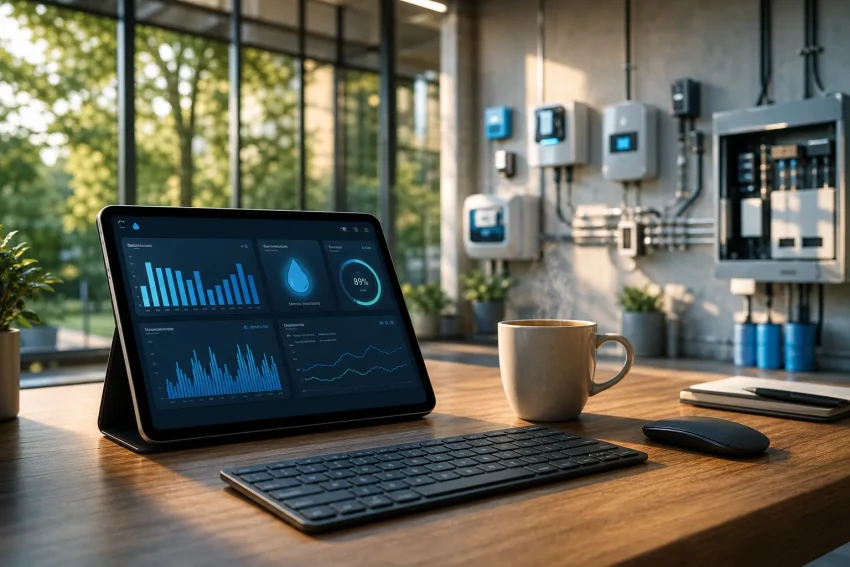
Buildings are leaking money and resources every single day, and most owners don’t even realize it. Water and energy systems rarely talk to each other, which means inefficiencies compound silently until utility bills spike or equipment fails. Lifee, a French pioneer in AI-powered automation, has spent years designing intelligent systems that bridge this gap for individuals, businesses, and real estate professionals.
Their approach doesn’t just monitor; it predicts, adapts, and optimizes both water and energy use in real time. This guide walks you through how smart building technology actually works to cut waste, lower costs, and future-proof your property without the complexity.
Introduction to Smart Building Water and Energy Management
Smart buildings in 2026 operate far beyond isolated lighting, heating, or plumbing controls. Artificial intelligence, Internet of Things sensors, connected meters, and building management software now allow operators to view resource use as one operational picture. That matters because water and energy are closely linked: pumping, heating, treating, and distributing water all consume energy, while equipment faults can increase demand across both systems.
Adoption is moving from experimentation toward routine operation. A 2025 survey of 308 building owners, operators, and managers in the United States and Canada found that 91 percent had deployed smart devices, systems, or software in their facilities. Operational efficiency and cost reduction were the leading priorities for 56 percent of respondents, while real-time water monitoring was increasingly considered alongside energy monitoring and automated optimization.
European policy is reinforcing this shift. Directive (EU) 2024/1275 supports a zero-emission building stock by 2050 and introduces a framework for assessing smart readiness. The European Commission’s Smart Readiness Indicator evaluates a building’s capacity to optimize energy performance, respond to occupant needs, and interact intelligently with technical systems, including heating, cooling, domestic hot water, ventilation, monitoring, and control.
- 91 percent of surveyed facilities had deployed smart technology: This indicates that connected monitoring is no longer limited to experimental flagship projects. Owners can begin with a focused pilot and expand after proving operational value.
- 56 percent prioritized operational efficiency and cost reduction: The strongest business case remains practical rather than purely environmental. Lower bills, fewer emergency repairs, and better equipment performance help fund further improvements.
- 75 percent had formal net-zero goals: Carbon targets create a reason to measure energy carefully, but water-related data helps reveal hidden energy use in pumps, boilers, cooling towers, and hot-water distribution.
- More than 1,000 buildings had been assessed through European smart-readiness test phases: These assessments show that smart capability is becoming measurable, making it easier to compare buildings and prioritize upgrades.
How Integrated Water and Energy Management Systems Work
An integrated platform begins by collecting data from submeters, pressure sensors, flow meters, leak detectors, thermostats, boilers, heat pumps, pumps, HVAC equipment, and occupancy systems. Software then compares live conditions with historical patterns, weather, schedules, and expected occupancy. Lifee’s intelligent automation approach is designed to combine these signals so that owners and operators can move from passive monitoring to contextual decisions.
AI-powered building management
AI identifies patterns that conventional alarms often miss. A slow overnight flow may indicate a hidden leak, while an unexpected rise in hot-water demand can point to a failed valve, a circulation problem, or a change in occupancy. The system can rank the anomaly by likely cost and urgency, helping maintenance teams focus first on issues with the greatest water, energy, or equipment impact.
IoT sensors for water and energy
Granular measurement makes waste visible. A main meter may show that consumption increased, but floor-level, riser-level, or equipment-level sensors can help locate the cause. Temperature, pressure, humidity, flow, and occupancy data can then be combined to distinguish normal demand from a fault, reducing false alarms and unnecessary interventions.
The water-energy nexus in practice
The connection is particularly clear in domestic hot water, cooling towers, boilers, and pumping systems. A leak on a hot-water loop wastes the water itself and the energy used to heat and circulate it. Conversely, an inefficient pump or poorly controlled recirculation system can increase electricity demand without improving service. Coordinated controls address both sides of the problem rather than optimizing one metric at the expense of another.
For example, if a sensor detects continuous flow in an unoccupied restroom, the platform can notify maintenance, close an isolation valve where appropriate, and examine nearby hot-water and pump loads. If a conference room is empty, occupancy-based controls can reduce conditioning while preserving minimum ventilation and hygiene requirements. These actions require carefully configured safeguards, but they demonstrate why connected systems outperform isolated devices.
| Building signal | Potential issue | Coordinated response |
|---|---|---|
| Continuous night-time flow | Leak, running fixture, or unauthorized use | Alert the responsible team, isolate the affected zone, and check related hot-water or pumping demand |
| High hot-water energy with normal occupancy | Insulation loss, recirculation fault, or temperature-control problem | Inspect the loop, adjust schedules, and verify service temperature before changing setpoints |
| High HVAC demand in an empty zone | Incorrect schedule, sensor fault, or control override | Validate occupancy data and apply contextual heating, cooling, or ventilation settings |
| Pressure fluctuation with rising pump electricity | Restriction, leak, failing pump, or poor control logic | Investigate the hydraulic system and optimize pump operation after verification |
Benefits of Joint Water and Energy Management
Integration creates value because it connects consumption with causes. Instead of treating a higher utility bill as a monthly accounting problem, operators can see whether the increase came from occupancy, weather, equipment degradation, leaks, or control errors. This shortens the path from detection to correction.
- Lower operating costs: Leak detection reduces avoidable water charges, while demand-based heating, cooling, and pumping reduce energy use during unoccupied periods. The strongest projects measure savings against a weather- and occupancy-adjusted baseline rather than comparing arbitrary months.
- Fewer failures and emergency repairs: Abnormal flow, pressure, temperature, and runtime patterns can reveal developing faults before they become floods, boiler failures, or major comfort complaints. Maintenance teams gain time to schedule work instead of responding under pressure.
- Stronger sustainability reporting: Unified dashboards can support energy, water, carbon, and operational reporting with consistent timestamps and defined boundaries. This improves the credibility of ESG information and helps identify whether targets are being achieved through real performance improvements.
- Better occupant comfort: Predictive controls can maintain stable temperatures and reliable hot water without running equipment continuously. Occupants benefit when automation responds to actual conditions rather than relying on fixed schedules that ignore holidays, weather, or changing use.
| Performance area | What to measure | Why it matters |
|---|---|---|
| Water efficiency | Consumption per occupant, room, floor area, or operating hour | Separates genuine improvement from changes in occupancy or business activity |
| Energy efficiency | Energy use by end use, peak demand, equipment runtime, and weather-adjusted intensity | Shows whether controls are reducing demand without creating comfort problems |
| Reliability | Alarm response time, repeat faults, downtime, and emergency callouts | Connects smart management with maintenance productivity and asset protection |
| Occupant experience | Comfort complaints, hot-water availability, indoor conditions, and satisfaction | Ensures savings do not come at the expense of the people using the building |
Case Studies: Real-World Examples and Lifee Solutions
The supplied project material describes a mid-sized Lyon office using Lifee’s AI-driven platform, with reported water waste falling by 30 percent and energy use by 25 percent within a year. Those figures are useful as project-level claims, but they should be accompanied by a measurement and verification method, baseline period, occupancy context, weather conditions, and precise definitions of “waste” and “energy use” before being presented as independently validated industry results.
The same principle applies to the described Paris residential high-rise. Unit-level alerts and personalized temperature controls can make savings visible to residents, while building-level analytics can reveal shared-system issues such as circulation losses, pressure problems, or plant-room inefficiencies. A successful deployment should protect resident privacy by using the least detailed occupancy data needed for control.
Lifee’s value lies in custom project design rather than a one-size-fits-all installation. A property can begin with water monitoring, add energy submeters, connect existing HVAC controls, and introduce predictive automation after the data quality has been tested. This phased approach limits disruption and gives owners evidence for each subsequent investment.
- Start with a defined operational problem: A recurring leak, high hot-water consumption, or excessive HVAC runtime provides a clear baseline and a measurable objective. The project team can then select only the sensors and integrations required to investigate it.
- Make the data actionable: Every alert should identify a location, likely cause, priority, and responsible person. Lifee’s contextual automation can help turn raw readings into workflows that maintenance and property teams can actually use.
- Verify results before scaling: Compare performance with normalized historical data and document changes in occupancy, weather, schedules, tariffs, and equipment. This prevents overstating savings and helps identify which interventions should be repeated elsewhere.
Implementation Steps for a Secure, Scalable System
Technology alone does not create efficiency. The building needs a reliable baseline, compatible controls, clear responsibilities, and a process for learning from the data. A phased plan makes the investment easier to manage and reduces the risk of installing disconnected devices.
- Run an intelligent water and energy audit: Map meters, equipment, schedules, occupants, tariffs, and maintenance records before purchasing hardware. Reconcile utility bills with interval data, identify the largest end uses, and look for simultaneous signals such as water flow during unoccupied hours and unnecessary pump or hot-water runtime.
- Define measurable targets: Establish baselines such as litres per occupant, kilowatt-hours per square metre, peak demand, alarm response time, and comfort complaints. Targets should include a time frame and acceptable operating limits so that efficiency does not compromise hygiene, safety, or occupant needs.
- Choose interoperable technologies: Prefer open interfaces, documented data ownership, secure authentication, and equipment that can integrate with existing building management systems. A scalable platform should support phased deployment across residential, commercial, and mixed-use properties without forcing a complete replacement of functioning controls.
- Launch a focused pilot: Select one riser, plant room, floor, or building with a clear problem. Test sensor accuracy, network reliability, alert routing, manual overrides, and maintenance response before extending automation to the entire portfolio.
- Automate carefully: Begin with recommendations and verified alerts, then enable low-risk automatic actions such as schedule adjustments or approved valve responses. Keep safety interlocks, fallback modes, and human approval for actions that could affect water quality, critical equipment, or occupant wellbeing.
- Review and optimize continuously: Hold regular performance reviews with facility managers, maintenance contractors, occupants, and IT teams. Recalibrate sensors, remove duplicate alarms, update schedules after operational changes, and compare actual savings with the original baseline.
Cybersecurity, Privacy, and Interoperability Cannot Be Optional
Protect connected equipment from operational risk
Water valves, pumps, HVAC controllers, meters, and occupancy sensors expand the building’s digital attack surface. Use network segmentation, unique credentials, multifactor authentication where supported, encrypted communications, timely firmware updates, least-privilege access, backups, and an incident-response plan. A system that saves energy but allows unauthorized control of critical equipment is not resilient.
Limit personal data and explain its use
Occupancy-based automation does not require identifying individuals in most cases. Aggregate counts, room status, schedules, or anonymous sensor events can often deliver the needed control signal with less privacy risk. Define retention periods, access permissions, vendor responsibilities, and resident or employee communication before collecting detailed data.
Demand interoperability from the beginning
Proprietary systems can create stranded assets when a supplier changes its service or pricing. During procurement, ask how data can be exported, which protocols are supported, how alarms integrate with existing workflows, and whether the system can continue safe local operation during an internet outage. Lifee’s custom project design should be evaluated against these practical requirements alongside predicted savings.
Why Measurement and Verification Determine the Business Case
Reported savings can be misleading when a building changes occupancy, operating hours, tariffs, weather exposure, or equipment at the same time as a smart-management installation. A credible evaluation records the baseline, documents intervention dates, normalizes for relevant conditions, and separates water savings from energy savings while also examining their interaction.
| Project stage | Evidence to collect | Decision enabled |
|---|---|---|
| Before installation | Utility bills, interval data, equipment inventory, schedules, occupancy, faults, and comfort records | Identify the highest-value intervention and create a defensible baseline |
| During pilot | Sensor accuracy, alert frequency, response time, overrides, and operating conditions | Determine whether the system is trustworthy and usable |
| After optimization | Normalized water and energy intensity, peak demand, maintenance events, and occupant outcomes | Verify savings and decide whether to scale |
The Road Ahead for Smart Building Water and Energy Management
The next phase is less about adding more sensors and more about improving the quality of decisions. Better interoperability, digital twins, predictive maintenance, demand response, renewable energy coordination, and low-carbon hot-water systems will allow buildings to respond dynamically to weather, occupancy, grid conditions, and water constraints.
European smart-readiness policy will continue encouraging buildings to assess how effectively their systems monitor, adapt, and optimize operations. At the same time, owners will expect clearer financial evidence, stronger cybersecurity, and simpler interfaces for facility teams. The most useful platforms will connect advanced analytics with practical workflows rather than presenting complex data without an action path.
Lifee is positioned within this transition by combining French engineering, AI-powered automation, custom energy-efficiency solutions, and home automation for individuals, businesses, and real estate professionals. Its strongest role is helping translate a building’s specific conditions into an upgrade path that is measurable, adaptable, and understandable to the people responsible for operating it.
Frequently Asked Questions
Can an older building use integrated water and energy management?
Yes. Existing buildings can usually begin with submeters, leak detection, temperature sensors, and gateway devices that connect selected equipment without replacing every control system. A pilot in a plant room, vacant zone, or high-consumption area can establish value before broader integration.
Does saving water always save energy?
Not automatically. Saving hot water, reducing unnecessary pumping, and correcting recirculation losses can reduce energy use, but some water-saving measures may increase pump pressure or treatment requirements. Joint monitoring is therefore essential to verify the net result.
What should a building owner measure first?
Start with total water use, energy use, peak demand, hot-water consumption, equipment runtime, occupancy, leak events, and comfort complaints. These measures create a practical baseline and help identify whether the first priority should be leak detection, plant optimization, scheduling, or equipment replacement.
How does Lifee fit into an implementation?
Lifee can support a custom project that combines intelligent energy audits, AI-powered automation, contextual controls, and scalable monitoring. The appropriate configuration depends on the building’s systems, objectives, budget, cybersecurity requirements, and ability to act on alerts.
Smart building water energy management is In the end an operational strategy, not just a technology purchase. By connecting water data with heating, cooling, pumping, occupancy, maintenance, and cybersecurity practices, owners can find waste earlier and make better decisions. A measured pilot, followed by secure and interoperable expansion, gives individuals, businesses, and real estate professionals a realistic path toward lower costs, improved comfort, stronger resilience, and more credible sustainability performance.