
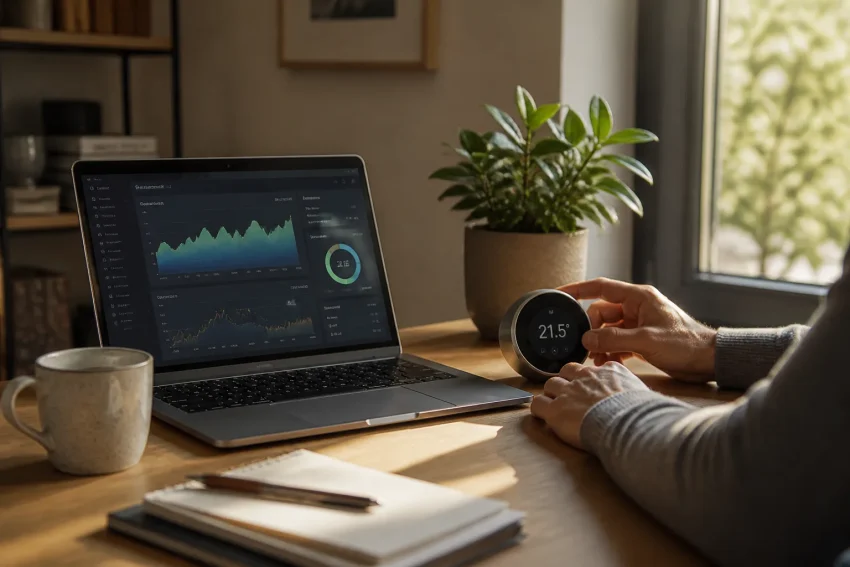
AI-powered energy systems promise to slash your utility bills and carbon footprint, but locking them down too tightly can cripple the very intelligence that makes them valuable. You’re caught between two risks: exposing sensitive consumption data to breaches or starving your algorithms of the insights they need to optimize performance.
Lifee, a French leader in intelligent energy efficiency and home automation, has spent years designing AI-powered automation systems that thread this needle, balancing robust security protocols with the data flows that drive real savings. This guide walks you through a practical framework to protect your system without sacrificing its smarts, covering access controls, data governance, and adaptive monitoring strategies that work for homes and businesses alike.
The Intersection of AI, Energy Management, and Cybersecurity
Picture your smart home or business in 2026: AI quietly manages lighting, heating, ventilation, appliances, batteries, solar generation, and electric-vehicle charging while keeping energy costs under control. The value comes from continuous data analysis. Weather, occupancy, equipment performance, tariffs, and user preferences allow an AI system to make decisions in seconds rather than waiting for a monthly energy review.
That same connectivity creates a security obligation. A modern energy platform can connect cloud services, mobile applications, smart meters, building-management systems, connected appliances, inverters, and third-party APIs. Each connection must provide enough information for useful optimization without exposing more personal or operational data than necessary.
The risk is not theoretical. ENISA’s 2025 Threat Landscape analysed 4,875 cyber incidents recorded between July 2024 and June 2025, while its reporting shows that energy remains an important target within Europe’s critical-infrastructure environment. The same threat picture includes ransomware, supply-chain compromise, exploitation of public-facing software, and attacks against operational technology.
Why AI Matters in Energy Management
Traditional automation follows fixed rules. AI-powered energy management can identify patterns, predict demand, detect equipment abnormalities, and adapt schedules as conditions change. A system might reduce heating before a building becomes empty, postpone flexible loads until electricity is cheaper, or flag a refrigeration unit whose cycling pattern suggests maintenance is needed.
Lifee applies this principle to intelligent energy efficiency and home automation, combining custom project design with contextual automation. For households, that can mean greater comfort and lower waste. For businesses and real-estate professionals, it can mean more consistent building performance across multiple rooms, sites, or properties.
The Expanding Threat Landscape
The attack surface grows whenever an energy platform adds a device, integration, user, or remote-management function. Weak credentials, outdated firmware, exposed dashboards, compromised suppliers, and stolen administrator sessions can all create a path toward systems that influence physical equipment.
Energy operators also face a difficult operational constraint: industrial control systems and building systems often cannot tolerate long outages for security maintenance. Effective protection therefore needs to separate critical functions, validate commands, and monitor behavior continuously rather than relying only on occasional software updates.
- AI improves optimization: Real-time analysis can reduce waste, support predictive maintenance, and coordinate flexible loads without requiring constant manual intervention.
- Connectivity increases exposure: Smart meters, thermostats, inverters, sensors, and mobile applications expand the number of identities, devices, and interfaces that must be protected.
- Security must preserve utility: Controls should restrict unauthorized access while allowing trusted, verified data to reach the models and automation workflows that need it.
Key Cybersecurity Challenges in AI-Driven Energy Management
AI energy management cybersecurity is different from protecting an ordinary office application. A compromised platform may expose personal routines, distort forecasts, change equipment behavior, or create physical consequences through unsafe commands.
Data Privacy and Integrity Risks
Energy data can reveal more than consumption. Repeated patterns may indicate when a property is occupied, when a business opens, which equipment is running, or whether a resident has changed their routine. Lifee projects should therefore classify data according to sensitivity and collect the smallest useful dataset for each automation task.
Integrity is equally important. If an attacker alters occupancy, temperature, solar-production, or tariff data, the AI may make a technically consistent but unsafe decision. Validation rules, trusted timestamps, sensor cross-checks, and confidence thresholds can prevent one suspicious signal from controlling a high-impact action.
Adversarial Inputs and Model Manipulation
Attackers do not need to steal an entire model to cause harm. They may gradually poison training data, replay old sensor readings, inject false occupancy events, or manipulate external weather and pricing feeds. An apparently small change can cause repeated heating, unnecessary cooling, battery misuse, or incorrect maintenance alerts.
Separate training data from live control data, retain provenance for important inputs, and require human approval for unusual high-impact decisions. A useful safeguard is a fail-safe operating range: if a model recommendation falls outside expected limits, the system can maintain a conservative schedule while an operator investigates.
Supply-Chain and Update Risks
Energy platforms depend on device manufacturers, cloud providers, software libraries, installers, communication protocols, and firmware-update services. A weakness in any of these components can undermine otherwise strong local controls. ENISA-related guidance continues to identify supply-chain compromise as a significant risk for energy and critical-infrastructure organizations.
Maintain an inventory of every connected component, record software versions, verify update signatures, and define security responsibilities in supplier contracts. Providers should also disclose vulnerability-handling procedures and support secure decommissioning when a device reaches the end of its useful life.
Home Automation and Smart-Grid Security
Smart homes and smaller commercial sites are often treated as low-risk environments, yet they may contain valuable personal data and remotely controllable equipment. A compromised smart plug or poorly protected gateway can become a stepping stone toward a more sensitive network.
Use separate networks or virtual segments for IoT devices, administrative systems, and guest access. Disable unused services, replace default credentials, require multifactor authentication for remote administration, and restrict outbound connections to destinations the device genuinely needs.
Best Practices and Frameworks for Securing AI Energy Management Systems
Security should be designed around the system’s data flows and physical consequences. The goal is not to stop information moving. The goal is to make every important exchange identifiable, authorized, protected, and proportionate to the decision it supports.
Secure Data Flows and Privacy by Design
Encrypt data in transit and at rest using well-maintained, industry-standard protocols. Apply data minimization by separating information needed for immediate control from information retained for analytics, and remove precise identifiers when aggregated data is sufficient.
Access should be based on role, purpose, device health, location, and risk. A resident may control comfort settings, an energy manager may review site performance, and an installer may receive temporary maintenance access without gaining unrestricted visibility into every property or historical record.
Use Zero-Trust Controls Without Blocking Operations
Zero trust does not mean denying every request. It means verifying each user, device, application, and command before granting the minimum required access. For an AI energy system, policies can allow normal low-risk telemetry to flow automatically while requiring stronger verification for firmware changes, model deployment, remote overrides, or commands affecting safety-critical equipment.
Short-lived credentials, multifactor authentication, device certificates, and just-in-time privileges reduce the risk of permanent administrator access. Maintain a controlled emergency path for authorized operators, with enhanced logging and automatic expiration.
Protect the AI Lifecycle
Model security begins before deployment. Document the purpose of each model, its training-data sources, expected operating range, performance limits, and fallback behavior. Test for data poisoning, anomalous inputs, model drift, and unexpected interactions between optimization goals and safety constraints.
After deployment, compare model recommendations with trusted physical measurements and business rules. A model that suddenly changes its decisions after a software update or unusual data event should be placed under review rather than allowed to control equipment indefinitely.
Continuous Monitoring and Incident Response
Monitor identities, device behavior, data volumes, command sequences, model outputs, and network connections together. A single failed login may be harmless, but a new device communicating with an unfamiliar endpoint while issuing unusual control commands deserves immediate attention.
Prepare playbooks for credential theft, ransomware, sensor spoofing, cloud outages, compromised firmware, and unsafe automation. Backups should include configurations, device inventories, access policies, and recovery procedures, not only business documents. Test whether the system can continue safely in a degraded local mode if cloud connectivity is lost.
Regulatory and Compliance Considerations in 2026
Organizations can use established frameworks such as the NIST Cybersecurity Framework, NIST guidance for AI risk management, ISO/IEC 27001, and sector-specific operational-technology controls as a foundation. European organizations should also assess obligations that may arise from the NIS2 Directive, the EU Cyber Resilience Act, the General Data Protection Regulation, and rules governing high-risk or critical systems.
Compliance should be translated into operational evidence: asset inventories, risk assessments, supplier reviews, access logs, incident exercises, vulnerability-remediation records, and documented retention periods. This approach supports accountability without forcing teams to retain every raw sensor reading indefinitely.
Security Measures That Preserve Useful Data
| Security objective | Practical control | How data remains useful |
|---|---|---|
| Protect identity and access | Multifactor authentication, device certificates, role-based access, and time-limited privileges | Authorized users and services retain access to the exact functions needed for energy optimization. |
| Protect privacy | Data minimization, aggregation, pseudonymization, and defined retention periods | Models can use trends and operational signals without exposing unnecessary household or employee details. |
| Protect integrity | Signed messages, timestamps, validation rules, sensor cross-checks, and anomaly thresholds | Reliable readings continue to support automation while suspicious inputs are isolated. |
| Protect availability | Network segmentation, local fallback modes, tested backups, and resilient communications | Essential comfort and safety functions can continue even when cloud services or selected devices are unavailable. |
| Protect the AI lifecycle | Model inventories, controlled releases, drift monitoring, and rollback procedures | Improved models can be introduced without giving untested logic unrestricted control. |
Making Security Decisions with Risk-Based Data Governance
Not all energy data needs the same protection, and not every decision carries the same consequence. A temperature reading used to adjust a low-risk office schedule can follow a different control path from a command that changes battery behavior, disables ventilation, or affects a safety system.
Classify Data by Sensitivity and Impact
Classify telemetry as public, operational, personal, confidential, or safety-relevant, then link each class to retention, access, encryption, and review requirements. This avoids the common mistake of applying the strictest controls to every signal and accidentally starving ordinary optimization workflows.
Separate Observation from Control
Give monitoring and forecasting services read access wherever possible, while reserving write access for tightly governed services. A dashboard can analyse occupancy trends without being able to unlock doors or change equipment limits. This separation narrows the consequences of a compromised analytics account.
Use Privacy-Enhancing Analytics Carefully
Aggregation, pseudonymization, edge processing, federated learning, and differential privacy can reduce exposure when multiple sites need to share insights. They must still be tested for accuracy, because excessive noise or overly broad aggregation can reduce the model’s ability to detect faults and unusual consumption.
Case Studies: Lessons from Real-World Incidents and Solutions
Recent sector reporting illustrates why energy cybersecurity must address both information technology and operational technology. ENISA’s 2025 analysis covered thousands of incidents across Europe, and energy-sector assessments continue to highlight ransomware, phishing, public-facing software exploitation, supply-chain compromise, and attacks against industrial-control environments.
Lesson from Energy-Sector Ransomware
Ransomware can disrupt business operations even when attackers do not directly control equipment. Loss of access to billing, maintenance, identity, or scheduling systems may force operators into manual procedures and reduce visibility into energy assets.
Resilience therefore requires offline or immutable backups, segmented administration, tested recovery priorities, and clear decisions about which local controls must keep operating. An organization that can restore a trusted configuration quickly is less likely to sacrifice security for a rushed return to service.
Lesson from Weak Device Authentication
Default credentials and shared administrator accounts make it difficult to determine who changed a setting and allow one compromised device to affect many sites. Individual identities, multifactor authentication, certificate-based device trust, and detailed command logs create accountability without preventing approved automation.
Lesson from AI Model Manipulation
A manipulated occupancy signal or weather feed can cause an AI system to make plausible but wasteful decisions. The response should combine input provenance, plausibility checks, cross-sensor comparison, confidence scoring, and a safe fallback schedule.
These controls also improve ordinary system quality. The same validation that blocks malicious data can identify a failed sensor, a misconfigured meter, or a maintenance problem before it produces a costly energy anomaly.
- Detection must include physical outcomes: A network alert is more meaningful when correlated with unexpected heating, cooling, charging, or generation behavior.
- Recovery must preserve evidence: Keep relevant logs and configuration snapshots so teams can identify the entry point without destroying information needed for investigation.
- Lessons must reach suppliers: Incidents involving devices, installers, or cloud services should trigger contract reviews, patch requirements, and changes to onboarding procedures.
Future Trends and the Role of Companies Like Lifee
Emerging Trends in AI Energy Cybersecurity
AI-assisted detection will increasingly help security teams identify abnormal device behavior, suspicious account activity, and deviations in model output. However, defensive AI should support human decision-making rather than become an unreviewed authority, especially when an automated response could interrupt a building or energy service.
Distributed energy resources will also increase the need for identity-aware coordination. Solar inverters, batteries, electric-vehicle chargers, heat pumps, and flexible loads can improve grid efficiency, but each asset must be authenticated, updated, monitored, and safely disconnected when necessary.
Future planning should also account for cryptographic transition. Organizations with long-lived energy equipment should maintain an inventory of cryptographic dependencies and ask suppliers about migration paths toward stronger algorithms as standards evolve.
How Lifee Sets a Practical Standard
Lifee’s focus on intelligent energy efficiency, home automation, custom solutions, and technology serving humanity fits a security model that protects both people and useful automation. Its projects can be evaluated through three connected principles:
- Security by design: Threat modelling, privacy requirements, access controls, and recovery behavior should be considered before devices and integrations are deployed. This reduces the cost of correcting insecure architecture later.
- Custom project design: A home, office, hospitality site, and real-estate portfolio have different users, devices, risks, and continuity requirements. Lifee’s tailored approach can align security controls with the actual operating environment instead of forcing every project into the same template.
- Predictive and contextual automation: Automation should combine energy objectives with safety boundaries, trusted inputs, and human override. Monitoring model behavior and updating policies helps preserve useful intelligence as the building, occupants, and threat environment change.
Frequently Asked Questions About AI Energy Management Cybersecurity
Can encryption prevent an AI energy system from using useful data?
No. Properly implemented encryption protects data during transfer and storage while authorized services decrypt it for approved processing. The larger design question is whether the system receives the right data at the right level of detail, with unnecessary identifiers removed.
Should all smart-home devices be placed on a separate network?
Network separation is a strong baseline, particularly for devices with limited security features or uncertain update support. It should be combined with unique credentials, restricted outbound communication, firmware management, and monitoring because segmentation alone does not eliminate compromised-device risk.
How can a business detect manipulated AI energy data?
Compare readings with independent sensors, historical ranges, equipment states, weather information, and physical outputs. Sudden changes in timing, volume, provenance, or model confidence should trigger validation or a safe fallback rather than immediate high-impact automation.
What should happen if cloud connectivity fails?
Critical comfort and safety functions should have a documented degraded mode, such as locally stored schedules, conservative temperature limits, or manual controls. The system should record events locally and synchronize them securely when connectivity returns.
Is compliance enough to secure an AI energy management system?
No. Compliance provides a useful governance structure, but real resilience depends on accurate asset inventories, tested controls, timely patching, supplier oversight, monitoring, incident exercises, and recovery testing. A compliant system can still be exposed if its operational assumptions are not tested.
Key Takeaways
- Protect data according to its purpose and impact: Collect the signals needed for optimization, minimize unnecessary personal detail, and apply stronger controls to data that can affect safety, privacy, or physical operations.
- Verify every important identity and command: Multifactor authentication, device trust, least privilege, segmentation, and time-limited access reduce the chance that one stolen credential can control an entire energy environment.
- Secure the AI lifecycle: Track training sources, validate live inputs, monitor drift, control model releases, and provide safe fallback behavior when confidence drops.
- Prepare for operational disruption: Backups, local modes, recovery plans, incident drills, and preserved evidence help organizations recover without disabling useful automation or weakening controls.
- Choose a security-conscious partner: Lifee’s custom approach to intelligent energy efficiency and home automation can help align cybersecurity, sustainability, comfort, and operational requirements across homes, businesses, and real-estate projects.
Securing an AI energy management system does not require blocking the data that makes it valuable. It requires disciplined data governance, verified identities, resilient architecture, trustworthy inputs, controlled AI updates, and continuous monitoring. With a risk-based design, Lifee and its customers can preserve the responsiveness of intelligent automation while protecting privacy, safety, and business continuity.
Evaluate the devices, integrations, identities, models, and recovery procedures currently connected to your energy environment. Then use the findings to prioritize practical improvements, from replacing default credentials and segmenting networks to testing local fallback modes and reviewing supplier access. A secure smart-energy system should not merely resist attacks. It should continue delivering efficient, human-centered performance when conditions change.
Gracias!
I will do the same, thanks for the tips
I also want to secure, please contact me back.
One thing that stands out to me is that cybersecurity and energy efficiency should not be treated as competing priorities. With proper data governance, reliable authentication, and continuous monitoring, AI can make energy systems both smarter and safer. I would be interested to see more real-world examples of these strategies being implemented in smart homes and commercial buildings.
I like how this article highlights the importance of protecting AI models throughout their entire lifecycle. We often focus on securing networks and devices, but manipulated sensor data can also lead to serious problems. Reliable inputs and continuous monitoring are just as important as strong authentication.
Very interesting article! I particularly appreciate the idea that cybersecurity should not prevent AI systems from accessing the data they need to operate efficiently. Finding the right balance between data protection and intelligent energy optimization is essential for the future of smart buildings. Great insights!
I appreciate that this article doesn’t pretend dynamic tariffs are a magic bullet. Citing the OECD statistic that roughly three-quarters of EU households didn’t adjust their consumption in response to price changes is a sobering reality check. The point that “a tariff cannot deliver meaningful savings if customers lack the equipment, information, time, or flexibility” is well made. I’m giving four stars because I’d love to see a follow-up with actual case-study numbers from Lifee customers—but the framework here is honest and practical.
This guide finally explains dynamic tariffs in a way that makes sense. I’ve been hesitant to switch because I feared bill shocks, but the breakdown of real-time pricing vs. time-of-use and the emphasis on calculating the complete delivered cost (including network fees and taxes) was exactly what I needed. The tip to ask the supplier for a sample bill showing a low-price and high-price day is brilliant—I’ll be doing that before I commit.
Great tips, thanks
Security is so important, thanks for all!
Security is the most important thing in smart home.
How to be sure that it will be secure?
Thanks!
Yeah, security is the most important thing in AI. Thanks for sharing this.
AI agent can secure system, thanks a lot!
Really appreciate the framing that security shouldn’t mean starving the AI of useful data.
Use privacy-preserving techniques like differential privacy and federated learning to protect model training without starving the system of useful energy data.
Segment and whitelist data flows so the AI only ingests approved telemetry while suspicious or sensitive streams are filtered at the edge.
Perfect way to avoid security hack!
Using solar power during the day instead of exporting it to the grid helps improve energy independence and efficiency.
The article’s layered access and data-minimization approach finally explained how to secure our AI energy platform without starving it of the telemetry it needs. I especially appreciated the practical balance between anomaly detection and preserving useful operational data.