
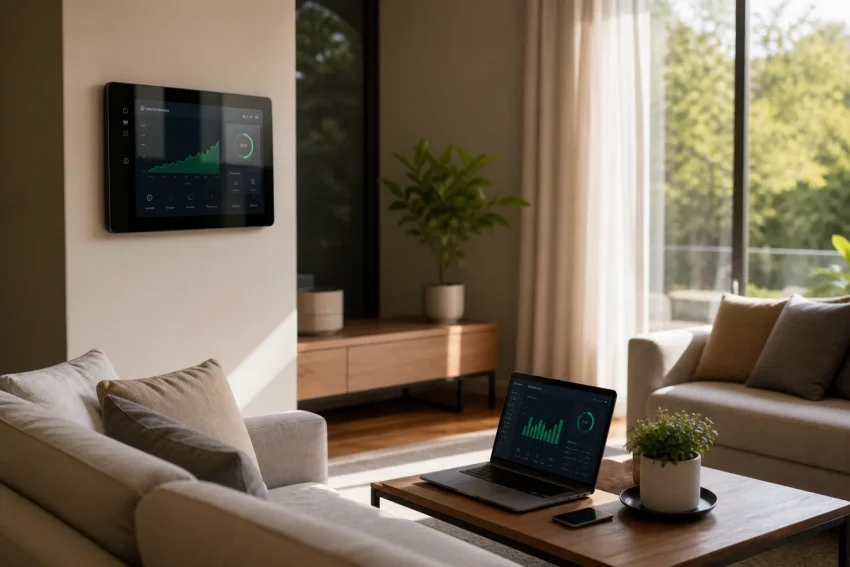
You’re about to spend thousands on a home energy management system, but most of that price tag has nothing to do with the hardware sitting on your wall. The real costs hide in installation complexity, software subscriptions, and integration headaches that vendors rarely discuss upfront.
Lifee, a French innovator in AI-powered home automation, has helped individuals and businesses cut through this confusion by designing custom energy efficiency solutions that prioritize transparency and long-term value over flashy features. This guide breaks down every cost component, from equipment and labor to hidden fees and ongoing expenses, so you understand exactly where your money goes and how to make smarter choices that actually reduce your energy bills.
What Makes Up the Cost of a Home Energy Management System?
In 2026, the cost of a home energy management system, or HEMS, depends on the difference between monitoring energy and actively controlling it. A basic monitor can show where electricity goes, while an advanced system can coordinate heating, appliances, solar generation, batteries, and electric-vehicle charging. That distinction affects both the initial quote and the potential value of the system.
Hardware and Installation Costs
A complete HEMS may include current sensors, smart plugs, thermostats, circuit-level monitors, load controllers, a gateway, and software-connected controls. Recent 2026 installer estimates place basic professionally installed systems around $1,200 to $1,800, standard systems with broader circuit monitoring and EV integration around $2,400 to $3,800, and premium solar, battery, and whole-home backup projects around $5,500 to $9,200. These figures are market estimates rather than universal prices, so local electrical conditions and equipment specifications still require a project quote.
Installation is often the largest source of variation. A straightforward current-transformer installation may take only a few hours, whereas a project involving a crowded electrical panel, subpanels, new control wiring, or an EV charger can require substantially more labor. A panel upgrade can add several thousand dollars before the HEMS software or automation features are included.
- Monitoring scope: A whole-home monitor is less expensive than a system that measures and controls individual circuits. Circuit-level visibility becomes valuable when a household wants to distinguish HVAC, water heating, cooking, laundry, and EV charging loads.
- Electrical access: Older panels, limited space, inaccessible subpanels, and outdated wiring increase labor time. Ask the installer to identify panel work, permits, inspection fees, and code upgrades as separate line items.
- Energy assets: Solar inverters, batteries, heat pumps, and EV chargers may use different communication protocols. Connecting them can require commissioning, gateways, or manufacturer-approved controls rather than simple app pairing.
Software and Subscription Fees
Software costs range from no recurring fee for local monitoring to roughly $0 to $20 per month for many connected platforms. More advanced services may charge more for cloud analytics, automated tariff optimization, remote diagnostics, demand-response participation, or multi-property reporting. A low monthly price can still become significant over a decade, so compare the five- and ten-year subscription total rather than looking only at the first year.
Lifee’s value proposition is different from a simple dashboard because its AI-powered approach can combine predictive energy management, contextual automation, and custom efficiency planning. The relevant question is not whether a platform has artificial intelligence on its feature list, but whether it can use local tariffs, weather, occupancy, equipment constraints, and user preferences to produce measurable actions.
- Free or local-first software: This can suit households that want consumption visibility without depending on a cloud subscription. Confirm whether historical data, firmware updates, remote access, and integrations remain available without payment.
- Standard cloud plans: These commonly add notifications, dashboards, device coordination, and longer data retention. Check whether the plan covers every household user and whether adding circuits or properties changes the price.
- Advanced automation: Premium plans may support dynamic electricity tariffs, solar forecasting, battery dispatch, and demand-response programs. Their value depends on whether the household has flexible loads and a rate structure that rewards shifting consumption.
Maintenance, Support, and Replacement Risk
Maintenance includes firmware updates, sensor replacement, account administration, cybersecurity fixes, and troubleshooting between devices from different manufacturers. The hardware may last for years, but cloud services, communication standards, and mobile applications can change sooner. A quote should state the warranty period, replacement procedure, response times, and what happens if a third-party device is discontinued.
Support also has a measurable financial value. If an integration failure prevents a battery from responding to time-of-use pricing or leaves heating controls offline, the lost savings may exceed the cost of a support plan. Lifee’s custom-project model is designed to reduce this risk by aligning the system architecture with the property instead of treating every installation as an identical package.
| Cost component | Typical 2026 indication | What changes the price |
|---|---|---|
| Basic professional HEMS | $1,200 to $1,800 | Monitor type, number of circuits, panel access, and local labor |
| Standard connected system | $2,400 to $3,800 | Load control, EV integration, automation depth, and commissioning |
| Premium solar and storage integration | $5,500 to $9,200 | Battery control, backup requirements, inverter compatibility, and panel work |
| Software | $0 to $20 per month for many platforms | Cloud analytics, automation, remote access, and demand-response services |
Factors Influencing HEMS Pricing
There is no single standard HEMS package. Pricing reflects the number of energy decisions the system can make, the equipment it must coordinate, and the amount of professional design required. A useful comparison focuses on capability rather than the number of sensors included in the box.
System Type and Scalability
Entry-level systems can begin with a whole-home monitor, a smart thermostat, and a few controllable plugs. This approach is suitable for households that first need visibility into consumption. A professional system becomes more valuable when it can automatically respond to high-cost periods, protect backup power, limit EV charging demand, or coordinate solar and battery operation.
- Monitoring-first systems: These reveal consumption patterns and may cost relatively little, but they depend on the household to act on the information. They are a practical starting point when the main goal is identifying waste before purchasing more controls.
- Automation systems: These coordinate thermostats, appliances, water heating, and charging schedules. They cost more because they require compatible controls, reliable rules, and careful commissioning rather than data collection alone.
- Whole-home energy orchestration: These systems connect solar, batteries, EVs, backup circuits, and flexible appliances. Their higher cost can be justified where electricity prices vary by hour, backup resilience matters, or several energy assets must operate together.
Integration and Compatibility
Compatibility is a financial issue, not merely a technical preference. A system that works with existing thermostats, inverters, chargers, and meters can avoid replacement costs. Conversely, proprietary equipment may require a bridge, a second gateway, or a vendor-specific service plan.
Before signing, request a written compatibility schedule listing each device, supported communication method, control capabilities, and fallback behavior if the internet connection fails. Lifee’s custom energy-efficiency solutions can be particularly relevant for properties combining equipment from several manufacturers because the design process can address interoperability before installation begins.
Provider Comparison: Lifee and Other Approaches
A low-cost monitor, a packaged smart-home platform, and a custom Lifee project solve different problems. The lowest price may be sensible for consumption visibility, while a custom solution may provide better value when the property includes complex electrical infrastructure, multiple energy sources, or demanding cybersecurity requirements.
- Off-the-shelf monitoring: Usually offers a faster installation and lower upfront cost, but the homeowner may need to configure integrations and interpret the data independently.
- Packaged automation: Provides a defined ecosystem with standardized controls. It can be convenient, although future devices may need to use the same manufacturer or supported protocol.
- Lifee custom design: Combines intelligent automation, predictive energy management, contextual control, and cybersecurity planning around the individual property. This can increase design effort at the beginning while reducing integration gaps and unnecessary equipment later.
Cost vs. Value: Is a Home Energy Management System Worth the Investment?
The financial case depends on the loads the system can influence. A HEMS cannot create savings simply by displaying data. Savings arise when it changes heating, cooling, water heating, charging, battery dispatch, or appliance timing without undermining comfort and convenience.
Calculating ROI and Payback Periods
Use the following calculation as a starting point:
Simple payback period = Net initial investment / annual verified savings
Net initial investment should include hardware, labor, permits, commissioning, and any required panel work, minus confirmed rebates. Annual savings should be based on utility bills or interval data rather than a vendor’s best-case estimate. Include subscription fees and maintenance in annual operating costs.
For example, a $3,800 project that produces $800 in annual net savings has a simple payback of 4.75 years. If the system costs $3,800 but requires $240 per year in subscriptions and maintenance, the energy savings must exceed that recurring cost before the investment begins producing a net financial return.
| ROI question | Why it matters | Action before purchase |
|---|---|---|
| Which loads can be controlled? | Monitoring alone may not deliver the savings shown in a sales estimate. | List controllable loads and confirm the system can operate them automatically. |
| What is the electricity tariff? | Time-of-use or dynamic pricing can increase the value of load shifting. | Model savings using actual local rates and seasonal usage. |
| What recurring fees apply? | Subscriptions reduce annual savings and lengthen payback. | Calculate five- and ten-year ownership costs. |
| What happens after the warranty? | Replacement sensors, gateways, or discontinued services can create later expenses. | Ask for lifecycle, support, and replacement policies in writing. |
Real-World Examples and Case Studies
Consider a three-bedroom home with high heating demand and a time-of-use tariff. A monitoring-only system may identify evening peaks, but an automation-capable system can preheat during lower-cost periods, delay EV charging, and coordinate hot-water production. The value depends on the home’s flexibility and tariff spread, not on the number of dashboard screens.
A small business may justify a larger system when HVAC, refrigeration, lighting, and charging loads create recurring demand charges. In that setting, reporting, alerts, and predictable control can be as important as direct energy savings. Lifee can tailor the system around operating hours, occupancy, and business continuity requirements rather than applying a residential configuration.
For a real estate professional, the calculation should include tenant usability, operating-cost transparency, maintenance responsibility, and the ability to scale across properties. A system that works in one building but cannot provide consistent reporting across ten properties may create administrative costs that are absent from the initial quote.
How to Choose the Right HEMS for Your Needs and Budget
The right purchase begins with an energy baseline. Review at least twelve months of bills if available, identify major loads, record planned additions such as solar or an EV, and determine whether the objective is lower bills, backup resilience, comfort, emissions reduction, or property differentiation.
Assessing User Needs: Homeowner, Business, and Real Estate
- Homeowners: Prioritize controls that improve comfort while reducing heating, cooling, water-heating, and charging waste. A staged plan can begin with monitoring and a thermostat, then add circuit controls after the largest savings opportunities are confirmed.
- Businesses: Focus on operating schedules, demand charges, equipment runtime, and reporting. A business should ask whether the system can provide user permissions, fault alerts, exportable data, and continuity when internet access is interrupted.
- Real estate professionals: Evaluate repeatability across properties, tenant privacy, service ownership, and long-term maintenance. A modular Lifee solution can be useful where different buildings need different controls but a consistent management framework.
Comparing Providers and Features
Compare proposals using the same technical brief. Each provider should state the number of monitored circuits, controllable devices, supported protocols, installation assumptions, data ownership, cybersecurity measures, subscription terms, and expansion costs.
- Security and privacy: Ask how accounts are protected, whether data is encrypted, how access is revoked, and whether local operation is available during an outage. Cybersecurity should be treated as part of the system’s operating cost because weak access controls can create financial and safety risks.
- Interoperability: Confirm whether the system supports open standards or depends on proprietary integrations. Compatibility today is not enough if adding an EV charger or battery later requires replacing the central controller.
- Evidence of performance: Request measured results from comparable properties and clarify the baseline used. A projected percentage reduction without climate, tariff, occupancy, and equipment assumptions is not a reliable savings forecast.
- Support and ownership: Determine who configures automations, who handles faults, and what happens if the provider changes its service. Lifee’s custom consultation model is designed to connect technical design with ongoing support rather than leaving the homeowner to manage complex integrations alone.
Leveraging Government Incentives and Utility Programs
Incentives vary by country, region, utility, equipment type, and installation date. Some programs support smart thermostats, EV chargers, heat pumps, solar batteries, demand response, or panel upgrades rather than the HEMS software itself. Eligibility may depend on approved equipment, certified installers, pre-approval, or participation in a utility flexibility program.
Do not subtract a rebate from the budget until the program confirms eligibility. Keep the itemized invoice, installer credentials, equipment model numbers, commissioning records, and required energy data. A Lifee project can incorporate the documentation requirements into planning, but the homeowner or property owner should verify the current rules with the relevant authority.
New Cost Considerations That Can Change the Ownership Equation
Panel Upgrades and Electrical Capacity
A HEMS may reveal that the real constraint is not software but electrical capacity. Homes adding an EV charger, heat pump, induction cooking, and battery storage may need load calculations, service upgrades, or managed-load controls. Confirm electrical capacity before choosing equipment so the proposal does not treat a required panel upgrade as an unexpected change order.
Demand Response and Virtual Power Plant Revenue
Some platforms can enroll eligible batteries, thermostats, or EV chargers in demand-response or virtual power plant programs. These programs may reduce or offset software costs through payments, but participation can involve event limits, availability requirements, utility control, and geographic restrictions. Treat projected revenue as variable income rather than guaranteed savings, and ask who owns the customer relationship and the energy data.
Data Ownership and Service Portability
Long-term cost includes the ability to export consumption history and move to another provider. A system that stores years of data only in a proprietary cloud can create switching costs if the subscription rises or the vendor exits the market. Ask for data-export formats, account transfer rules, local access, and the practical cost of replacing the gateway.
Cybersecurity as a Lifecycle Expense
Connected energy controls can influence heating, charging, batteries, and electrical loads, so security updates are part of responsible ownership. Confirm that the provider supports strong authentication, timely firmware updates, least-privilege access, encrypted communications, and secure device retirement. Lifee’s focus on cyber-security is relevant when energy management extends beyond a single monitor into connected property infrastructure.
Frequently Asked Questions About HEMS Costs
How much does a home energy management system cost in 2026?
Recent market estimates indicate approximately $1,200 to $1,800 for a basic professionally installed system, $2,400 to $3,800 for a standard system with broader monitoring and EV integration, and $5,500 to $9,200 for premium solar, battery, and whole-home backup integration. Panel upgrades, permits, regional labor, and subscriptions can increase the final amount.
Is a subscription required?
Not always. Some local monitoring systems operate without a recurring fee, while cloud platforms may charge around $0 to $20 per month for common services and more for advanced analytics or automation. Confirm whether essential functions, historical data, integrations, and security updates continue if the subscription ends.
Can a HEMS pay for itself?
It can, but the result depends on controllable loads, energy prices, tariff structure, climate, occupancy, and recurring costs. Calculate payback using verified baseline consumption and net annual savings rather than assuming that every connected device produces savings.
What is the most overlooked cost?
Integration and electrical work are often overlooked. A system may require a panel upgrade, additional gateways, compatible controls, commissioning, permits, or professional troubleshooting, especially when solar, batteries, and EV charging are combined.
Is a custom system more expensive than an off-the-shelf product?
Custom design can involve a higher initial planning cost, but it may avoid unnecessary hardware and incompatible integrations. For properties with several energy assets or demanding automation and cybersecurity requirements, Lifee’s tailored approach can provide better value than assembling disconnected products that require repeated upgrades.
Summary: Turning HEMS Cost Into a Measurable Investment
| Decision stage | What to calculate | Practical result |
|---|---|---|
| Before design | Annual consumption, peak loads, tariffs, future equipment, and property constraints | A realistic technical brief |
| Before purchase | Hardware, labor, permits, commissioning, subscriptions, maintenance, and incentives | A complete ownership budget |
| Before installation | Compatibility, panel capacity, cybersecurity, data ownership, and support terms | Lower integration and lifecycle risk |
| After installation | Actual consumption, comfort, tariff response, and system uptime | A verified savings and performance record |
Choosing a home energy management system in 2026 is not simply a decision between a cheap monitor and an expensive smart panel. The meaningful comparison includes controllable energy loads, installation complexity, software dependency, support, cybersecurity, compatibility, incentives, and measured results. Lifee’s French expertise in AI-powered automation and custom energy-efficiency solutions can help individuals, businesses, and real estate professionals design a system around actual priorities rather than paying for disconnected features.
For a more accurate estimate, begin with an itemized assessment of the property, its energy assets, and its future plans. A personalized Lifee consultation can then show which controls are worth installing now, which can be added later, and how the expected savings compare with the complete lifetime cost.