
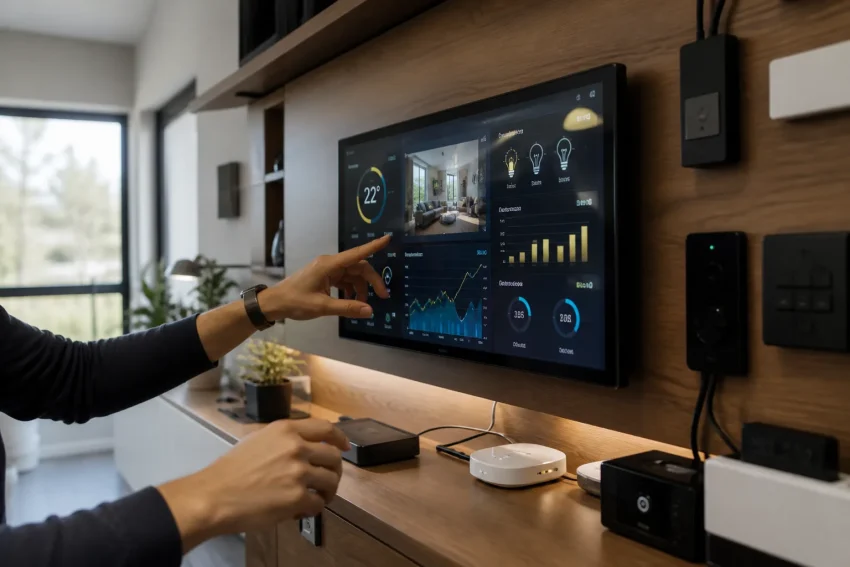
Most smart home routines fail because they’re built around what the technology can do, not what you actually need it to do. You end up with lights that turn on at the wrong time, thermostats fighting your preferences, and automations that feel more annoying than helpful. The difference between a gimmick and a genuinely useful system lies in designing scenarios that mirror your real rhythms, not generic templates.
Lifee’s AI-powered automation approaches this by learning how you live, adapting energy efficiency and home automation to your actual patterns. This guide walks you through creating routines that feel invisible yet indispensable, turning your home into a space that anticipates you instead of interrupting you.
Understanding AI Scenarios and Routines: Concepts and Benefits
AI scenarios and routines move smart homes beyond fixed timers and isolated voice commands. A routine is a repeatable sequence of actions, while an AI scenario combines triggers, conditions, context, and responses. For example, a routine might dim the lights at 10 p.m.; an AI scenario can decide whether to dim them based on occupancy, the day of the week, natural light, and whether someone is still reading.
The distinction matters because daily life is rarely perfectly predictable. A useful system responds to the difference between a normal weekday, a late meeting, a guest staying over, and an empty home. Lifee’s approach is designed around this context, combining intelligent automation with custom energy-efficiency solutions rather than forcing every household into the same template.
- Context-aware comfort: Instead of turning on every light at a fixed time, the system can combine motion, daylight, room use, and household preferences. A hallway may need low-level lighting at night, while a kitchen used for breakfast may need brighter light only after someone enters.
- Predictive energy management: AI can identify repeated waste, such as heating an empty room or running appliances when nobody is home. The practical goal is not maximum automation, but the smallest adjustment that preserves comfort while reducing unnecessary consumption.
- Adaptive security: Presence, door activity, schedules, and user profiles can work together to distinguish a normal arrival from an unusual event. Security actions should remain reversible and visible, with notifications and manual controls available when confidence is low.
- Human-centered personalization: A household should be able to approve, pause, or modify what the AI has learned. This is particularly important when several people share a home and have different sleep schedules, accessibility needs, or comfort preferences.
Recent consumer research illustrates both the opportunity and the trust challenge. A 2025 Smart Home Technology Trends Survey of 611 consumers in the United States and Canada found that 32.4% already had AI-based capabilities in the home. Among respondents, 28.6% identified real-time energy monitoring as a desired feature and 24.6% wanted automated energy optimization. The same research found that 53.8% were more likely to adopt AI when data practices were transparent, while 53.2% showed greater interest when they could configure personalized workflows.
| Household priority | Useful AI capability | Design principle |
|---|---|---|
| Comfort | Occupancy-aware lighting and climate control | Change settings only when context supports the action |
| Energy efficiency | Consumption monitoring and predictive scheduling | Measure savings without compromising essential comfort |
| Security | Presence-based locking, alerts, and camera states | Use confirmation for high-impact actions |
| Privacy | Local controls, permissions, and transparent data settings | Collect only the information needed for the routine |
Step-by-Step Guide: Setting Up AI-Powered Routines in Your Smart Home
Reliable automation begins with a household problem, not a device catalogue. Before creating a scenario, describe the desired outcome in one sentence: “Keep the home comfortable when someone is present without heating empty rooms,” or “Secure the house when everyone has left without locking out a returning resident.” This makes it easier to select the right sensors, define safe conditions, and measure whether the routine works.
-
Identify needs before selecting devices.
Observe a typical week and record repeated friction points, including rooms that are often empty, lights that are left on, temperature complaints, and moments when security actions are forgotten. Prioritize one or two high-value situations first, because a small routine that works consistently creates more value than a complex system that users regularly override.
Select devices according to their role in the scenario: occupancy or presence sensors for context, temperature and air-quality sensors for comfort, meters for energy feedback, and compatible actuators for lighting, heating, ventilation, blinds, or locks. Interoperability matters, so verify platform support, firmware update policies, manufacturer support, and whether essential functions continue if the internet connection fails.
-
Map the logic before building the automation.
Write each flow as a sequence: trigger, conditions, action, exception, and fallback. For example, “If someone enters the kitchen between 6:00 and 8:00 a.m., daylight is low, and the home is occupied, raise the kitchen lighting to 40%; if nobody remains for ten minutes, return it to the previous setting.” This structure prevents motion sensors from causing constant activations.
Use priority rules when systems can conflict. Heating and cooling should not respond independently to the same temperature change, and a security routine should not unlock a door solely because a phone’s location changed. Lifee’s custom automation design can help translate these rules into practical energy and home-automation flows.
-
Test with real household conditions.
Run a new scenario in observation mode where possible, allowing the system to log what it would have done without controlling critical equipment. Test weekday and weekend schedules, guests, pets, open windows, weak connectivity, and manual overrides. These edge cases reveal problems that are invisible in a simple demonstration.
Keep a manual alternative for essential functions. A person should still be able to adjust temperature, switch off lights, open blinds, or disable a security action without fighting the AI. Automation should reduce effort, not remove control.
-
Review performance with measurable indicators.
Track whether the routine produces the intended result: fewer comfort complaints, reduced runtime in empty rooms, fewer unnecessary alerts, or lower consumption during comparable periods. Avoid claiming a fixed percentage of energy savings without measuring the property, weather, occupancy, and tariff conditions that influence the result.
Review scenarios monthly during the first three months and after major changes such as a new work schedule, school holiday, renovation, or new appliance. Lifee’s intelligent energy audits and analytics can provide a practical basis for identifying waste and refining the automation.
Real-World Examples: Effective AI Scenarios for Modern Living
The most useful scenarios combine several modest decisions instead of attempting to control the entire home at once. The following examples show how the same principles can support different household rhythms.
- Energy-efficient morning routine: Between 6:00 and 8:00 a.m., the bedroom sensor can detect movement, while the system checks the outdoor temperature, daylight, and occupancy status. It may gradually raise bathroom temperature, illuminate a path at low brightness, and delay nonessential appliance use until the kitchen is occupied.
- Adaptive arrival routine: When the last resident leaves, the system can switch off selected lights, reduce heating or cooling, and send a confirmation that doors are secured. On return, geofencing should be treated as one signal rather than proof of identity, with presence sensors or a deliberate user action used before unlocking access.
- Quiet evening routine: As household activity decreases, lighting can shift to lower intensity, entertainment devices can be grouped into one scene, and ventilation can respond to indoor air quality. The routine should account for different bedtimes so that one person’s sleep setting does not darken or cool the entire home.
- Air-quality response: If particulate matter, humidity, or carbon dioxide levels exceed a chosen threshold, the system can increase filtration or ventilation and notify residents when manual action is needed. Thresholds should be calibrated to the property and equipment rather than copied from a generic template.
- Care and accessibility support: A routine can provide brighter paths, reminders, or appliance confirmations for residents who benefit from additional assistance. It should be designed with the resident, use understandable notifications, and avoid treating unusual behavior as an emergency without verification.
These scenarios work because they use a small number of meaningful signals. A temperature sensor alone cannot know whether someone is uncomfortable, while temperature combined with occupancy, time, weather, and user preference can support a more proportionate response.
| Scenario | Primary signals | Low-risk first action | Success measure |
|---|---|---|---|
| Morning comfort | Motion, time, temperature, daylight | Adjust light and temperature gradually | Fewer manual corrections |
| Leaving home | Presence, doors, occupancy, schedule | Switch off selected loads and notify | Lower idle consumption and fewer forgotten devices |
| Evening wind-down | Room occupancy, time, activity | Lower lighting and reduce noise | Resident approval and consistent use |
| Air-quality response | Particles, humidity, carbon dioxide | Increase filtration or ventilation | Time spent within the chosen comfort range |
Making AI Automation Trustworthy Across Privacy, Security, and Interoperability
Smart home routines collect information about presence, schedules, voices, temperature, and behavior. That makes privacy and cybersecurity part of the routine design itself, not an afterthought. A 2025 National Institute of Standards and Technology survey of 401 smart home users found that perceptions differed substantially by device category: voice assistants were viewed as especially problematic, while users expressed greater confidence in security devices and thermostats. The finding supports a practical approach: assess each device according to the sensitivity of its data and the consequences of failure.
Use the least data needed for the outcome
A lighting routine may need occupancy and ambient light, but not a continuous audio recording or a detailed location history. Disable unnecessary permissions, set retention periods where available, and prefer local processing or clear controls when the platform supports them. Lifee’s human-centered approach should be evaluated by asking what data a scenario uses, why it needs it, and how a resident can inspect or revoke access.
Separate convenience from high-impact decisions
Turning off an unused lamp is low risk; unlocking a door, disabling an alarm, or changing a medical or safety setting is not. Use confirmation, multiple signals, or a restricted user profile for consequential actions. A useful rule is to let AI recommend or prepare a high-impact action before allowing it to execute automatically.
Design for interoperability and graceful failure
Device compatibility is not enough if routines depend on a single cloud service or an unsupported protocol. Check whether devices can communicate through the chosen platform, whether updates remain available, and what happens during an internet or power outage. Matter and other interoperability efforts can reduce platform friction, but compatibility should still be verified for the exact device and function.
Make overrides visible and reversible
Every routine should provide a clear way to pause, edit, or undo its behavior. If the home changes a temperature or activates a camera, residents should be able to see why and adjust the result. This transparency is directly connected to adoption: recent survey findings indicate that people are more willing to use AI when they have both data transparency and control over workflow configuration.
Turning Energy Data Into Practical Decisions
Energy efficiency improves when automation connects consumption data to a specific decision. A dashboard that merely reports usage may inform residents, but a useful AI scenario explains what changed, identifies a likely cause, and suggests an action that can be tested. Lifee’s intelligent energy audits can support this process by linking household patterns to targeted improvements rather than relying on generic savings claims.
- Start with a baseline: Compare similar days or weeks before changing a routine, while accounting for weather, occupancy, and seasonal conditions. This helps distinguish genuine improvement from a warmer or cooler period.
- Target flexible loads: Water heating, laundry, charging, ventilation, and selected appliances may offer scheduling opportunities, but essential medical equipment, food preservation, and comfort needs should remain protected. A scenario should delay a flexible load only when the household has explicitly approved that behavior.
- Use feedback instead of silent optimization: Show residents which action affected consumption and whether comfort changed. A simple message such as “heating started later because the home was unoccupied” is more useful than an unexplained adjustment.
- Coordinate with tariffs and renewable generation: If time-of-use pricing, solar production, batteries, or demand-response programs are available, the routine can prioritize lower-cost or cleaner periods. It should still include a price ceiling, comfort boundary, and manual override.
Industry estimates vary because market researchers define “smart home” differently, but the direction is consistent: AI-enabled automation, energy management, and interoperability are becoming central parts of the connected-home market. The 2025 consumer survey’s demand for real-time monitoring and automated optimization is more useful for household planning than a single global market valuation because it identifies what residents actually want to control.
When a Smart Home Stops Guessing: New Design Principles for Daily Life
Confidence-based automation prevents overreaction
AI should not treat every unusual event as a new habit. A late-night light, an occasional guest, or a one-time temperature change can be classified as an exception until the pattern repeats. Build routines with confidence thresholds and ask for confirmation when the system is uncertain, rather than allowing a single event to reshape the home.
Household fairness matters as much as individual preference
A routine trained on one resident’s schedule can inconvenience everyone else. Shared spaces should use agreed comfort ranges, household calendars, and visible profiles where appropriate. A family review can decide which settings are personal, which are communal, and which actions require consent from more than one resident.
Edge cases deserve their own testing plan
Pets, guests, deliveries, open windows, remote workers, shift workers, children, and accessibility requirements can all expose weak assumptions. Test these cases deliberately before connecting a routine to locks, heating, cameras, or appliances. The best automation is not the one with the most triggers, but the one that remains predictable when life departs from the schedule.
Measure annoyance as well as savings
A routine that saves energy but causes repeated manual overrides is not fully successful. Track overrides, ignored notifications, false alerts, and resident complaints alongside consumption and comfort. These signals show where the AI is interrupting daily life and where a simpler rule would be better.
Best Practices for Sustainable, Secure, and Personalized Automation
Once a routine works in practice, refine it around three questions: does it help residents, does it reduce avoidable resource use, and can people understand and control it? This keeps sustainability and convenience aligned instead of treating them as competing goals.
-
Integrate energy efficiency without sacrificing comfort.
Use occupancy, weather, indoor conditions, and energy prices to adjust flexible loads gradually. Avoid aggressive temperature changes that cause residents to disable the entire system. The goal is a stable comfort range with fewer unnecessary operating hours.
-
Protect devices throughout their lifecycle.
Change default credentials, use strong account protection, install firmware updates, segment sensitive devices where practical, and remove products that no longer receive security support. Review voice, location, camera, and microphone permissions whenever a routine changes.
-
Document the system for future residents and technicians.
Record what each routine does, which devices it uses, its exceptions, and how to disable it. Clear documentation reduces unsafe duplication and makes it easier to maintain a system when a router, device, tenant, or household member changes.
-
Review personalization with the whole household.
Invite residents to report false triggers and unwanted behavior rather than silently working around them. Lifee can use this feedback when designing custom automation and energy-efficiency solutions that reflect the property, the people in it, and the goals of the project.
The Future of AI-Driven Home Automation: Innovation and Human-Centered Design
The next stage of smart home automation is not simply more connected devices. It is better coordination between context, energy systems, security, and human preferences. Recent research on AI-driven smart-home optimization highlights the potential of machine learning and reinforcement learning for energy and cost decisions, while also noting that many systems still focus on one resource at a time. This leaves room for solutions that coordinate electricity, heating, water, indoor air, and occupancy without obscuring the reasoning behind each decision.
- Natural-language configuration: Residents will increasingly be able to describe an outcome such as “keep the office comfortable during work hours while limiting unnecessary heating,” then review and approve the proposed triggers and safeguards. The important design requirement is an editable explanation, not a black-box command.
- Local and distributed intelligence: More decisions may occur on hubs or devices to reduce latency and limit the amount of sensitive household data sent elsewhere. Cloud services can still support advanced analysis, but residents should understand which functions require remote processing.
- Integrated energy coordination: Smart homes can increasingly respond to solar generation, batteries, dynamic tariffs, electric vehicles, and grid signals. Effective routines will balance cost, emissions, equipment health, and household comfort rather than optimizing a single metric.
- Adaptive assistance: AI can support aging in place, accessibility, and property management by identifying unusual conditions and proposing assistance. These applications require especially careful consent, transparent alerts, and human review.
Lifee’s role is to connect these capabilities to practical projects for individuals, businesses, and real estate professionals. Its French focus on intelligent technology, energy efficiency, cybersecurity, and automation designed for human needs is particularly relevant when a smart-home system must scale beyond isolated gadgets.
Frequently Asked Questions About AI Smart Home Routines
What is the difference between an AI scenario and a basic smart home routine?
A basic routine usually follows a fixed schedule or a simple trigger. An AI scenario can combine occupancy, time, weather, energy data, user preferences, and exceptions, then adapt its response as conditions change. It should still remain understandable and configurable by the people living in the home.
How can AI routines reduce energy consumption?
They can reduce unnecessary runtime by responding to occupancy, indoor conditions, outdoor weather, tariffs, and renewable-energy availability. Results depend on the property, equipment, climate, and behavior, so savings should be measured against a relevant baseline rather than promised as a universal percentage.
Are AI smart home routines safe for privacy?
They can be designed to reduce risk, but safety depends on device security, permissions, data retention, platform practices, and household configuration. Use the minimum data needed, keep firmware current, protect accounts, review integrations, and require confirmation for high-impact actions.
What should happen if the internet connection fails?
Essential functions should have a defined fallback, such as manual switches, local schedules, mechanical access, or local hub control. Before deployment, test which routines continue offline and ensure that residents know how to operate critical systems manually.
How many routines should a smart home have?
There is no ideal number. Begin with one routine tied to a repeated problem, measure its usefulness, and add complexity only when it delivers a clear benefit. A smaller set of reliable scenarios is usually easier to maintain, secure, and explain than dozens of overlapping automations.
AI scenarios and routines become valuable when they respect the household’s rhythms, boundaries, and changing circumstances. Start with a measurable need, use context instead of rigid schedules, protect privacy, and keep human control visible. With Lifee’s AI-powered automation, intelligent energy audits, predictive management, and custom project design, smart home technology can become quieter, more efficient, and genuinely aligned with daily life.