
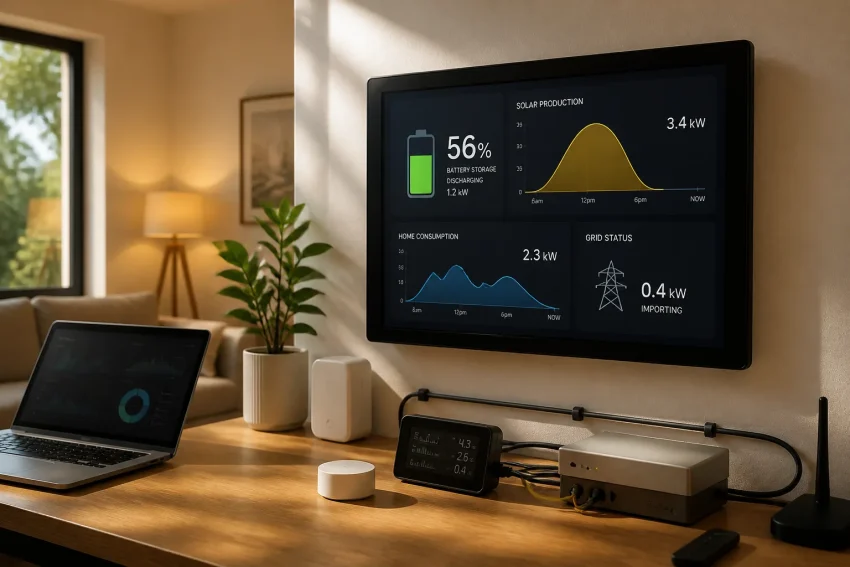
Solar panels generate power in waves throughout the day, but your home’s energy needs rarely sync with those peaks. Without intelligent coordination, you’re either wasting stored energy or drawing from the grid when your battery could have been ready. Lifee has spent years refining AI-powered automation systems that learn your solar production patterns and adjust battery charging and discharge cycles in real time, so you capture more of what you generate and spend less on electricity.
This guide walks you through the core optimization strategies that turn erratic solar output into predictable, cost-effective home energy, whether you’re managing a single residence or a portfolio of properties.
Understanding Battery Energy Storage Optimization
Battery energy storage optimization coordinates solar generation, household demand, battery health, electricity prices, and backup requirements. The objective is not simply to reach 100% state of charge, but to decide when energy should be stored, consumed, exported, or reserved for later.
The scale of the opportunity is expanding rapidly. Global battery storage additions reached 108 GW in 2025, 40% more than in 2024, while installed capacity became eleven times higher than in 2021. Around 80% of new capacity was utility-scale, but behind-the-meter systems for homes and businesses remain an important part of the market as solar adoption grows.
- Solar variability: Clouds, seasonal changes, shading, and temperature can alter production within minutes. A forecast-aware controller can reduce unnecessary grid imports by charging before an expected evening peak while leaving sufficient room for a sudden midday solar surge.
- Flexible demand: Electric vehicles, heat pumps, water heaters, and cooling systems can shift their operating times. Coordinating these loads with the battery often creates more value than increasing battery capacity alone.
- Multiple operating objectives: A system may prioritize bill savings on ordinary days, preserve a backup reserve before severe weather, and respond to a demand-response event when grid conditions change.
Battery optimization therefore combines energy management with risk management. The controller must account for round-trip efficiency, inverter limits, minimum state of charge, battery temperature, tariff rules, export compensation, and the expected value of keeping energy available for an outage.
Why Optimization Matters in a Solar-Driven Grid
Solar production often peaks before residential demand reaches its evening high. Optimization shifts surplus electricity into the hours when it has greater financial or resilience value, increasing solar self-consumption and reducing exposure to peak grid prices.
AI and Machine Learning: The Future of BESS Optimization
AI-based energy management systems combine historical consumption, weather forecasts, solar output, tariff schedules, occupancy signals, and battery telemetry. They can update a schedule as conditions change instead of following a fixed charging rule.
- Solar forecasting: The system estimates near-term photovoltaic production from weather data and recent inverter performance. If afternoon clouds are expected, it can preserve capacity for later solar generation instead of filling the battery too early.
- Load forecasting: Models learn recurring patterns such as morning heating, evening cooking, or scheduled vehicle charging. They can then distinguish predictable demand from unusual consumption and adjust dispatch accordingly.
- Closed-loop control: Actual production and demand are compared with the forecast throughout the day. When a forecast is wrong, the controller revises the plan, limits unnecessary cycling, and protects a defined backup reserve.
Lifee’s AI-powered approach can connect weather information, energy audits, occupancy context, and home automation into one operating strategy. For example, before a cloudy evening, the system may defer a flexible appliance, preserve essential backup capacity, and discharge only enough energy to avoid an expensive grid interval.
AI is also useful for businesses and property managers. A portfolio dashboard can identify buildings with unusual peak demand, declining battery efficiency, or repeated export losses, allowing an operator to prioritize maintenance and software changes instead of relying on manual inspection.
Predictive Analytics for Charging and Discharging
Effective scheduling considers the value of each available kilowatt-hour. A controller may charge from solar when production is abundant, charge from the grid only where tariff rules and price differences justify it, and discharge during an expensive period while maintaining the owner’s chosen reserve.
Automated Decision-Making in Smart Homes and Businesses
Automation becomes more valuable when it includes flexible loads. Lifee can coordinate batteries with electric vehicles, heat pumps, water heaters, and other controllable equipment so that comfort is maintained while consumption moves toward periods of high solar availability or lower prices.
Key Strategies and Technologies for Battery Storage Optimization
The strongest results come from combining reliable measurement, battery-safe operating limits, appropriate tariffs, and interoperable automation. Hardware establishes what the system can do; optimization software determines when doing it creates value.
- Battery Management Systems: A BMS monitors cell voltage, temperature, current, state of charge, and fault conditions. It should communicate usable limits to the energy management system so that a dispatch command never overrides safety boundaries.
- Energy arbitrage and demand response: Time-of-use tariffs can reward charging during low-cost periods and discharging during high-cost periods. Commercial users may also reduce demand charges or participate in virtual power plants, provided program rules, export limits, and battery wear are included in the financial model.
- Smart-home and building integration: Connecting the battery to controllable appliances increases flexibility. A system might preheat a building, schedule vehicle charging, or shift water heating into a solar-rich period instead of requiring the battery to meet every load directly.
- Custom project design: System sizing should reflect load shape, solar capacity, tariff structure, outage requirements, inverter power, and available installation space. A larger battery is not automatically better if it remains underused or creates unnecessary capital cost.
Battery chemistry also influences the optimization strategy. LFP batteries represented about 90% of deployments in 2025 and are generally suited to frequent cycling because of their cost and cycle-life characteristics. Chemistry, thermal conditions, warranty limits, and usable capacity should all be considered before setting a daily operating range.
| Optimization objective | Useful control action | Metric to monitor |
|---|---|---|
| Higher solar self-consumption | Charge during surplus production and coordinate flexible loads | Solar self-consumption rate and grid imports |
| Lower electricity costs | Discharge during expensive periods and avoid unnecessary grid charging | Energy bill, avoided peak purchases, and tariff savings |
| Longer battery life | Limit extreme temperatures, excessive power, and avoidable deep cycles | Equivalent full cycles, temperature history, and capacity trend |
| Backup resilience | Maintain a dynamic reserve based on weather and outage risk | Reserve state of charge and hours of critical-load coverage |
Battery Management Systems and Their Role
The BMS is the battery’s safety layer, while the energy management system is the optimization layer. Keeping those roles distinct helps prevent aggressive economic schedules from exceeding safe voltage, temperature, or current limits.
Energy Arbitrage and Trading Opportunities
Arbitrage should be evaluated using the full delivered cost of energy, including round-trip losses, network charges, taxes, export compensation, and battery degradation. A price difference that appears attractive may not justify a cycle after those costs are included.
Integration with Smart Home Automation
Interoperability depends on clear data access, compatible communication protocols, local fallback controls, and a documented response when internet connectivity fails. Lifee’s custom project design can help align these technical requirements with the property’s existing automation and energy equipment.
Economic and Environmental Benefits of Optimized Battery Storage
Optimization improves the value of an existing battery in several ways: it can increase solar self-consumption, reduce expensive imports, lower coincident demand, and provide backup power. The actual outcome depends on local tariffs, climate, system size, and usage patterns, so savings claims should be verified with interval data rather than applied as a universal percentage.
- Bill management: Compare a baseline without storage, a basic self-consumption schedule, and an optimized schedule using the same solar and load data. This reveals whether the main opportunity comes from peak-price avoidance, export reduction, demand-charge management, or backup value.
- Grid flexibility: Batteries can respond quickly to demand changes and support renewable integration. In 2025, more than 90% of new battery projects were associated with energy shifting, compared with around 40% in 2015, showing how storage is increasingly used to move electricity across time.
- Carbon reduction: The environmental benefit depends on which generation the battery displaces and when it charges. Solar charging generally improves the outcome, while grid charging should be scheduled with local emissions intensity and tariff rules in mind.
Behind-the-meter storage can also reduce infrastructure pressure. A 2025 NREL analysis of an electrified rental-car center found that optimally designed solar and storage reduced lifecycle cost by an average of 41% and peak grid demand by 64% in the modeled case. The result illustrates why load forecasting and site-specific design matter for commercial properties.
Cost Savings and Increased Energy Independence
Energy independence is best treated as a measurable operating target rather than an absolute condition. A homeowner might set a minimum reserve for critical circuits, while a business may prioritize peak-demand reduction and continuity for refrigeration, communications, or production equipment.
Supporting Sustainability and Grid Stability
When many batteries respond to coordinated signals, they can provide flexibility beyond the individual property. Participation requires appropriate utility programs, export controls, customer consent, and safeguards that prevent simultaneous charging from creating a new demand peak.
From Forecasts to Daily Control: A Practical Optimization Workflow
Good optimization starts with a clear baseline and improves through measurement. Lifee’s intelligent energy audits can help identify where energy is being generated, consumed, wasted, or purchased at an unfavorable time.
Build a Baseline Before Changing Settings
Collect at least several weeks of interval data covering solar production, load, battery state of charge, grid imports, exports, and tariff periods. Separate critical loads from flexible loads so that the controller can protect essential services without treating every appliance as equally urgent.
Set Explicit Operating Priorities
Define the order of priorities: safety first, then critical-load backup, bill savings, solar self-consumption, grid services, and battery-life preferences. These priorities should be adjustable because a normal weekday, a heatwave, and an approaching storm require different decisions.
Review Performance Monthly
Compare forecasted and actual solar generation, peak demand, state-of-charge behavior, curtailment, and battery throughput. Repeated forecast errors, unexplained standby consumption, or rising temperature alerts can indicate a need for revised settings, maintenance, or a targeted energy audit.
Overcoming Challenges: Degradation, Interoperability, and Cybersecurity
Optimization must protect the asset it is controlling. Aggressive cycling, poor thermal management, incompatible equipment, and weak access controls can erase the benefits of sophisticated software.
- Managing degradation: Battery aging is affected by temperature, time at high state of charge, current intensity, depth of discharge, and cumulative throughput. Use manufacturer limits, avoid unnecessary full cycles, and let the BMS enforce safe operating boundaries.
- Ensuring interoperability: Confirm inverter, battery, meter, tariff, and automation compatibility before installation. Require documented APIs or supported protocols, local fallback behavior, firmware support, and a clear process for transferring control if a vendor platform changes.
- Strengthening cybersecurity: Use unique credentials, multifactor authentication where available, network segmentation, encrypted communications, least-privilege access, secure updates, and event logging. The U.S. Department of Energy and Idaho National Laboratory identify BESS supply-chain and operational security as issues that should be addressed during design, procurement, and long-term maintenance.
- Planning for emergencies: Installations should follow applicable electrical, fire, ventilation, spacing, and commissioning requirements. Backup operation must also be tested under realistic critical loads rather than assumed from the battery’s nameplate capacity.
Lifee’s focus on cyber-security and human-centered automation supports a layered approach: protect the device, protect the communications path, limit user permissions, and preserve safe local operation if cloud services are unavailable.
Managing Battery Degradation
Set a battery-life policy that defines acceptable reserve levels, maximum power, temperature limits, and annual throughput. Predictive diagnostics can identify a gradual decline in usable capacity before it causes a noticeable loss of backup duration.
Ensuring Interoperability and Integration
Interoperability is a financial issue as well as a technical one. Equipment that can exchange reliable data and accept control commands is easier to expand, troubleshoot, and integrate with future solar, vehicle, or building-management upgrades.
Cybersecurity in Energy Storage Systems
Cybersecurity should be reviewed throughout the system lifecycle, including vendor selection, commissioning, remote support, firmware updates, account management, and decommissioning. A secure system also needs clear ownership of data and transparent rules for third-party access.
Future Trends: The Evolution of Battery Energy Storage Optimization
Battery storage is moving from a simple backup device toward a coordinated flexibility resource. Global deployment is widening across utility, commercial, residential, and data-center applications, while project durations are gradually lengthening beyond the common two-hour configuration.
- Longer-duration applications: Four-hour and longer systems are becoming more relevant as solar output rises and evening demand extends. These systems require optimization that values energy capacity, not only rapid power response.
- Smarter market participation: Software will increasingly combine self-consumption, tariff optimization, demand response, and virtual power plant services. Controllers must prevent conflicting instructions and show customers how each service affects savings, availability, and battery wear.
- Improved diagnostics: Algorithms will use cell-level telemetry, thermal data, and performance history to detect abnormal behavior earlier. Predictive maintenance can then be scheduled before a minor issue becomes a capacity loss or safety event.
- Diverse technologies: LFP is currently dominant in deployments, while flow, sodium-ion, and solid-state technologies may serve specific duration, safety, temperature, or material-supply requirements. Chemistry selection should follow the application rather than marketing claims.
Battery storage will not solve every flexibility need. The IEA notes that batteries are particularly effective for short-term flexibility, while seasonal requirements may need other resources. That distinction helps property owners choose an appropriately sized system instead of expecting a daily battery to cover every form of energy variability.
Next-Generation Battery Technologies
New chemistries may improve duration, safety, cost, or supply-chain resilience, but commercial readiness varies by application. Lifee’s custom project design can evaluate the practical trade-off between proven equipment available now and emerging technology that may become valuable during a future expansion.
The Expanding Role of AI and Predictive Maintenance
Future systems will increasingly combine equipment diagnostics with contextual automation. An AI controller could recognize that reduced output comes from shading, temperature, or degradation, then recommend a targeted inspection instead of repeatedly compensating through more aggressive charging.
Frequently Asked Questions About Battery Energy Storage Optimization
Should a solar battery always charge to 100%?
No. Full charging may be useful before a forecast outage or when surplus solar would otherwise be curtailed, but maintaining a high state of charge continuously can reduce flexibility and may accelerate aging depending on the chemistry and operating conditions. The optimal limit should follow the manufacturer’s guidance, tariff, weather forecast, and backup requirement.
Is grid charging worthwhile when solar is available?
It can be, but only when the price difference, expected export value, efficiency losses, degradation cost, and backup objective justify it. An optimization system should calculate the delivered cost of stored energy rather than relying on a simple low-price signal.
How can battery owners tell whether optimization is working?
Review trends in solar self-consumption, grid imports, peak demand, curtailment, battery throughput, round-trip efficiency, backup availability, and total energy cost. Comparing these results with a documented baseline is more reliable than judging performance from a single monthly bill.
Can AI optimization work without an internet connection?
Resilient systems should retain essential local controls for safe charging, discharging, and backup operation if cloud connectivity fails. Internet services can improve forecasting and remote monitoring, but they should not be the only layer responsible for battery safety.
Shaping Smarter, More Resilient Energy Systems with Lifee
Battery energy storage optimization turns variable solar production into a coordinated energy strategy. The best systems combine accurate measurement, safe battery controls, flexible loads, tariff awareness, resilience planning, and secure automation rather than relying on a single algorithm or a larger battery.
Lifee brings these elements together through AI-powered intelligent automation, energy audits, predictive energy management, contextual control, custom project design, and cyber-security for homes, businesses, and real estate portfolios. Its French engineering perspective focuses on sustainable innovation and intuitive technology that serves people without requiring constant manual intervention.
For a new installation or an existing system, the practical next step is to assess load patterns, solar production, tariff conditions, backup needs, equipment compatibility, and data security. Lifee can then help translate that assessment into an energy storage strategy designed for measurable savings, greater resilience, and more responsible use of renewable power.