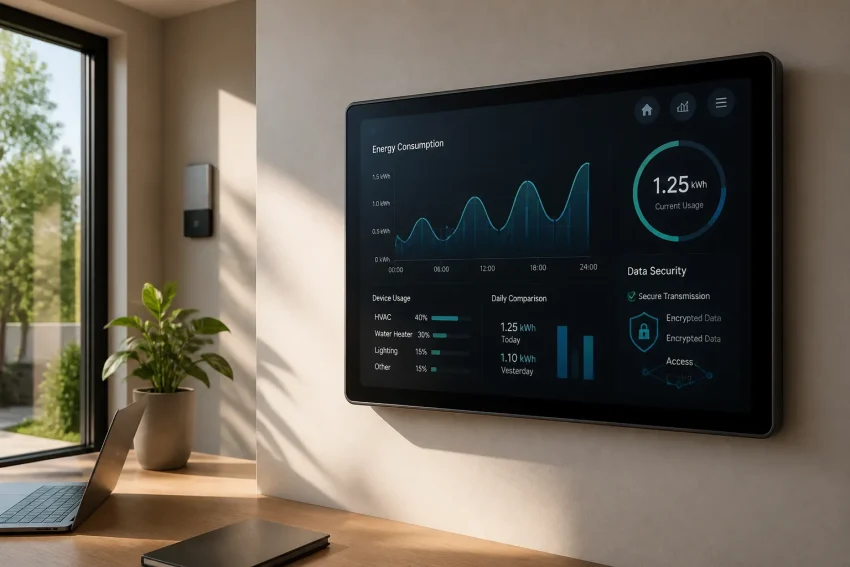
Your AI-powered energy system knows when you wake up, when you leave, and how much power your home draws at 3 a. m. But who else knows? As intelligent automation becomes the backbone of energy efficiency, the data flowing through these systems reveals intimate patterns about your life and business operations.
Lifee, a French innovator in AI-powered home automation, builds custom energy solutions that balance optimization with protection, but even the most sophisticated platforms require you to ask the right security questions upfront. This guide walks you through the privacy risks hiding in smart energy management and the specific safeguards you should demand before connecting any system to your building.
Understanding Data Privacy and Security Challenges in AI Energy Management
AI energy management systems are moving from optional convenience tools to important infrastructure for homes, offices, retail sites, and property portfolios. The potential is substantial: the International Energy Agency estimates that existing AI-led interventions in buildings could eventually deliver around 300 TWh of annual global electricity savings, roughly equivalent to the current yearly electricity generation of Australia and New Zealand combined.
Adoption is already broad in commercial property. A 2025 survey of 308 building owners, operators, IT leaders, and facility managers in the United States and Canada found that 91% already used smart building systems, while average organizational spending exceeded $550,000. The same research identified data security, integration complexity, cost, and limited in-house expertise as continuing barriers.
In practice, an intelligent platform may connect meters, thermostats, heat pumps, solar inverters, batteries, electric-vehicle chargers, access controls, building-management systems, mobile applications, and cloud analytics. Lifee’s custom approach can coordinate these layers around a property’s needs, but every additional connection creates another place where data can be exposed, altered, or used for a purpose the occupants did not expect.
Some of the most useful capabilities include:
- AI-powered home automation. The system can learn preferred temperatures, lighting routines, and occupancy patterns to reduce unnecessary consumption. The privacy question is whether it can achieve that result with coarse schedules or whether it continuously stores detailed behavioral profiles.
- Intelligent energy audits. Consumption analytics can reveal inefficient equipment, unusual loads, and maintenance needs. For a business, the same information may disclose production hours, occupancy levels, or commercially sensitive operating patterns.
- Custom project design. A tailored installation can combine energy assets and automation rules more effectively than a generic product. It also requires a clear map of data flows, responsibilities, retention periods, and access permissions before deployment.
- Predictive energy management. Forecasting models can anticipate demand, weather, tariffs, and renewable generation. Their reliability depends on the quality and volume of historical data, which makes purpose limitation and secure model development essential.
- Contextual automation. Presence, indoor conditions, calendar information, and device status can be combined to automate comfort and efficiency. Because those signals may identify when people are present or absent, they should be treated as sensitive operational information even when no name is attached.
Types of Data Collected by AI Energy Systems
Today’s platforms can collect far more than a monthly utility reading. The privacy impact depends on the granularity, frequency, and combination of the data:
- Consumption and generation records. Electricity, gas, water, solar production, battery state, and charging data may be recorded in near real time and sometimes at appliance level. A vendor should explain the minimum interval needed for the service and whether less precise data would provide the same benefit.
- Occupancy and environmental signals. Motion sensors, room temperature, humidity, air quality, door contacts, and location-based presence can indicate where people are and how a building is used. Even pseudonymized occupancy data can become identifiable when combined with schedules or access records.
- Device and appliance histories. Logs showing when heating, refrigeration, machinery, or lighting starts and stops can expose household habits or business workflows. These logs should have defined retention periods and role-based access rather than remaining available indefinitely to every administrator.
- Account and integration data. Names, addresses, meter identifiers, billing details, mobile-device identifiers, API tokens, and support records may sit alongside energy data. A breach of this administrative layer can make otherwise harmless readings directly attributable to a person or organization.
- Audio and video feeds. Cameras and microphones are not necessary for every energy-management use case, and their inclusion substantially raises the privacy risk. If they are connected, the provider should document the precise purpose, processing location, access rules, retention period, and deletion mechanism.
Combined, these datasets can reveal daily routines, employee presence, production schedules, business occupancy, and periods when a property is empty. A useful rule is to classify energy data according to what it can reveal when combined, not merely according to whether it contains a person’s name.
Common Security Vulnerabilities and Threats
When sensors, controllers, gateways, cloud services, and mobile applications are linked together, the attack surface expands beyond the energy platform itself:
- Weak identity controls. Reused passwords, shared administrator accounts, missing multi-factor authentication, and excessive privileges can let an intruder reach both data and operational controls. Require individual accounts, phishing-resistant authentication where practical, and immediate removal of access when staff or contractors leave.
- Unprotected interfaces. Application programming interfaces and remote-maintenance channels may expose consumption records or permit commands to equipment. Ask for documented authentication, authorization, rate limiting, logging, and independent testing of every external interface.
- Insecure devices and firmware. Default credentials, unsupported controllers, unsigned updates, and outdated libraries can create vulnerabilities that a cloud security layer cannot repair. Confirm the support lifetime, update process, vulnerability disclosure procedure, and end-of-life plan before installation.
- Flat networks. If thermostats and sensors share a network with office computers, payment systems, or production equipment, one compromised device may provide a route to more valuable assets. Segmentation, restricted east-west traffic, and separate management networks reduce the potential blast radius.
- Manipulation of AI inputs or outputs. False sensor readings can cause unnecessary heating, battery cycling, load shedding, or unsafe operating decisions. Monitoring should detect implausible values, abrupt behavioral changes, and conflicts between physical measurements and model predictions.
- Ransomware and service disruption. Attackers may encrypt configuration files, disable dashboards, or threaten to publish occupancy and operational data. Resilient offline backups, manual override procedures, tested recovery plans, and local safe operating modes are as important as prevention.
Homes and small businesses can be attractive targets because systems are often deployed without dedicated security teams. For a property owner, the practical question is not whether a platform has ever been attacked, but whether it can limit the consequences when one account, device, or supplier connection is compromised.
What Recent Adoption Data Says About the Security Stakes
Security decisions become more urgent as intelligent building systems become more connected and expensive to operate. Recent evidence illustrates the scale of the transition:
- 91% of surveyed commercial organizations used smart building systems in 2025. The figure comes from an ASHB and Harbor Research survey of 308 organizations in the United States and Canada. It indicates that privacy and cybersecurity are now operational requirements, not experimental concerns.
- More than $550,000 was the average smart-technology investment reported per organization. Large installations justify formal architecture reviews, supplier due diligence, asset inventories, and recovery testing before a system is connected to core facilities.
- 64% expected spending on sensors and data-collection systems to increase. More sensors can improve energy visibility, but they also increase the volume and granularity of personal and operational data that must be governed.
- 58% expected cybersecurity spending to increase. This signals that organizations increasingly recognize security as part of the smart-building budget rather than as an optional IT add-on.
- 56% expected spending on building-management and automation systems to increase. As control systems expand, procurement teams should evaluate safety, resilience, privacy, and security together instead of treating them as separate purchasing decisions.
- Around 300 TWh of potential annual electricity savings has been identified by the IEA. Efficiency benefits are substantial, but fragmented ownership, limited digitalization, and weak incentives can slow adoption. Strong privacy controls help remove one of the barriers that makes owners and occupants reluctant to connect more data.
| Indicator | Recent finding | Security implication |
|---|---|---|
| Commercial smart-building adoption | 91% of surveyed organizations | Vendor and integration risk affect mainstream operations. |
| Average smart-technology spending | More than $550,000 per organization | Projects merit formal governance, testing, and recovery planning. |
| Expected sensor investment growth | 64% of respondents | Data minimization and retention controls must scale with sensor deployment. |
| Expected cybersecurity investment growth | 58% of respondents | Security is becoming a recognized lifecycle cost. |
| Potential AI-enabled building savings | Approximately 300 TWh annually | Efficiency gains should be pursued without treating privacy as expendable. |
Regulatory Landscape: GDPR, EU AI Act, and French Data Laws in 2026
In the EU, compliance depends on the system’s purpose, the organization operating it, the type of data processed, and whether the deployment affects essential energy services. A residential automation platform is not automatically subject to every obligation that applies to an electricity network operator, and an AI feature is not automatically classified as high risk merely because it manages energy.
GDPR: Purpose, Proportionality, and Accountability
The General Data Protection Regulation applies when energy, occupancy, device, or account information relates directly or indirectly to an identifiable person. Key obligations include:
- Choose and document a lawful basis. Consent is not the only possible basis, and it may not be freely given in every employment or service context. The controller should identify the appropriate legal basis for each purpose and explain it in clear language.
- Limit collection and reuse. Data needed to optimize a heat pump may not be needed for targeted advertising, employee monitoring, or unrelated analytics. Separate purposes, restrict secondary use, and avoid collecting video, precise location, or detailed appliance data without a defensible necessity.
- Set retention periods. Keeping high-resolution occupancy and consumption histories forever increases exposure without necessarily improving optimization. Define deletion or aggregation rules and verify that backups, exports, and vendor copies follow the same schedule.
- Support individual rights. Residents, employees, tenants, and other data subjects may need access, correction, objection, restriction, or deletion mechanisms. A vendor should be able to search and export relevant records without exposing other occupants’ information.
- Demonstrate security and accountability. Contracts, records of processing, access logs, risk assessments, processor oversight, and incident procedures turn privacy promises into evidence that can be reviewed.
EU AI Act: Classify the Use Case Before Making Promises
The original article’s claim that all AI energy-management systems are high risk is too broad. Under the EU AI Act, classification depends on the system’s function and context. AI used by an energy provider or in certain critical-infrastructure contexts may fall within high-risk categories, while a private home system used to optimize comfort may not automatically do so.
For a potentially high-risk deployment, governance may include risk management, data and model governance, technical documentation, logging, transparency, human oversight, accuracy, robustness, and cybersecurity. The provider and deployer should identify who performs the classification, which obligations apply, and how conformity evidence will be maintained.
NIS2, the Cyber Resilience Act, and the Data Act
Energy organizations covered by the NIS2 framework must address cybersecurity risk management, incident handling, business continuity, supply-chain security, access control, encryption, and other protective measures. Significant incidents can trigger rapid reporting obligations, while senior management may carry governance responsibilities under national implementation laws.
The Data Act also matters for connected energy devices. It strengthens users’ ability to access data generated by connected products and related services and, in applicable situations, share that data with third parties. Access rights do not remove privacy or security duties: shared data should still be minimized, authenticated, authorized, and protected against disclosure.
The Cyber Resilience Act adds product-security obligations for many hardware and software products placed on the EU market. Buyers should ask suppliers how vulnerability handling, security updates, support periods, and conformity documentation will be managed throughout the product lifecycle.
Role of CNIL in France
CNIL expects organizations to apply data protection by design and by default, document processing activities, secure processors and integrations, and conduct a Data Protection Impact Assessment when processing is likely to create a high risk to individuals. A DPIA is particularly relevant where detailed occupancy data, systematic monitoring, large-scale profiling, or connected technologies could affect people’s privacy.
Responsibility is distributed. A property owner may be the controller, a platform provider may act as a processor, and an integrator or maintenance company may receive privileged access. Contracts should define instructions, sub-processors, international transfers, audit rights, breach notification, deletion, assistance with data-subject requests, and access termination.
| Framework | Primary concern | Question for a project team |
|---|---|---|
| GDPR | Personal-data processing | What data is personal, why is it needed, and when is it deleted? |
| EU AI Act | AI risk and system governance | What is the system’s legal risk category and who documented it? |
| NIS2 | Cyber resilience in covered entities | Are incident response, continuity, and supplier controls tested? |
| Data Act | Access to connected-device data | Can users securely access and share data without exposing others? |
| Cyber Resilience Act | Security of connected products and software | How are vulnerabilities, updates, and support periods managed? |
Best Practices for Safeguarding Data in AI-Powered Energy Solutions
Effective protection combines privacy engineering, cybersecurity architecture, vendor governance, and daily operating discipline. The objective is not to eliminate useful data, but to collect the least amount necessary, protect it throughout its lifecycle, and make every access or automated action explainable.
Actionable Checklist for Evaluating AI Energy Management Vendors
- Map the data lifecycle. Ask what enters the system, where it is processed, where it is stored, who can access it, and what happens when the contract ends. Require a diagram covering sensors, gateways, cloud regions, support tools, backups, analytics, and third-party integrations.
- Verify encryption and key management. Data should be protected in transit and at rest using current, well-maintained cryptographic controls. Ask who controls the keys, how keys are rotated, whether support staff can decrypt data, and whether sensitive commands receive additional protection.
- Test identity and privilege controls. Each user, service, installer, and support engineer should have an identifiable account with only the permissions required. Look for multi-factor authentication, privileged-access management, short-lived tokens, approval workflows, and logs that cannot be quietly altered.
- Demand secure development evidence. Ask for penetration-test summaries, vulnerability-management procedures, software bills of materials where available, secure-update mechanisms, code-signing practices, and a public or contractual vulnerability disclosure channel.
- Define retention and deletion precisely. A statement such as “we retain data as long as necessary” is not enough. Require retention periods for raw sensor data, model features, reports, logs, recordings, backups, and support tickets, together with a verifiable deletion process.
- Review artificial-intelligence governance. Find out whether customer data is used to train general models, whether it is isolated between customers, how inaccurate predictions are corrected, and how human operators can override unsafe or inexplicable recommendations.
- Examine resilience and incident response. Ask how the system continues during an internet outage, how manual controls work, how backups are restored, and when customers are notified of incidents. A written plan should include contact points, escalation thresholds, forensic preservation, and recovery exercises.
- Assess the supply chain. Identify every manufacturer, cloud provider, analytics service, remote-maintenance contractor, and subprocessor with access to the environment. Require equivalent security and privacy obligations throughout that chain, not only in the primary vendor’s marketing materials.
Lifee’s Privacy-First Approach
Lifee designs intelligent technological solutions for energy efficiency and home automation for individuals, businesses, and real-estate professionals. Its privacy-first positioning should be translated into project evidence: a documented data map, purpose-specific configuration, least-privilege access, secure integrations, retention controls, clear user dashboards, and an incident-response process suited to each installation.
For a Lifee project, the most useful discovery questions concern the property rather than a generic feature list. Which devices truly need cloud connectivity? Can occupancy decisions be processed locally or with reduced precision? Which users need administrative access? How will tenants, employees, visitors, and contractors be informed? What happens to data when a building changes owner or manager?
Lifee’s combination of custom design, intelligent automation, and sustainable innovation creates an opportunity to build privacy into the architecture from the beginning. Any claims about encryption, independent audits, certifications, or retention limits should be supported by current technical documentation and contractual commitments so that customers can verify the protection rather than simply assume it.
Secure Architecture Beyond the Cloud
Cloud analytics can provide powerful forecasting, but not every raw reading needs to leave the property. Local processing, aggregation, pseudonymization, and edge-based control can reduce the exposure of high-resolution occupancy and appliance data while preserving useful energy insights.
A balanced architecture may keep immediate control loops local, send aggregated measurements to the cloud, and permit detailed exports only for authorized maintenance or audit tasks. The right choice depends on reliability, latency, functionality, and risk, so the vendor should explain the trade-off rather than presenting cloud or local processing as universally superior.
Case Studies: Security Breaches and Lessons Learned
Specific public incidents involving AI energy-management platforms are not always disclosed in enough technical detail to verify every alleged cause. Claims about a 2025 European smart-building breach involving HVAC control, or a named property-management API incident, should not be presented as confirmed case studies without an authoritative incident report. The underlying scenarios are credible, however, and they reflect recurring weaknesses across connected building environments.
What a Plausible Building Incident Looks Like
An attacker may obtain a contractor credential through phishing, enter a remote-maintenance portal, discover that the building network is not segmented, and move from a controller to a management server. The immediate impact may be a loss of heating or cooling, but the privacy impact can include occupancy schedules, tenant information, energy profiles, and maintenance records.
Another route begins with an exposed API or poorly secured cloud token. The attacker may not need to control equipment at all: extracting detailed consumption histories can reveal when a home is empty, when a business opens, or when a production line is active. These scenarios demonstrate why confidentiality, integrity, availability, and safety must be assessed together.
Lessons for Prevention and Response
- Maintain an accurate asset inventory. Record every sensor, gateway, controller, application, cloud service, firmware version, owner, and network location. An organization cannot patch or isolate a device it does not know exists.
- Use strong access governance. Require multi-factor authentication, named accounts, short-lived contractor access, and periodic privilege reviews. A former installer should not retain permanent administrative control months after commissioning.
- Monitor behavior, not just login events. Alerts should cover unusual exports, commands outside normal schedules, simultaneous access from distant locations, disabled safety limits, and abrupt changes in sensor patterns. Correlating identity, network, and physical-process signals improves detection.
- Prepare safe operation and recovery. Define which systems can be controlled manually, which settings are safe during an outage, and how configurations are restored from trusted backups. Conduct exercises that include the facilities team, IT, privacy staff, vendors, and building occupants where appropriate.
- Communicate according to legal and operational needs. Preserve evidence, assess affected data, notify the relevant authorities and individuals when required, and explain the practical steps users should take. Transparent communication is more credible when the organization can state what was accessed, what was not, and what has changed.
Building Trust in AI Energy Management Through Robust Privacy and Security
Trust depends on more than a polished dashboard or a compliance logo. Users need to understand what the system does, what it cannot do, who can intervene, and how they can challenge or change its behavior.
The Role of User Education and Transparency
The best providers explain privacy settings in plain language and distinguish between energy optimization, safety monitoring, maintenance, and optional personalization. A resident should be able to understand why a presence sensor is needed; a facility manager should know which dashboard actions can affect equipment; and an employee should not be subjected to unexplained behavioral surveillance merely because a building has an efficiency program.
- Provide role-specific guidance. Occupants need controls for consent, notices, and personal-data rights, while administrators need instructions for access reviews, updates, exports, and incident escalation. Short, targeted guidance is more useful than a long policy no one reads.
- Show meaningful explanations. If an algorithm preheats a building, changes a setpoint, or recommends load shifting, the interface should identify the main factors and provide a human override. Explanations need not reveal protected intellectual property to be useful.
- Publish operational security information. Customers should be able to find support periods, update practices, vulnerability-reporting channels, subprocessors, service status, and breach contacts. Transparency about limitations is more valuable than vague assurances of absolute security.
Privacy-Preserving Analytics and Fairness
Energy optimization can unintentionally affect different occupants unevenly. A system trained on office-wide averages may overcool some rooms, infer occupancy inaccurately for people with irregular schedules, or prioritize savings over accessibility and comfort. Testing should consider different building zones, household patterns, disability-related needs, and operational exceptions.
Where detailed data is unnecessary, aggregation, pseudonymization, access separation, and privacy-preserving analytics can reduce exposure. These measures do not make data anonymous automatically, so re-identification risks should be assessed whenever datasets are combined or exported.
Procurement Metrics That Make Security Measurable
Security becomes easier to manage when requirements are measurable. A procurement specification can set maximum remediation timelines, minimum support periods, authentication requirements, logging coverage, backup recovery objectives, incident-notification deadlines, and deletion-verification procedures.
| Control area | Evidence to request | Operational measure |
|---|---|---|
| Identity and access | Access matrix and authentication design | Percentage of privileged accounts using multi-factor authentication |
| Vulnerability management | Update policy and test summaries | Time to remediate critical vulnerabilities |
| Privacy governance | DPIA, retention schedule, processor list | Verified deletion and periodic access-review completion |
| Resilience | Business-continuity and recovery plan | Recovery time and recovery-point test results |
| Incident response | Notification workflow and contact tree | Time from detection to customer escalation |
Questions to Ask Before Connecting an AI Energy System
What data is collected, and can the system work with less?
Ask for a field-by-field inventory that includes sensor readings, timestamps, occupancy signals, device identifiers, account data, voice or video, and inferred attributes. Request a demonstration of the least-data configuration and ask whether raw readings can be aggregated or processed locally.
Is my data used to train models or shared with third parties?
Clarify whether customer data is used for product improvement, general model training, benchmarking, advertising, or other secondary purposes. The answer should identify subprocessors, geographic locations, safeguards for transfers, customer isolation, and the ability to opt out where applicable.
Who can access the system and control the equipment?
Ask how administrators, installers, support staff, subcontractors, and emergency responders authenticate and what they can do. Require named accounts, multi-factor authentication, time-limited access, approval for sensitive commands, and complete audit logs.
How are vulnerabilities and updates handled?
Request the supported-device list, security-update period, vulnerability-disclosure process, patch testing method, and end-of-life policy. A system that cannot receive secure updates should not be connected to a network containing sensitive information or safety-relevant controls.
What happens during an outage or cyberattack?
Ask whether local control continues when the cloud or internet is unavailable, which functions fail safely, how manual override works, and how configurations are restored. Obtain recovery objectives and confirm that the provider tests them rather than relying on an unverified promise.
How do we leave the platform?
Before signing, define data export formats, deletion timelines, assistance during migration, removal of remote access, and treatment of backups. A privacy-responsible provider should make exit as clear as onboarding.
Lifee can use this question set to turn a custom energy-efficiency project into a transparent, governable system rather than a black box. The strongest deployment is not the one that collects the most information; it is the one that delivers measurable efficiency with the smallest practical exposure, clear human control, and security that remains effective throughout the system’s life.