
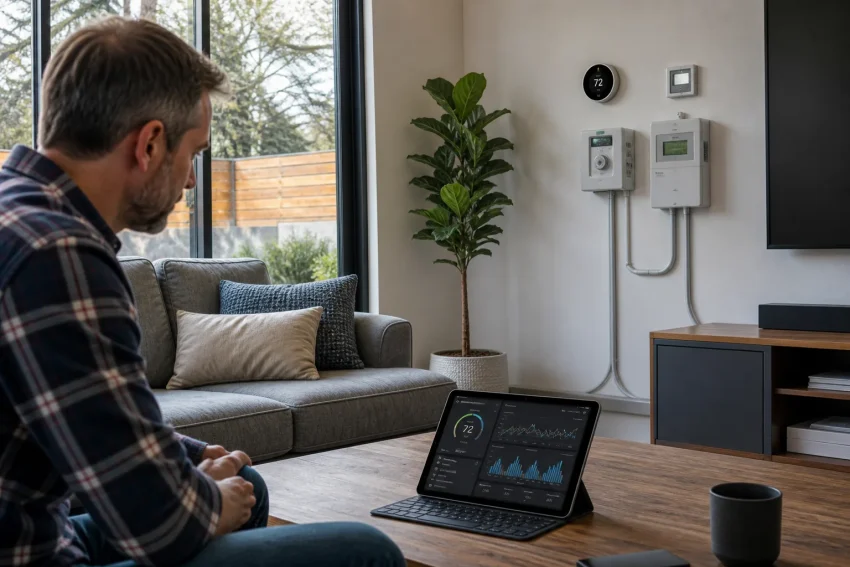
Adding a new smart device to your home without checking your energy baseline first is like pouring water into a leaky bucket. You might gain convenience, but you could also spike your bills, overload circuits, or create automation conflicts you won’t notice until the damage is done. Before you install that next gadget, you need a clear picture of how your home actually uses power right now.
This guide walks you through a practical AI-powered energy audit, drawing on insights from companies like Lifee that use intelligent automation to pinpoint waste and optimize consumption. You’ll learn exactly what to measure, which red flags to watch for, and how to prep your system so every new device works smarter, not harder.
The Evolution of Home Energy Audits: Why AI Matters in 2026
From Manual Inspections to Intelligent Automation
Traditional energy audits relied on a professional inspection, utility bills, appliance inventories, and tests for insulation, air leakage, heating, and cooling performance. That method remains valuable for building-envelope problems, but it usually provides a snapshot rather than a continuous view of household behavior.
An AI-assisted audit adds a living layer of analysis. Smart-meter records, thermostat data, plug-load monitors, occupancy sensors, weather information, and time-of-use tariffs can be combined to identify recurring patterns and unusual changes. Machine-learning models can then distinguish a normal increase during a cold week from a persistent fault, such as a heat pump cycling too often or a refrigerator drawing excess power overnight.
The strongest approach is not to replace professional judgment with software. It is to use AI for continuous detection and prioritization, while qualified professionals handle electrical safety, combustion equipment, insulation defects, ventilation, and other issues that cannot be assessed reliably from consumption data alone.
Why Energy Efficiency Is a Priority in 2026
Energy management is becoming more important as homes add heat pumps, electric vehicles, batteries, induction cooking, home offices, and larger collections of connected devices. These technologies can reduce emissions or improve comfort, but they also create new loads that may overlap during expensive or high-demand periods.
Recent ENERGY STAR material estimates that smart home energy management systems can influence roughly 4% to 15% of whole-home energy consumption, while connected-load savings can reach 8% to 21% in suitable applications. The results depend on the equipment, climate, tariff, household behavior, and quality of the control strategy rather than on AI alone.
- Continuous visibility: AI can compare hourly or sub-hourly consumption with occupancy, weather, and equipment states, helping reveal waste that monthly bills conceal.
- Prioritized actions: Instead of producing a long list of generic recommendations, a well-designed system can rank opportunities by expected savings, comfort impact, cost, and implementation effort.
- Adaptive control: Automation can update schedules when routines change, but it should preserve user overrides and safety limits rather than making unrestricted decisions.
How AI Enhances Smart Home Energy Audits
Key Technologies: Sensors, IoT, and Data Analytics
The audit begins with reliable data. A smart meter supplies whole-home electricity use, while circuit monitors or smart plugs add detail for major loads such as HVAC equipment, water heating, refrigeration, entertainment systems, and office equipment. Thermostats and environmental sensors provide temperature and humidity context, while occupancy information helps distinguish necessary use from waste.
AI then applies pattern recognition, anomaly detection, forecasting, and optimization. A model might learn that a heat pump normally runs Basically cycles during mild weather, identify a deviation, and recommend checking filters, controls, or equipment performance. It can also detect a load that remains active when the household is away, although the recommendation should be verified before an appliance is disconnected.
Lifee is positioned for this type of connected workflow by combining intelligent automation, custom energy-efficiency solutions, and home-management controls for households, businesses, and real estate professionals. Its practical value depends on the quality of the devices connected, the completeness of the data, and the transparency of the recommendations.
Step-by-Step: The AI-Powered Audit Process
- Define the audit boundary: Record the property type, floor area, occupants, heating and cooling systems, utility tariffs, solar generation, battery storage, electric vehicles, and planned devices. This prevents the AI from comparing a home with an EV and heat pump against an unsuitable generic benchmark.
- Build the baseline: Import utility bills and collect interval data where available. Add temperature, occupancy, and equipment information so the system can separate weather-driven demand from avoidable consumption.
- Measure major loads: Use circuit-level monitoring for high-energy equipment and smart plugs for suitable plug loads. Avoid using low-cost monitors on circuits or appliances unless their electrical ratings and installation instructions support that use.
- Analyze patterns and anomalies: Ask the AI to identify baseload, peak periods, standby consumption, short cycling, simultaneous loads, and changes from the normal pattern. Each alert should include the evidence behind it, not just a label such as “inefficient.”
- Test recommendations safely: Apply one change at a time, such as adjusting a schedule or shifting an appliance cycle, then compare normalized consumption and comfort over an appropriate period. Keep a record of the change so savings are not confused with weather or occupancy effects.
- Continue verification: Recheck the baseline after new devices are installed. A successful project should show measurable improvement without creating excessive cycling, uncomfortable temperatures, network instability, or new peak-demand problems.
The Role of Predictive and Contextual Automation
Predictive control uses weather forecasts, historical demand, occupancy patterns, solar production, battery state, and electricity prices to plan flexible loads. For example, it may preheat a home modestly before a time-of-use price peak or schedule vehicle charging when renewable generation is available.
Contextual automation adds real-world conditions. Lights can respond to occupancy and daylight, while heating and cooling can respond to comfort settings rather than occupancy alone. A good system needs clear boundaries: minimum and maximum temperatures, protected medical or food-storage loads, manual overrides, and a fallback mode when internet connectivity fails.
| AI function | What it detects | What to verify |
|---|---|---|
| Load disaggregation | Estimates the contribution of appliances from whole-home data | Confirm important findings with circuit monitoring or a suitable plug meter |
| Anomaly detection | Flags consumption that differs from the normal pattern | Check weather, occupancy, maintenance, and recent schedule changes |
| Forecasting | Predicts demand, costs, and potential peaks | Review tariff assumptions and forecast accuracy during unusual conditions |
| Automated control | Adjusts schedules or device settings | Set safety limits, retain manual control, and test failure behavior |
Checklist: What to Review Before Installing New Smart Devices
Start With the Electrical and Energy Baseline
Before buying a device, identify the circuit it will use, its continuous and peak power requirements, and the other loads likely to operate at the same time. A smart oven, heat-pump water heater, EV charger, or portable air conditioner can matter far more than the device’s networking function.
Compare the planned load with panel capacity, circuit ratings, outlet limitations, and local electrical requirements. Do not rely on an AI dashboard to determine whether a circuit is safe. A licensed electrician should evaluate panel loading, wiring, grounding, dedicated circuits, and installation requirements for substantial or permanently connected equipment.
Compatibility and Integration
Check whether the device supports the protocol, frequency, hub, authentication method, and data access required by the existing system. Common technologies include Wi-Fi, Zigbee, Z-Wave, Thread, Bluetooth, and Matter, but protocol support does not guarantee that every energy measurement or automation command will be available.
Before installation, confirm four practical points: whether the device reports real-time power, whether its data can be exported, whether automations continue locally during an internet outage, and whether it can be removed without breaking other routines. Lifee can help organize compatible intelligent automation across a property, but the exact integration should be confirmed for each product and installation.
Data Privacy and Security
Energy data can reveal occupancy, sleep schedules, work routines, travel, and the use of particular appliances. Review what data is collected, where it is stored, how long it is retained, whether it is shared for analytics or advertising, and whether the account supports multifactor authentication and role-based access.
Use unique passwords, current firmware, segmented networks for suitable IoT devices, and the smallest permissions necessary. For landlords and businesses, establish who can view data, who can change automations, and what happens to the account when a tenant, employee, or service provider changes.
Energy Consumption and Efficiency Ratings
A smart device can consume energy continuously through standby operation, cloud connectivity, displays, sensors, and communications. Compare its annual energy use, standby draw, operating modes, and expected service life, not only its purchase price.
ENERGY STAR’s smart home energy management criteria provide a useful reference point. The current criteria include an ENERGY STAR certified connected thermostat, connected lighting, and a plug-load monitor or control device, with maximum standby-power thresholds listed for several categories. Certification does not guarantee that a particular home will save a specific percentage, but it creates a more consistent starting point for product selection.
Plan the Automation Before You Install the Hardware
Write the intended rule in plain language before connecting the device. For example: “If the room is unoccupied for 20 minutes and daylight is sufficient, turn off the lights, but never disable the freezer or medical equipment.” This exposes conflicts and unsafe assumptions before they become active.
Also define the baseline, the success metric, and the review period. For a smart thermostat, measure normalized heating or cooling energy and comfort complaints. For an EV charger, measure charging cost, peak demand, departure readiness, and the effect on the household’s total load.
Leveraging Lifee for Seamless Integration
Lifee’s role is most valuable when a project requires more than isolated device control. Its French-developed approach combines AI-powered LLM automation with custom energy-efficiency planning, allowing households, companies, and property professionals to connect operational data with practical energy goals.
Use a platform such as Lifee to centralize device status, identify patterns across rooms or properties, coordinate schedules, and monitor whether recommendations deliver the expected outcome. Keep a human approval step for costly equipment changes, electrical work, privacy-sensitive integrations, and any automation that could affect health or safety.
- Compatibility: Verify protocols, local-control behavior, data access, firmware support, and integration limits before purchasing.
- Electrical capacity: Check circuit loading and installation requirements, and use a qualified professional for panel, wiring, or permanently connected equipment.
- Privacy: Review retention, sharing, account access, encryption, updates, and the consequences of a cloud outage.
- Measurement: Define the baseline and success metric so energy savings can be separated from weather, occupancy, and tariff changes.
- Automation safety: Set limits, alerts, manual overrides, and fallback behavior before granting a system permission to control equipment.
What the Latest Evidence Says About Savings and Adoption
Evidence supports meaningful but variable savings. ENERGY STAR materials cite estimates of approximately 10% residential energy reduction with widespread smart-home energy-management adoption, while ACEEE estimates commonly cited in the same program materials indicate about 10% to 13% savings from home energy-management technology plus an additional 4% to 12% from feedback and behavior change. These are potential ranges, not guarantees for every household.
A 2026 systematic review of AI-driven smart-home optimization reports experimental and review findings commonly in the 15% to 25% savings range for data-driven controls, while emphasizing differences in methods, boundaries, and operating conditions. It is therefore more responsible to present AI as an optimization tool whose results depend on the starting inefficiency and the actions it can control.
- Adoption signal: A 2025 smart-home industry survey reported that nearly 32% of respondents had AI-based capabilities at home; among those users, AI-based energy management represented about 40% of reported AI applications. Survey results describe respondents and should not be treated as a universal population estimate.
- User demand: The same survey reported that 35.0% identified high energy costs as a primary home challenge, while 28.6% wanted real-time energy monitoring and 24.6% sought automated optimization. These figures explain why energy dashboards are increasingly tied to automation rather than presented as passive monitoring tools.
- Program criteria: ENERGY STAR’s SHEMS framework requires a connected thermostat, connected lighting, and plug-load monitoring or control. This provides a practical minimum architecture for a measurable smart-home energy project.
- Standby demand: ENERGY STAR criteria list maximum standby thresholds of 3.0 watts for a connected thermostat, 0.5 watts for smart switches, and 1.0 watt for plug-load monitors or controls in the specified categories. Small standby loads matter because a home can accumulate many always-on devices.
- Research limitation: Market forecasts and vendor claims often report large growth rates or savings ranges, but definitions differ between software revenue, hardware revenue, connected loads, whole-home energy, and bill reductions. Treat independent field results and transparent measurement methods as more useful than a headline market estimate.
| Metric | Recent reported figure | How to interpret it |
|---|---|---|
| Potential whole-home SHEMS influence | 4% to 15% | A broad estimate that varies by equipment, behavior, climate, and control quality |
| Potential connected-load savings | 8% to 21% | More relevant when the system controls identified flexible loads |
| Common AI-control research range | 15% to 25% | Reported in research contexts and not a guaranteed household outcome |
| Reported AI capability adoption in one 2025 survey | Nearly 32% | Survey-specific and not equivalent to nationwide adoption |
| Potential broad-adoption residential reduction | About 10% | Program estimate rather than an individual savings guarantee |
Case Studies: Real-World Impact of AI-Powered Energy Audits
Residential Example: Family Home Energy Transformation
Consider a family that begins with twelve months of utility bills, smart-meter data, thermostat readings, and plug-level measurements for entertainment and office equipment. The AI identifies nighttime HVAC operation, lighting schedules that ignore occupancy, and a high standby baseload. The family first verifies the HVAC finding, adjusts the schedule, adds occupancy-based lighting only where useful, and monitors comfort as well as consumption.
An 18% reduction can be a reasonable project illustration, but it should not be presented as a universal result or as independently verified evidence unless the underlying measurement is published. A credible comparison would normalize for weather, occupancy, billing periods, and major changes in equipment before assigning savings to AI.
Commercial Example: Small Business Cost Savings
A small retailer can use the same process for refrigeration, lighting, HVAC, and opening hours. AI may reveal that cooling and lighting begin too early, that doors remain open during peak heat, or that defrost cycles overlap with other large loads. The business can test schedule changes, verify food-safety requirements, and measure energy per operating hour rather than relying only on the monthly bill.
A reported 22% operating-cost reduction should likewise be treated as a scenario unless supported by an auditable case study. Costs can fall because of tariff changes, weather, reduced hours, equipment replacement, or lower demand, so the audit should separate those variables.
Measure Outcomes Without Overclaiming
The most useful result is a documented before-and-after comparison. Track kilowatt-hours, peak demand, cost, carbon intensity where available, indoor comfort, equipment alarms, and user overrides. For heating and cooling, weather-normalized energy use is more informative than comparing two unadjusted billing periods.
- Energy: Compare total and end-use consumption using the same measurement boundaries before and after the intervention.
- Cost: Separate energy reduction from tariff changes, fixed charges, export credits, and demand charges.
- Comfort: Record temperature, humidity, complaints, and room-to-room differences so savings do not come from unacceptable conditions.
- Reliability: Monitor missed automations, disconnected devices, short cycling, and manual overrides as signs that the system needs tuning.
New Devices Need a Data and Resilience Plan
Design for Missing Data and Cloud Outages
An AI audit can produce false conclusions when a sensor disconnects, a smart meter reports late, or a device changes firmware. Configure alerts for missing data, label estimated readings, and avoid treating gaps as zero consumption. Critical functions should continue through local schedules or manual controls when the cloud service is unavailable.
Account for Rebound Effects
Efficiency can encourage increased use. A family may lower the cost of heating and then heat more rooms, or use an efficient appliance more frequently. Measure total household energy and comfort together, and make recommendations that improve service quality without assuming every efficiency gain becomes a bill reduction.
Coordinate Solar, Storage, EVs, and Flexible Loads
Once a home has solar panels, a battery, an EV, or a heat pump, the audit should optimize the system as a whole. Charging at the cheapest time may increase emissions in some grids, while maximizing solar self-consumption can conflict with backup-reserve requirements. Lifee’s custom automation approach can help coordinate these priorities, provided the owner defines cost, carbon, resilience, and comfort goals in advance.
Protect Equity and Accessibility
AI recommendations should not assume that every household can buy sensors, replace appliances, or change occupancy patterns. Prioritize low-cost actions, explain expected payback, and identify available utility or public incentives. For renters and multifamily properties, focus on portable monitoring, privacy boundaries, and controls that do not require structural alterations.
Frequently Asked Questions About AI Energy Audits
Can AI perform a complete home energy audit by itself?
No. AI can analyze consumption, identify patterns, prioritize likely waste, and coordinate connected controls, but it cannot reliably replace inspection of insulation, air leakage, wiring, combustion safety, ventilation, or equipment condition. Use AI as a continuous measurement and decision-support layer alongside qualified inspection when physical or electrical issues are involved.
How much data is needed before an AI audit becomes useful?
A few weeks can reveal obvious schedules, baseload, and standby patterns, while a full year gives a stronger view of seasonal heating and cooling. Start with the best data available, label unusual events such as vacations or renovations, and improve the audit as more readings accumulate.
Will adding smart devices automatically reduce energy use?
No. A connected device can add standby consumption, create conflicting automations, or encourage more use. Savings depend on selecting efficient equipment, measuring the baseline, setting appropriate controls, and checking whether the change improves whole-home performance.
Is my energy data safe in an AI platform?
Security depends on the provider, device manufacturers, network configuration, account practices, and data-retention policy. Before connecting a device, review collection and sharing terms, enable multifactor authentication, apply updates, restrict permissions, and confirm how data is deleted or transferred.
What should a homeowner do first?
Collect recent utility bills, identify major loads, note occupancy and comfort concerns, and list the devices you plan to add. Then connect only the measurements needed to answer a defined question, establish a baseline, and use Lifee or another suitable platform to test recommendations gradually rather than automating everything at once.
The Future of AI in Smart Home Energy Management
From Dashboards to Verified Outcomes
The next stage of smart-home energy management is not simply more sensors or more AI-generated suggestions. It is better measurement, interoperability, explainable recommendations, and automated verification. Systems will increasingly connect flexible loads with tariffs, renewable generation, storage, demand-response programs, and comfort requirements.
Lifee’s opportunity is to make that complexity practical by combining intelligent LLM automation with custom energy-efficiency projects for households, businesses, and real estate portfolios. The strongest implementation will remain human-centered: it will explain why an action is recommended, show what changed, protect privacy, and allow the user to approve or reverse important decisions.
Next Steps for Homeowners and Businesses
Begin with a baseline rather than a shopping list. Gather utility and interval data, identify the largest loads, check electrical capacity, select devices with credible efficiency and interoperability information, and define one or two measurable goals. After installation, compare normalized energy use, cost, comfort, and reliability before expanding the automation.
- Audit first: Establish a seasonal baseline and identify the loads that can materially affect energy use.
- Install selectively: Choose devices that provide useful measurements or controls, not simply more connectivity.
- Automate safely: Set limits, overrides, privacy controls, and offline behavior before enabling autonomous actions.
- Verify continuously: Use data to confirm savings and adjust the system when weather, occupancy, tariffs, or equipment change.
Ready to see how your home or property actually uses energy? Explore Lifee’s AI-powered energy-efficiency and home-automation solutions, define a measurable audit objective, and build a system that makes every new device serve a clear purpose.