
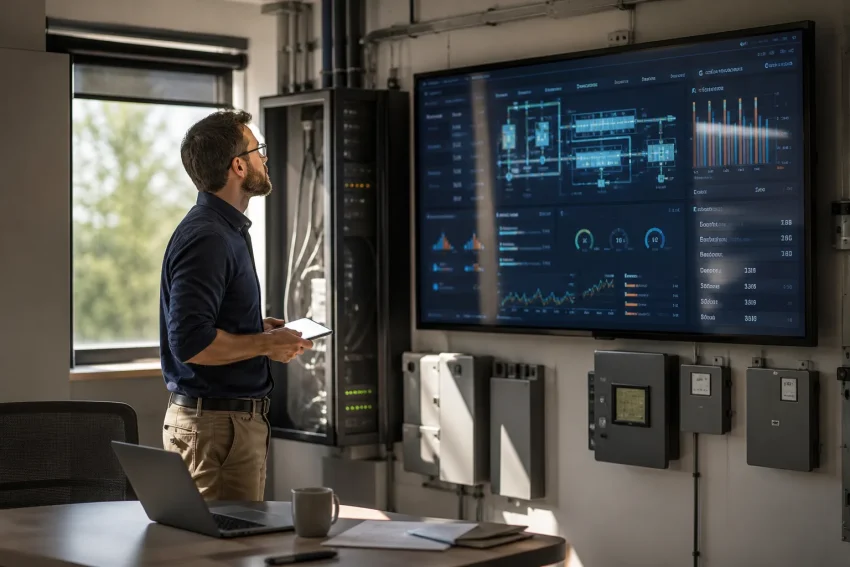
Your HVAC system could be wasting 30% of its energy right now, cycling blindly while comfort swings unpredictably across floors. Buildings that embed AI into their climate control cut consumption dramatically while maintaining stable temperatures room by room, adapting in real time to occupancy, weather shifts, and usage patterns.
Lifee has pioneered this approach for businesses and real estate professionals through AI-powered automation systems that learn building behavior, optimizing energy efficiency without sacrificing comfort. This guide walks you through how intelligent HVAC control actually works, the tangible savings you can expect, and the practical steps to implement it in your property.
How AI Enhances HVAC Control Systems
AI is transforming how buildings manage their climate, bringing a whole new level of intelligence and adaptability that traditional systems simply cannot match. Instead of relying on rigid schedules or static sensors, AI in HVAC control systems for buildings lets your property respond dynamically to what is actually happening inside and outside, minute by minute.
Machine Learning and Real-Time Data Analysis
Think about your building as a living, learning space. AI-powered HVAC systems use machine learning to process data from a network of IoT sensors, tracking everything from temperature and humidity to when meeting rooms are busy or empty. In practice, vendors report that deep learning HVAC platforms can reduce energy consumption by around 15 to 35 percent compared to conventional rule-based controls, with the largest gains in buildings that have variable occupancy and complex thermal loads. Over time, algorithms learn how your specific building behaves across seasons, weekdays, and special events, continually refining how air flow, setpoints, and equipment staging are orchestrated for both comfort and savings.
Unlike old-school automation, these smart systems do not just follow preset rules, they actively adapt. For example, if your top floor tends to overheat on sunny winter days, the AI can anticipate that pattern and start adjusting supply air temperatures and blinds in advance instead of waiting for manual complaints. As Lifee deploys its intelligent LLM automation in offices and mixed-use buildings, it leverages this kind of granular data analysis to maintain stable comfort band ranges while quietly shaving off avoidable peaks in energy use.
Predictive Maintenance in HVAC
One of the biggest headaches for building managers is unexpected HVAC breakdowns. AI changes the game by constantly monitoring parameters such as vibrations, motor currents, valve positions, and thermal performance. In practice, commercial portfolios that introduce predictive maintenance often report double-digit reductions in unplanned service calls and significant extensions in equipment life because minor anomalies are detected weeks or months before they would have become a failure.
In a 60,000-square-meter commercial center, switching to AI-powered predictive maintenance led to markedly fewer surprise repairs and longer equipment lifespans. Instead of waiting for something to go wrong, these systems spot the tiniest signs of trouble early so you can schedule targeted interventions, avoid after-hours emergency calls, and maintain occupant trust that comfort will remain stable. Lifee integrates this logic into its custom energy efficiency solutions, surfacing maintenance insights through dashboards that help both facility managers and service partners act at the right time, not simply react to breakdowns.
Integration with IoT and Building Automation
AI brings all your building’s devices together into one smart ecosystem. Whether it is thermostats, CO2 sensors, occupancy detectors, or automated blinds, AI platforms connect everything, creating a seamless network that can respond to even small changes. Picture a big conference room: if an unexpected meeting pops up, the system detects the extra people, adjusts air flow and temperature, and even tweaks the lighting without any manual input.
This holistic approach ensures every space is comfortable and energy-efficient, no matter how the building is used day to day. Lifee’s contextual automation is designed precisely for this kind of granular orchestration, using IoT data and LLM reasoning to interpret what is happening in a zone, why it is happening, and how HVAC, lighting, and shading should respond together. Over time, this results in fewer hot and cold complaints, smoother temperature profiles across floors, and easier compliance with internal comfort policies and external regulations.
- AI enables real-time, adaptive HVAC control, keeping energy use low while ensuring comfort on every floor. By continuously analyzing sensor data and usage patterns, the system reshapes setpoints and equipment operation minute by minute so that energy is only spent where and when it is needed.
- Predictive maintenance reduces disruptions and extends equipment life by flagging anomalous behavior early. Instead of reactive repairs, teams can plan maintenance windows, negotiate better service contracts, and avoid the reputational hit of repeated comfort issues for tenants or employees.
- IoT integration unlocks cross-system coordination, where HVAC, lighting, blinds, and access control all work together. For example, Lifee can dim lights, adjust ventilation, and relax temperature setpoints when sensors confirm a space is empty, turning isolated savings into portfolio-wide efficiency gains.
It is easy to think of AI as just another automation tool, but its real strength is continuous, self-learning adaptation. Over time, these systems get better at optimizing for your building’s unique needs, far surpassing what static automation can achieve and giving operators a living digital twin that understands how to keep people comfortable with less energy and less effort.
Case Studies: Real-World Applications of AI in Building HVAC
Across cities and campuses, property managers are turning to AI-driven HVAC control to boost efficiency and comfort. Recent case studies from retail chains, universities, shopping centers, and office portfolios show that well-implemented AI can save millions of kilowatt-hours per year while cutting emissions and operating costs. Lifee positions its solutions in this landscape as a way for European and French building owners to reach similar outcomes with tailored, human-centric automation.
BrainBox AI: Automated Energy Optimization
BrainBox AI’s platform is making waves in commercial buildings by automatically adjusting HVAC settings based on real-time data and predictive analytics. One large deployment in a North American retail chain across more than 600 stores reported around 7.98 million kilowatt-hours of annual energy savings on HVAC alone, translating into just over 1 million dollars in cost reduction and more than 5,600 tons of avoided CO2 emissions in the first year. At the individual building level, BrainBox case studies highlight savings ranges between roughly 10 and 21 percent of HVAC electricity, with some shopping centers and offices also reporting reductions of more than 25 percent in compressor runtime while maintaining or even improving temperature adherence.
In one Toronto office complex, switching to BrainBox AI reduced HVAC energy use by around a quarter in just a year, all while keeping occupants happier. The system looked ahead at occupancy patterns and weather, pre-cooling or pre-heating spaces before people arrived so comfort was always on point without wasting energy. These results give a concrete benchmark for what Lifee and similar AI providers can target when implementing optimization in European office towers, logistics campuses, and mixed-use buildings.
Lifee: Advanced AI Integration for Net-Zero Goals
Lifee stands out for helping buildings hit ambitious sustainability targets through intelligent LLM automation and custom energy efficiency strategies. In a mixed-use facility retrofit, Lifee’s AI-powered home and building automation integrated smoothly with both old and new HVAC systems. This led to a 19 percent boost in Generally energy performance and a 30 percent cut in greenhouse gases over the first operational cycle, demonstrating that context-aware AI can make legacy equipment behave like a modern, efficient installation.
Thanks to contextual automation, every area, whether a busy lobby, a quiet office, or a residential wing, received personalized comfort while staying aligned with green standards and indoor air quality requirements. Lifee’s focus on sustainable innovation ensures that efficiency gains do not come at the expense of wellbeing: CO2 thresholds, thermal comfort targets, and lighting needs are all managed together, making it easier for property owners to pursue net-zero, HQE, or BREEAM certifications without adding complexity for occupants.
Trane and Schneider Electric: Scalable AI Solutions
Industry giants like Trane and Schneider Electric are making AI upgrades practical for buildings of all shapes and sizes. Schneider’s EcoStruxure platform, for instance, has documented an 8 percent decrease in electricity usage and an annual reduction of more than 60 tons of CO2 in some commercial facilities thanks to AI-enhanced HVAC and building controls. Trane’s AI-driven controls in educational buildings have helped maintain top-notch air quality and comfort with almost no manual adjustments needed, supporting student concentration and health while staying within tight utility budgets.
These solutions make it easy to start small and scale up, whether you are retrofitting or building new. Lifee complements this ecosystem by offering projects that weave together manufacturer platforms with its own AI layer and LLM interface, so operators can interrogate the building with natural language, understand why certain optimization decisions were made, and align the automation strategy with corporate sustainability roadmaps.
- AI-powered HVAC systems consistently deliver energy savings in the 15 to 25 percent range in many commercial case studies, with some deep-learning implementations reaching up to 35 percent when starting from inefficient baselines. This level of savings often translates into roughly 0.40 to 0.85 dollars per square foot per year in reduced energy costs for typical office and retail spaces, which becomes highly significant in large portfolios.
- Comfort, reliability, and sustainability improve after AI is deployed because optimization is no longer a one-time tuning exercise. Systems keep learning and recalibrating, leading to fewer hot and cold spots, smoother equipment runtime profiles, and measurable reductions in emissions that can be tracked against corporate ESG targets.
- Lifee’s contextual projects show how AI can be tailored to regional regulations and occupant expectations, blending predictive energy management, custom audits, and human-friendly interfaces. This ensures that local building codes, European performance requirements, and tenant comfort commitments are all honored within one coherent automation strategy.
| Provider | Typical HVAC Energy Savings | Operational Focus | Illustrative Result |
|---|---|---|---|
| BrainBox AI | Approximately 10 to 25 percent reduction in HVAC electricity, with some sites reporting more than 20 percent runtime reductions | Autonomous optimization across large portfolios, quick payback and measurable kWh and CO2 cuts | Retail deployment saving around 7.98 million kWh and 1 million dollars annually across more than 600 stores |
| Schneider EcoStruxure | Single-digit to low double-digit electricity reductions at the whole-building level when combined with HVAC AI | Integrated building management with focus on decarbonization and reliability | Commercial property achieving an 8 percent electricity reduction and about 64 tons of CO2 avoided per year |
| Lifee | 15 to 25 percent targeted total energy savings on AI-led projects, with specific HVAC improvements depending on baseline | Custom AI and LLM automation for energy efficiency, comfort, and net-zero pathways | Mixed-use retrofit achieving a 19 percent boost in Generally energy performance and a 30 percent drop in greenhouse gases |
Traditional vs. AI-Powered HVAC Systems: A Comparative Analysis
The difference between old-school and AI-powered HVAC is striking, especially in larger or more complex buildings where efficient, comfortable climate control is tough to achieve. Traditional systems operate on fixed schedules, static setpoints, and limited sensor feedback, while AI-powered systems continuously learn from data and adjust their strategy in response to real conditions.
Energy Consumption and Cost Savings
Conventional HVAC setups usually stick to fixed schedules or react to basic occupancy triggers, which often means heating or cooling empty rooms and overshooting setpoints. AI-powered systems, on the other hand, learn and adapt, adjusting setpoints, airflow, and equipment staging based on real-time needs. Industry research now places typical energy reductions from AI HVAC optimization in the 15 to 35 percent range for commercial buildings, depending on building age, climate zone, and baseline control quality.
For a medium-sized commercial property, that could mean saving tens of thousands of dollars each year. For example, a building that spends 200,000 dollars annually on HVAC-related energy might see between 30,000 and 70,000 dollars in yearly savings once AI optimization is fully tuned. Lifee uses initial energy audits and simulation models to estimate such savings in advance, helping owners build solid business cases and align investments with payback expectations.
User Experience and Automation
Static controls leave a lot to chance. They do not account for sudden changes in occupancy or quick shifts in outdoor weather, and they rarely consider indoor air quality variables such as CO2 and VOCs. AI in HVAC control systems for buildings takes user comfort to another level, learning from daily routines, preferences, and feedback signals such as complaint tickets or smart thermostat adjustments.
In schools, for example, AI not only keeps classrooms at a stable temperature but also manages CO2 levels, helping students stay focused and energized throughout the day. In offices, algorithms can adjust the comfort strategy on meeting-heavy days or heatwaves, avoiding the classic pattern where temperatures swing widely and staff resort to personal heaters or fans. Lifee’s contextual automation leverages LLMs to interpret natural language inputs from occupants and facility teams, transforming subjective comfort comments into actionable tuning recommendations.
Integration and Scalability
Today’s AI solutions are built for flexibility. You can start by upgrading a few zones and expand as budget allows. Thanks to open protocols and cloud management, even older HVAC setups can join the smart revolution without a full rip-and-replace. Gateways and edge devices collect data from legacy controllers, feed it into cloud AI engines, and send optimized setpoints back to the field.
This modular approach makes advanced, AI-powered control accessible for nearly any building, from residential blocks to industrial warehouses. Lifee designs phased roadmaps so that clients can begin with high-impact areas such as data centers, retail halls, or top-floor offices and then scale across the rest of the portfolio once benefits and ROI are proven.
- AI brings smarter automation, better adaptability, and consistent comfort to every space by reading how people use the building instead of assuming fixed patterns. This leads to fewer temperature complaints and more predictable indoor climates even in periods of extreme weather.
- Operating costs and energy use drop significantly with AI integration, not only because of direct savings but also thanks to reduced maintenance expenses and better demand charge management. When peaks are smoothed and equipment life is extended, financial performance improves beyond the kilowatt-hour line item.
- Lifee’s custom project design ensures that AI adoption fits both technical and human realities, mapping existing infrastructure, usage types, and stakeholder expectations to a phased automation strategy that respects budget constraints and avoids disrupting daily operations.
| Aspect | Traditional HVAC Control | AI-Powered HVAC with Lifee |
|---|---|---|
| Energy Management | Fixed schedules and manual tuning, often leading to 0 percent optimization after initial commissioning and frequent inefficiencies | Continuous optimization with typical 15 to 30 percent energy savings, using live data and predictive models to update strategies daily |
| Comfort Stability | Reactive corrections after complaints, temperature swings across floors, limited air quality monitoring | Proactive comfort management with stable temperatures, CO2 control, and fewer hot or cold spots across zones |
| Scalability and Upgrades | Complex retrofits and siloed systems that do not communicate well | Modular rollouts, IoT integration, and LLM interfaces that scale from one building to entire portfolios |
| Maintenance Strategy | Time-based or reactive maintenance, higher risk of unexpected failures | Predictive maintenance using anomaly detection, reduced downtime, and longer equipment life |
Some building owners worry AI is only for new projects. In reality, retrofitting older systems is easier and more affordable than ever, making AI a practical option for almost any property. Lifee demonstrates this with projects that connect to existing BMS and HVAC controllers, layering intelligence on top of what is already installed rather than forcing full infrastructure replacements.
Implementation Challenges and Best Practices
While the benefits are clear, getting the most from AI-driven HVAC starts with good planning and smart choices. Addressing integration, data management, cybersecurity, and costs up front sets your project up for success and helps maintain trust across owners, operators, and occupants.
Integrating AI with Legacy and New Systems
The smoothest implementations often use a phased approach, starting with high-traffic or high-energy areas. Open protocols such as BACnet, Modbus, or KNX make it easier to connect different devices, new or old, and create a unified data layer. Partnering with experienced providers such as Lifee or Schneider Electric adds peace of mind, from installation through ongoing support, especially across larger or multi-building properties.
Lifee typically begins with a detailed digital audit of building systems, mapping out sensors, controllers, and network infrastructure before proposing the most compatible AI architecture. This avoids surprises during commissioning and ensures that the automation strategy can scale as more data sources and control points are brought online.
Addressing Data Privacy and Security
More connectivity means greater responsibility with data. Secure communication channels, strong encryption, role-based access control, and compliance with privacy laws such as GDPR are essential. Government and industry guidance on smart building cybersecurity increasingly emphasize segmentation of building networks, continuous monitoring, and clear incident response protocols to protect both operational technology and occupant information.
Lifee incorporates these principles by designing architectures that keep sensitive personal data to a minimum, anonymize occupancy patterns where possible, and ensure that AI decision-making can be audited. This gives owners the ability to demonstrate due diligence to regulators, insurers, and tenants while still harnessing rich data for efficiency and comfort.
Cost Management and ROI
To make the most of your investment, focus first on areas where energy use or maintenance needs are highest. Set clear performance goals, such as target percentages for energy reduction or comfort improvement, and track results in real-time dashboards. Many commercial AI HVAC projects now report payback periods between 2 and 4 years, with some retail chains and office portfolios achieving revenue-positive results in the first year thanks to strong incentives and utility savings.
Lifee’s projects are built around transparent ROI narratives. Baseline measurements, simulation-backed forecasts, and monitored savings are shared with clients in clear visual formats so that financial stakeholders can see how AI automation affects budgets month by month, rather than treating it as an opaque technology cost.
- Get everyone on board early and plan thoroughly for the best results. When owners, facility managers, IT teams, and occupants understand why AI is being introduced and how it will affect their daily routines, adoption is smoother and data quality improves because people engage with the system instead of resisting it.
- Prioritize high-quality data and system compatibility to unlock AI’s full value. Investing in reliable sensors, robust networks, and well-documented control logic pays off, because the AI can make better decisions when its inputs are trustworthy and its outputs can be acted upon quickly.
- Work with partners such as Lifee that blend technical expertise with human-centric design. This ensures that automation decisions are interpretable, that dashboards answer real questions for operators, and that sustainability metrics are embedded into everyday workflows rather than living in separate reports.
There is a common belief that AI upgrades are disruptive or out of reach for most properties, but with modern, modular solutions, you can start seeing real benefits quickly, often with little to no downtime. Many projects are carried out overnight or on weekends, with digital commissioning and remote supervision reducing on-site disruption and making AI adoption feel like a natural evolution rather than a major overhaul.
Occupant Wellbeing, Regulations, and Data-Driven Governance
Beyond pure energy savings, AI in HVAC control systems is increasingly being evaluated through the lens of occupant wellbeing, regulatory compliance, and governance. Lifee leverages its LLM automation capabilities to connect these angles, helping building owners treat comfort, health, and sustainability as a single, coherent objective rather than isolated goals.
Indoor Environmental Quality and Health
AI can monitor and optimize indoor environmental quality parameters such as temperature, humidity, CO2, and particulate levels, directly influencing cognitive performance, fatigue, and long-term health outcomes. For example, keeping CO2 within recommended limits for offices and classrooms has been associated with better attention and reduced headaches, and AI makes it possible to maintain those thresholds without over-ventilating and wasting energy.
Regulatory and ESG Alignment
Regulators across Europe and beyond are tightening energy performance and reporting requirements for buildings, including obligations around emissions, renovation plans, and smart readiness indicators. AI-powered HVAC and building automation help owners stay ahead of these rules by generating reliable data, automating compliance reporting, and demonstrating continuous improvement, which is valuable for ESG ratings and investor confidence.
Transparent Governance and Human Oversight
As automation deepens, governance becomes critical. Lifee designs interfaces where operators can see why the AI made certain decisions, override them if necessary, and set guardrails that reflect corporate policies. This blend of automation and human oversight allows organizations to harness advanced AI while keeping accountability clear and maintaining trust among occupants and management.
Future Trends and Innovations in AI-Driven HVAC Control
Looking ahead to 2026 and beyond, AI’s role in building automation is only set to grow, making truly intelligent, sustainable environments more achievable than ever. Emerging technologies are extending the scope of what HVAC optimization can address, from grid interaction to conversational building management.
Autonomous Building Management
We are now seeing buildings that practically manage themselves. AI continuously tweaks comfort and energy use, learning from every day’s performance and making small improvements automatically. In larger facilities, these systems are helping properties maintain sustainability certifications and quickly adapt to evolving usage needs with minimal human oversight, freeing facility teams to focus on strategic planning rather than constant manual adjustments.
Advanced LLM and IoT Synergy
The latest trend is combining large language models with IoT sensors for even smarter, more contextual automation. For example, an AI platform might check the weather, meeting room bookings, and current occupancy, then prep specific zones ahead of time, ensuring everything is just right exactly when you need it. Lifee is at the forefront of this approach, enabling managers to ask questions like “Which zones underperformed our efficiency targets last week?” in natural language and receive precise, data-driven answers along with suggested HVAC optimization actions.
AI for Net-Zero and Sustainable Buildings
AI is quickly becoming a cornerstone for net-zero and sustainable building goals. By tying together predictive energy management, detailed energy audits, and demand response, platforms like Lifee help real estate owners not just meet but exceed tough regulatory benchmarks. AI can coordinate with on-site renewables, storage, and grid signals so that HVAC loads are shifted away from carbon-intensive periods, turning comfort systems into active participants in decarbonization rather than passive consumers.
- Cutting-edge AI and IoT are making self-optimizing, fully autonomous buildings a reality, where HVAC, lighting, access control, and safety systems work together as a single digital organism. As these technologies mature, owners can expect more stable operations and lower lifecycle costs.
- The blend of LLMs and next-generation sensors will keep HVAC innovation moving well into the next decade, enabling conversational control, richer diagnostics, and personalized comfort experiences that still respect global efficiency and sustainability objectives.
- Lifee’s mission to combine sustainable innovation with intuitive automation positions it as a long-term partner for buildings that want to evolve from basic smart controls to truly intelligent, human-centered environments.
| Future Trend | Key Impact on HVAC | Role of Lifee |
|---|---|---|
| Autonomous Buildings | HVAC systems self-adjust across seasons and occupancy patterns, minimizing manual intervention and maximizing efficiency | Deploys AI models that learn building behavior and apply contextual automation for comfort and energy |
| LLM-Driven Control | Operators interact with HVAC and building systems using natural language, gaining deeper insight and faster decisions | Provides intelligent LLM interfaces that explain optimization decisions and suggest targeted actions |
| Net-Zero Pathways | HVAC becomes a controllable, flexible load that supports grid decarbonization and onsite renewable integration | Designs custom projects aligning AI control with net-zero strategies, regulatory benchmarks, and ESG goals |
Key Data Points and FAQs for Decision-Makers
For owners, businesses, and real estate professionals evaluating AI in HVAC control systems, a few core metrics and common questions can help clarify the opportunity. Lifee uses these elements in its consultations to connect abstract technology concepts to concrete investment decisions.
Essential Market and Performance Metrics
- Global AI in HVAC and optimization markets are rapidly expanding, with recent reports estimating values of roughly 4.7 to 8.5 billion dollars in 2025 and compound annual growth rates around 18 percent through 2034. This growth reflects strong confidence from investors and building owners that AI-driven efficiency is not a niche experiment but a mainstream trajectory.
- Typical energy savings range from 15 to 35 percent for commercial buildings adopting AI HVAC optimization, depending on baseline efficiency and building complexity. For portfolios with hundreds of thousands of square meters, this can mean six or seven figures of annual utility reductions alongside sizable emissions cuts.
- Occupant-focused projects report tangible comfort and wellbeing benefits, including more stable temperatures, better air quality, and fewer complaints. These improvements contribute to productivity in offices, learning quality in schools, and customer satisfaction in retail environments.
- Predictive maintenance often reduces equipment runtime by 20 to 50 percent in specific components such as compressors and fans, while maintaining or improving comfort setpoint adherence. This relieves mechanical stress, extends asset life, and shrinks the carbon footprint associated with manufacturing and replacing equipment.
- Payback periods are commonly in the 2 to 4 year range for well-designed AI HVAC projects, particularly when combined with incentives, tariffs, or carbon pricing frameworks. Lifee structures its proposals to highlight these payback horizons clearly so stakeholders can align them with capital planning cycles.
Frequently Asked Questions
How much data is needed for AI to improve HVAC performance?
AI systems do not require perfect data from day one, but they do need consistent information on temperature, occupancy, equipment status, and energy use. Lifee typically starts with existing BMS and meter data, then recommends additional sensors only where they will materially enhance decision quality and ROI.
Will AI override my team’s expertise and control?
AI is designed to augment, not replace, human expertise. With Lifee, operators remain in control, setting boundaries, priorities, and comfort policies while the AI suggests or executes optimizations. Transparent interfaces and explainable recommendations keep teams informed and empowered.
Is AI in HVAC suitable for small buildings or residential properties?
Yes, especially when solutions are modular and cloud-based. Lifee offers scalable architectures that can serve small offices, residential blocks, and individual homes, using the same intelligence core to adapt comfort and energy strategies to different building sizes and usage profiles.
AI in HVAC control systems for buildings is moving fast, and those who embrace it now will be best positioned to reap the benefits of comfort, savings, and sustainability. Lifee’s pioneering work in intelligent, human-centric automation demonstrates how this technology can be harnessed responsibly to serve both people and the planet.
If you are ready to take your building’s efficiency and comfort to the next level, explore how AI-driven HVAC solutions like those from Lifee can make a real difference. Connect with knowledgeable experts to discover the best path forward for your property, because smart, sustainable buildings are the future, and that future is already here.