
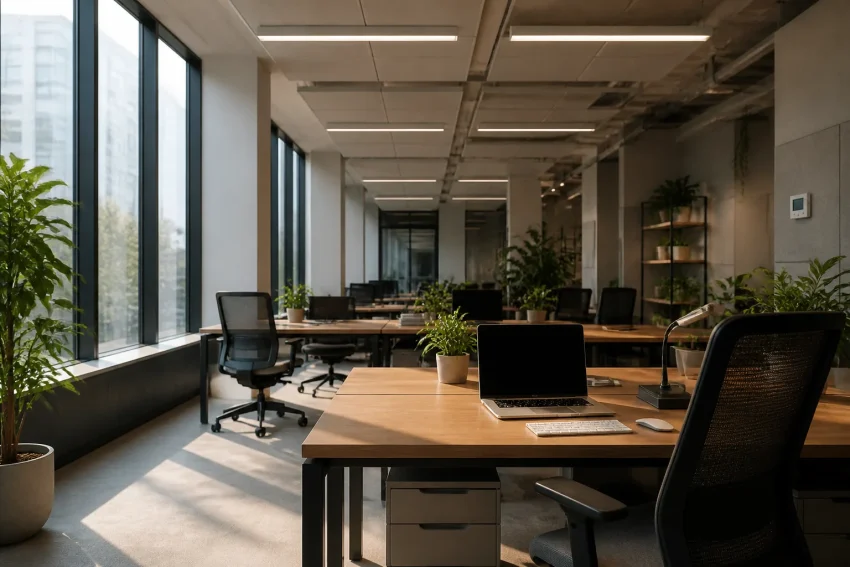
Most commercial buildings waste up to 40% of their lighting energy while employees still complain about dim corners and glare. The culprit isn’t daylight harvesting itself, but poorly calibrated systems that treat every workspace like a uniform grid. Lifee’s AI-powered automation systems solve this by continuously learning occupancy patterns and individual lighting needs, adjusting zones in real time so natural light reduces your energy costs without leaving anyone squinting at their screen.
This guide walks you through designing a smart lighting strategy that cuts consumption dramatically while maintaining comfortable, productive spaces. You’ll see exactly how intelligent sensors, adaptive algorithms, and thoughtful zoning create the balance most systems miss.
Understanding Daylight Harvesting and Smart Lighting
What Is Daylight Harvesting?
Daylight harvesting is a control strategy that measures available natural light and adjusts electric lighting to maintain a suitable illumination level. Photosensors detect light near windows and deeper inside the room, while dimming or switching controls reduce artificial output when daylight can carry more of the visual task.
The approach works best when a room is divided into daylight zones rather than treated as a single grid. Workstations close to a bright facade may need little electric light at midday, while desks several metres from the window may still require substantial output. A well-designed system therefore preserves a minimum lighting level in each zone instead of dimming every fixture in response to the brightest part of the room.
How Smart Lighting Enhances Daylight Harvesting
Smart lighting adds occupancy data, schedules, user feedback, weather information, and historical patterns to the daylight signal. Lifee’s AI-powered automation can distinguish an occupied workstation from an empty circulation area, learn when a conference room is typically used, and adjust each lighting zone without forcing the entire floor to follow one setting.
This distinction matters because daylight availability changes quickly with cloud cover, blinds, facade orientation, and seasonal sun angles. Smooth dimming, appropriate transition delays, and localized control prevent the distracting flicker and sudden drops in brightness that often cause occupants to override automated systems.
Why 2026 Is a Pivotal Year
Smart lighting has become part of a wider building-efficiency strategy rather than a standalone lighting upgrade. The International Energy Agency identifies daylight and occupancy sensors as mature, cost-effective controls that can provide additional savings in non-residential buildings, particularly when connected to building-management platforms.
Recent IEA analysis also notes that digital optimization using sensors, communication, fault detection, and automation can typically deliver energy savings of 5% to 40% in existing facilities, although results depend on the building, technology, and baseline consumption. This makes measurement and commissioning essential: a promised percentage should never replace a verified before-and-after comparison.
Daylight harvesting should not be judged by how far lights dim. The better question is whether every occupied task area maintains appropriate visual conditions while the system uses no more electric light than necessary.
- Comfort remains the operating constraint. A system should preserve usable light at desks, meeting tables, and circulation routes even when a nearby window zone is bright enough for aggressive dimming. This prevents energy savings from creating dark workspaces.
- Daylight must be measured locally. A sensor positioned near a reflective window or hidden behind furniture can misrepresent the light reaching a work surface. Sensor placement, shielding, and calibration are therefore as important as the control software.
- Energy performance must be verified. Lighting schedules, fixture power, occupancy, daylight availability, and manual overrides should be recorded so savings can be compared with a credible baseline rather than estimated from nominal settings.
How Smart Lighting Systems Enable Effective Daylight Harvesting
Key Components: Sensors, Controllers, and AI
Effective daylight harvesting depends on several layers working together. The sensor measures the environment, the controller applies the lighting strategy, and the software interprets patterns that are difficult to manage with fixed schedules.
- Daylight sensors: Photosensors measure illuminance and provide the signal required for daylight-responsive dimming. They should be positioned to represent the light on occupied work surfaces, not simply the brightness visible from a window. Commissioning should test readings under morning, midday, overcast, and late-afternoon conditions.
- Occupancy sensors: Presence detection prevents the system from maintaining full output in empty rooms and supports separate settings for occupied, temporarily vacant, and unoccupied states. In an office, this allows a window-side zone to harvest daylight aggressively when occupied while switching down unused desks elsewhere.
- Intelligent controllers: Controllers translate sensor data into dimming commands for defined lighting zones. They should support gradual transitions, minimum output limits, scene control, and manual adjustments that expire or feed back into the system instead of permanently defeating automation.
- AI algorithms: AI can identify recurring occupancy patterns, detect persistent manual overrides, and anticipate changes linked to schedules or weather. Lifee’s automation approach uses this contextual information to refine zones over time rather than assuming that a fixed daylight curve will suit every day.
The result is not simply an automatic dimmer. It is a feedback loop: measure conditions, adjust output, observe occupant responses, and refine the operating parameters. That loop is especially valuable in spaces where furniture, teams, blinds, or room functions change after installation.
IoT and Contextual Automation
Connected lighting allows daylight harvesting to work with the wider building. Integration with a building-management system can combine lighting data with occupancy schedules, weather forecasts, blind positions, HVAC operation, and energy meters. The IEA reports that this type of integration supports predictive maintenance, adaptive lighting, motion-responsive operation, and more detailed usage analytics.
- Centralized monitoring: Facility teams can view zones, alarms, energy trends, and override rates from one interface. This shortens the path between an occupant complaint and a targeted correction, especially in multi-floor properties.
- Predictive energy management: Forecasts and historical daylight patterns can help the system prepare for changing conditions instead of reacting after a room becomes uncomfortable. Lifee can use this data within custom energy-efficiency projects to coordinate lighting behavior with actual building use.
- Contextual scenes: A presentation, video call, cleaning cycle, or detailed visual task may require a different lighting scene from ordinary desk work. Context-aware controls can temporarily change the balance between daylight and electric light while retaining safe and comfortable defaults.
- Cyber-security and resilience: Connected lighting should use authenticated devices, least-privilege access, encrypted communications, segmented networks, and documented update procedures. A fallback mode should preserve basic local control if the network or cloud service becomes unavailable.
Applications Across Different Environments
In offices, the priority is usually visual comfort at screens and workstations. In retail, daylight harvesting must preserve product appearance and colour consistency. In homes, occupants may prefer scenes that balance energy efficiency with ambience, while hospitality spaces need predictable transitions that support guest comfort and brand identity.
Lifee’s custom project design adapts the control logic to the building’s use, facade, ceiling height, furniture layout, and user expectations. The same sensor strategy should not be copied from an office into a retail display area without considering different visual tasks and operating hours.
| Environment | Primary daylight challenge | Useful control response | Verification metric |
|---|---|---|---|
| Open-plan office | Glare, screen reflections, and uneven light depth | Perimeter zoning, gradual dimming, task-area minimums, and occupant feedback | Lighting energy, override frequency, and comfort complaints |
| Retail space | Changing display appearance and customer traffic | Daylight compensation combined with presentation scenes and occupancy response | Display quality, sales-floor consistency, and operating hours |
| Residential space | Personal preferences and changing routines | Presence-based scenes, sunset transitions, and local user control | Energy use, scene usage, and resident satisfaction |
Benefits: Energy Savings, Sustainability, and Occupant Comfort
Quantifying Energy and Cost Savings
Energy savings vary widely because they depend on window orientation, glazing, shading, fixture efficiency, operating hours, baseline controls, and the distance between work areas and the facade. Government performance data demonstrates this variation: one DOE-monitored daylighting study recorded average savings of about 30% in a west-facing sidelighted area and 50% to 60% in a stronger bilateral daylit area at a position 3.35 metres from the windows.
The same study found that switching lights off when daylight was sufficient produced higher savings than merely dimming fixtures to a minimum output in zones where daylight levels allowed it. That does not mean every office should use abrupt switching. Dimming is usually more acceptable in occupied workspaces, while automatic shutoff may be appropriate in unoccupied areas or where visual conditions are reliably adequate.
| Control condition | Reported result or range | Practical interpretation |
|---|---|---|
| West-facing sidelighting | Approximately 30% average lighting-energy savings in one monitored area | Useful savings are possible, but facade orientation and zone depth matter. |
| Strong bilateral daylighting | Approximately 50% to 60% at 3.35 metres from windows | Perimeter zones may support more aggressive daylight response than interior zones. |
| Daylight plus occupancy controls | Potentially higher combined savings than either strategy alone | Use occupancy data to avoid lighting empty spaces while daylight controls manage occupied zones. |
| Digital optimization across facilities | Typically 5% to 40% energy savings according to recent IEA analysis | Measure the actual building rather than applying a universal savings promise. |
Enhancing Workspace Lighting Quality
Energy efficiency is successful only when occupants can work comfortably. A useful design separates illuminance from perceived comfort by considering glare, contrast, reflections, colour quality, flicker, view, and the relationship between a screen and the brightest surface in the field of view.
Lifee’s systems can incorporate occupant feedback into the control loop. If employees repeatedly raise lighting in one zone, the system should investigate whether the cause is insufficient output, a blocked sensor, a changed desk arrangement, or glare from the facade. Raising every fixture permanently may hide the symptom while wasting energy.
Supporting Sustainability Initiatives
Daylight harvesting reduces operational lighting demand, but a complete sustainability assessment should also consider fixture life, controls hardware, maintenance, embodied carbon, and end-of-life management. Efficient LEDs are easier to integrate with responsive controls than many legacy technologies, but intelligent features still require commissioning and maintenance to deliver their intended benefit.
Measured lighting reductions can support energy audits, carbon reporting, and green-building documentation when the baseline, boundaries, and calculation method are clearly recorded. Lifee’s intelligent energy audits help connect lighting data with broader energy-efficiency decisions instead of evaluating fixtures in isolation.
The strongest business case combines three measurements: kilowatt-hours saved, lighting quality maintained, and occupant behaviour after deployment. A system that saves energy but creates frequent overrides has not reached its full potential.
- Lower operating costs: Reducing output in daylit zones and switching down empty areas cuts consumption during normal operation. Savings become more dependable when energy meters and control logs confirm what the system actually did.
- More consistent comfort: Zone-level control can preserve light where people work while allowing stronger reduction near windows. This is more effective than applying one dimming percentage across an entire floor.
- Stronger sustainability evidence: A documented baseline and post-installation measurement provide credible evidence for internal targets and certification work. They also reveal when calibration or maintenance is needed.
Overcoming Challenges: Avoiding Dark Workspaces and Ensuring System Reliability
Common Pitfalls and How to Avoid Them
Most daylight-harvesting failures are design and commissioning failures rather than limitations of the concept. Furniture changes, reflective surfaces, blinds, sensor drift, and inaccurate assumptions about work schedules can gradually undermine an installation.
- Poor sensor placement: A sensor exposed to direct sun may interpret a bright patch as representative of the whole room, while a sensor blocked by a partition may command unnecessary output. Map sensor sightlines and test readings at representative work surfaces before finalizing zones.
- Insufficient calibration: Fixtures, photosensors, and control curves must be calibrated together. Commissioning should test clear, cloudy, and transitional conditions, then establish minimum levels that protect task visibility.
- Overly aggressive dimming: A system that responds instantly to every passing cloud can feel unstable and encourage manual overrides. Smoothing, dead bands, and transition delays help maintain visual continuity without abandoning responsiveness.
- Ignoring shading and glare: Lowering electric light cannot solve direct sun on a screen. Automated blinds, interior shades, workstation orientation, and facade design may need to work with lighting controls to address the underlying glare source.
- Weak fallback operation: If a network connection or central controller fails, occupants still need usable local lighting. Define safe fallback levels, manual controls, alarm handling, and recovery procedures before handover.
Best Practices from Lifee
Lifee combines intelligent energy audits with custom project design so the automation reflects the building rather than forcing the building into a generic template. The process should begin with floor plans, facade orientation, fixture schedules, operating hours, occupancy patterns, user complaints, and available energy data.
During implementation, zones should be documented, sensors labelled, control sequences tested, and facility teams trained to interpret alarms and overrides. After handover, performance reviews can compare energy use and comfort feedback by zone, allowing the system to improve without losing accountability.
Continuous Improvement with AI and IoT
AI is most useful when it turns operational data into specific actions. A repeated override near one window might indicate glare, an unsuitable setpoint, or a sensor problem. A gradual increase in energy use in one zone might indicate fixture failure, a changed schedule, or a control rule that no longer matches occupancy.
Lifee’s predictive energy management can prioritize these signals for review, while remote diagnostics reduce the need for unnecessary site visits. Human approval remains valuable for changes that affect comfort, privacy, network access, or safety, particularly in multi-tenant and cybersecurity-sensitive buildings.
Making the Business Case: Measurement, Payback, and Lifecycle Value
Start With a Defensible Baseline
Before installation, record lighting power, operating schedules, occupancy, daylight conditions, control settings, and representative energy consumption. A baseline should distinguish lighting use from unrelated loads so that savings are not incorrectly attributed to daylight harvesting.
Use a Pilot Before a Full Deployment
A pilot on one perimeter zone and one interior zone can expose problems with sensor placement, glare, user preferences, and network integration. Compare the pilot with a similar untreated area where practical, then use the findings to refine the control sequence before expanding across the property.
Evaluate Total Cost of Ownership
The investment includes fixtures, sensors, controllers, commissioning, software, network security, training, maintenance, and future replacements. Lifee’s project design can prioritize the measures that address the building’s largest sources of waste first, rather than adding advanced features that are difficult to operate or maintain.
| Project phase | Key question | Evidence to retain |
|---|---|---|
| Audit | Where and when is lighting energy being used? | Fixture inventory, schedules, meter data, occupancy observations, and user feedback |
| Design | How should daylight, occupancy, shading, and task needs interact? | Zone map, sensor plan, control sequence, cybersecurity requirements, and simulations |
| Commissioning | Does the installed system behave as designed? | Test scripts, calibration records, setpoints, fallback tests, and training records |
| Optimization | Are savings and comfort maintained over time? | Energy trends, override rates, fault reports, complaints, and periodic re-commissioning results |
Real-World Applications and Case Studies
Office Building: Maximizing Comfort and Savings
In a Lifee office project, adaptive lighting controls responded to daylight and occupancy across multiple zones. The reported result was a 55% reduction in lighting energy use over a year, alongside fewer complaints about glare and dark areas. Such a result should be interpreted in the context of the building’s baseline, operating schedule, fixture power, daylight exposure, and commissioning quality rather than treated as a universal guarantee.
Smart Homes: Personalized Automation
In a home with large windows, Lifee’s AI-powered automation can coordinate daylight, presence, blinds, and evening scenes. Lights can remain off when natural illumination is sufficient, then rise gradually as daylight fades. Residents retain local control, while usage patterns help refine transitions without requiring constant manual programming.
Commercial Spaces: Meeting Sustainability Goals
Retail and hospitality projects require a different balance because lighting affects merchandise, atmosphere, wayfinding, and brand presentation. Lifee’s custom project design can combine daylight response with display scenes, occupancy controls, and predictive schedules so energy reduction does not flatten the visual hierarchy of the space.
- Scale begins with repeatable zones: A successful pilot can establish sensor placement, commissioning procedures, and user settings that transfer to other floors or sites. This reduces implementation risk without assuming every area behaves identically.
- Results need context: Report lighting energy, floor area, operating hours, daylight exposure, and comfort indicators together. This makes a 40%, 55%, or 60% result meaningful rather than promotional.
- Long-term value depends on operation: Training, cybersecurity, maintenance, and periodic calibration protect performance after installation. Connected lighting is an operational system, not a fit-and-forget product.
Frequently Asked Questions
Can daylight harvesting make an office too dark?
It can if the system uses poorly placed sensors, oversized zones, unsuitable minimum levels, or aggressive dimming curves. Proper zoning, commissioning, glare control, and occupant feedback allow daylight to reduce electric lighting near windows while maintaining usable illumination at interior workstations.
How much energy can smart daylight harvesting save?
Results vary by building and baseline. DOE-monitored projects have reported approximately 30% savings in some sidelighted conditions and 50% to 60% in stronger bilateral daylit zones, while recent IEA analysis places broader digital-optimization savings at roughly 5% to 40% depending on the facility and technologies applied.
Should lights dim or switch off when daylight is available?
Dimming generally provides smoother transitions and greater occupant acceptance in occupied workspaces. Switching off can produce additional savings where daylight is consistently sufficient, but it should be applied only after testing visual conditions, task needs, reactivation behaviour, and user expectations.
Does smart lighting require a building-management system?
No. A standalone system can provide daylight and occupancy control, but integration with building-management platforms adds broader scheduling, analytics, fault detection, energy monitoring, and coordination with shading or HVAC systems. The appropriate architecture depends on project size, cybersecurity requirements, and facility capability.
How does Lifee approach a daylight-harvesting project?
Lifee begins with intelligent energy audits and workspace analysis, then develops a custom project design around daylight exposure, occupancy, comfort, cybersecurity, and operational goals. AI-powered automation and predictive management can be refined after deployment using measured performance and occupant feedback.
Smart lighting daylight harvesting works best when it is treated as a measured, adaptive building service rather than a simple dimming feature. Daylight-responsive controls can reduce lighting demand substantially, but the strongest results come from accurate zoning, careful commissioning, secure connectivity, appropriate shading, and continuous verification.
Lifee brings these elements together through AI-powered automation, intelligent energy audits, contextual control, predictive energy management, and custom energy-efficiency solutions for homes, businesses, and real estate professionals. The goal is straightforward: use natural light wherever it is genuinely useful, maintain comfortable conditions where people work and live, and keep improving the system as the building changes.
Ready to implement smart lighting daylight harvesting without creating dark workspaces? Contact Lifee for a personalized assessment and a lighting strategy built around measurable energy performance, occupant comfort, and reliable long-term automation.