
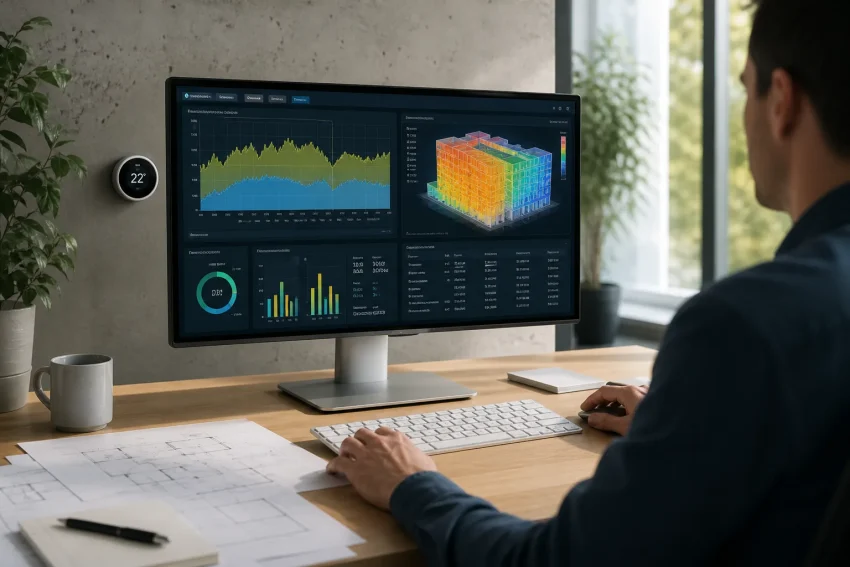
Most commercial buildings hemorrhage 20-30% of their energy costs into thin air, and you’d never know it without the right visibility. The culprit isn’t always aging HVAC systems or poor insulation, it’s the inability to see where and when power is being wasted in real time.
Lifee, a French innovator in AI-powered energy efficiency solutions, has built intelligent monitoring systems that pinpoint waste down to the circuit level, turning raw consumption data into actionable insights for businesses and real estate professionals. This guide walks you through how real-time energy monitoring works, what to measure, and how to translate those findings into measurable savings, without overhauling your entire infrastructure.
Understanding Real-Time Energy Monitoring
Real-time energy monitoring gives you a live, detailed picture of how energy is being used in a home, office, retail site, or multi-building portfolio. Instead of waiting for a monthly utility statement, connected meters and sensors show consumption at intervals ranging from seconds to minutes. That visibility helps teams distinguish normal operating demand from avoidable waste while an issue is still fixable.
The need is substantial. Buildings account for approximately 28% of global final energy consumption, representing about 120 exajoules in 2023. Building energy demand has also continued to grow by roughly 0.9% per year since 2010, driven by larger floor areas, population growth, and rising cooling demand. Under current policies, efficiency improvements are projected to remain below 1% annually through 2030, far below the approximately 4.4% yearly improvement required on a net-zero pathway.
- 28% of global final energy consumption: Buildings remain one of the largest energy-use sectors worldwide. For a property owner, this means small improvements in HVAC schedules, lighting controls, and equipment runtimes can scale into meaningful reductions across an entire portfolio.
- 0.9% annual growth in building energy demand: Efficiency gains are being challenged by cooling demand, electrification, and expanding floor space. Real-time data helps operators identify whether rising consumption comes from genuine business growth or an avoidable operating fault.
- 4.4% annual improvement needed for net zero: Conventional audits performed once a year cannot provide enough operational feedback on their own. Continuous measurement creates the recurring feedback loop needed to test measures, confirm results, and correct drift.
The Evolution of Energy Monitoring
Energy tracking has moved from manual meter readings and opaque utility statements to connected systems that combine interval data, circuit-level sensing, building management systems, and analytics. Lifee’s intelligent approach can connect consumption data with occupancy, weather, schedules, and equipment behavior, turning a kilowatt-hour reading into an operational explanation.
Adoption is no longer limited to large industrial facilities. A 2025 survey of 308 commercial building owners, operators, IT leaders, and facility managers in the United States and Canada found that 91% of respondents had deployed smart devices, systems, or software. Real-time monitoring and visualization ranked among the leading priorities, while 78% reported having a building automation or building management system in use.
- 91% smart-building adoption: Monitoring is increasingly part of standard building infrastructure rather than an experimental add-on. Smaller operators can begin with a main-meter connection or a few high-load circuits and expand after proving value.
- 78% using a BMS or BAS: Existing automation systems provide a useful foundation, but they do not automatically guarantee useful energy insight. A monitoring layer should make data understandable, expose faults, and connect observations to specific actions.
- 62% identifying energy optimization as a leading AI application: AI is being applied to practical operating problems such as excessive HVAC runtime, abnormal baseload, and poorly timed equipment operation. Lifee can use this context to design automation around the building’s actual patterns instead of generic schedules.
The central shift is from knowing how much energy a building used to understanding why it used it. A sharp overnight increase, a weekend baseload that never falls, or a cooling system operating during an unoccupied period can all become visible before they inflate the next bill.
How Real-Time Energy Monitoring Works: Technology and Integration
An effective system combines measurement, communication, interpretation, and action. Hardware records electrical behavior, software organizes the data, analytics identify meaningful deviations, and automation can respond when predefined conditions are met.
Core Components: Sensors, Smart Meters, and Analytics
Whole-building meters provide the Generally load profile, while current transformers, submeters, smart plugs, and equipment sensors add detail at the circuit or asset level. Data is then transmitted to a local gateway or cloud platform, where it can be displayed, compared, and analyzed.
- Main meters establish the baseline: They show total demand, peak load, daily patterns, and the relationship between energy use and operating hours. This baseline allows a facility manager to confirm whether a retrofit changed actual performance rather than relying on assumptions.
- Submeters reveal the source of waste: Circuit-level measurement can separate HVAC, lighting, refrigeration, plug loads, and production equipment. If total consumption rises, operators can determine whether the change came from a faulty fan, a new tenant, extended hours, or an unrelated load.
- Analytics add operational context: A useful platform compares consumption with occupancy, weather, production, schedules, and tariffs. Lifee’s custom energy-efficiency projects can use this context to convert a graph into a recommendation, such as changing a start time or inspecting an underperforming asset.
Measuring the Metrics That Actually Explain Waste
Energy data becomes actionable when it is paired with the right performance indicators. A building should not be judged only by total kilowatt-hours because total use can rise when occupancy, floor area, or operating hours increase.
| Metric | What it reveals | Useful action |
|---|---|---|
| Energy use intensity | Consumption relative to floor area, typically in kWh per square metre or square foot | Benchmark similar properties and identify inefficient buildings |
| Peak demand | The highest power draw during a billing or operating interval | Sequence large loads and reduce demand charges |
| Baseload | Energy consumed during nights, weekends, or low-occupancy periods | Find equipment that remains active when it should be off |
| Load profile | How demand changes through the day, week, and season | Match schedules, storage, and automation to actual behavior |
| Carbon intensity | Emissions associated with electricity consumption at a given time or location | Shift flexible loads toward cleaner or lower-cost periods |
AI-Powered Automation and Predictive Management
Artificial intelligence can compare current conditions with historical patterns and detect behavior that would be difficult to spot manually. For example, a model may recognize that an air-handling unit is drawing more power than usual at the same outdoor temperature, suggesting a filter, motor, damper, or control problem.
- Anomaly detection identifies unusual behavior: The system can flag an air conditioner that runs through an unoccupied period or a refrigeration circuit whose nighttime demand has gradually increased. Staff can investigate the highest-value alerts first instead of reviewing every chart.
- Forecasting supports better decisions: Demand forecasts can help facilities anticipate peaks, schedule flexible equipment, and coordinate batteries or on-site generation. This is particularly useful where demand charges or time-of-use tariffs affect operating costs.
- Contextual automation turns insight into action: Lifee’s AI-powered solutions can combine occupancy, weather, user preferences, and schedules to adjust lighting, heating, and cooling. Safeguards should preserve comfort, indoor-air-quality requirements, and manual override options.
Integration with Smart Home and Building Systems
Monitoring works best when it communicates with the systems already controlling the property. Depending on the site, integrations may include a building management system, lighting controls, HVAC equipment, access systems, occupancy sensors, photovoltaic inverters, batteries, electric-vehicle chargers, and utility tariff data.
Connectivity should be evaluated as carefully as measurement accuracy. A platform may support common building protocols such as BACnet, Modbus, or MQTT, but compatibility, data ownership, update policies, and vendor support still need to be confirmed before installation.
Cybersecurity and Data Governance Cannot Be Optional
Connected meters and building controls expand the digital attack surface. A responsible deployment should use unique credentials, role-based permissions, encrypted communication, timely firmware updates, network segmentation, and clear retention policies for occupancy and equipment data.
Lifee’s human-centered approach should treat cybersecurity as part of energy efficiency rather than a separate technical detail. Before connecting automation, define who can view consumption, who can change control rules, how access is revoked, and how anomalies are escalated without exposing sensitive tenant information.
Benefits and Applications: Who Gains from Real-Time Energy Monitoring?
Real-time monitoring produces value when it changes a decision. The same data can help a homeowner remove standby consumption, a facilities team prevent an equipment fault, or a real estate owner document operational performance for tenants and investors.
For Individuals: Savings and Sustainability
Households can use appliance-level or circuit-level monitoring to see which loads drive consumption and when they operate. Instead of asking why a bill increased, residents can compare heating, water heating, cooking, laundry, and standby loads across comparable days.
- Standby energy becomes visible: A smart plug or circuit monitor can reveal equipment that consumes power overnight or during holidays. Automation can then switch selected devices off while preserving appliances that need continuous operation.
- Comfort can be protected while reducing use: Occupancy and temperature data allow heating and cooling routines to respond to real conditions rather than fixed schedules. Lifee’s custom automation can prioritize comfort thresholds and prevent aggressive settings that create rebound use.
- Alerts encourage timely intervention: Notifications can identify an unusually long heating cycle, a freezer running continuously, or a water heater operating outside its normal schedule. The best alerts include a clear explanation and recommended next step instead of simply reporting a number.
For Businesses: Operational Efficiency and ESG
Businesses can connect energy performance to operating hours, production, occupancy, and financial outcomes. That makes it easier to prioritize measures that reduce both consumption and operational risk.
- Peak demand can be managed deliberately: A facility can stagger large loads, precondition spaces, or shift flexible processes after identifying when demand charges are triggered. Monitoring verifies whether the change reduced the peak without interrupting work.
- Maintenance becomes more predictive: A gradual increase in motor power, runtime, or temperature can indicate degradation before failure. Operators can schedule an inspection during planned downtime rather than responding to an emergency shutdown.
- ESG reporting becomes more defensible: Time-stamped meter data supports energy, emissions, and improvement claims with an auditable trail. It also helps distinguish measured operational savings from estimates based only on equipment specifications.
For Real Estate: Property Value and Tenant Experience
For owners and property managers, energy data supports both asset performance and communication. A dashboard can show common-area consumption, identify abnormal tenant loads, and provide evidence that efficiency measures are working.
- Portfolio comparisons reveal priorities: Normalized metrics can identify buildings that consume more than comparable properties after accounting for size and operating conditions. This helps allocate capital to the assets with the largest practical opportunity.
- Transparent data strengthens tenant engagement: Tenants are more likely to respond when dashboards connect energy use with operating schedules, comfort, and cost. Carefully designed access controls can share useful information without exposing another occupant’s data.
- Operational performance supports marketability: Verifiable energy improvements can complement certifications, leasing materials, and asset-management reporting. Monitoring does not replace certification requirements, but it supplies the ongoing evidence needed to maintain performance.
Public reporting illustrates why measurement quality matters. Portland’s 2025 building energy reporting program received data from 863 of 1,040 expected buildings, an 83% compliance rate. The median reported greenhouse-gas intensity decreased from 4.9 to 4.4 kilograms of carbon dioxide equivalent per square foot between the 2023 and 2025 reporting years, a 10% reduction. Better monitoring helps building owners move from compliance reporting toward continuous operational improvement.
Implementing Real-Time Energy Monitoring: Steps and Tips for 2026
A successful project begins with a decision that the data needs to support. The objective might be reducing peak demand, improving HVAC performance, validating a retrofit, preparing for disclosure, or giving tenants greater control. Once the objective is clear, the monitoring design becomes more focused and cost-effective.
Step 1: Assess Current Energy Usage
Collect utility bills, tariff details, floor area, operating hours, equipment inventories, and available BMS data. Lifee can use an intelligent energy audit to map major loads and identify whether the first opportunity lies in scheduling, equipment condition, controls, or occupant behavior.
Step 2: Define the Measurement Plan
Choose the level of detail required to answer the business question. A main meter may be enough for a small site, while a commercial building may need submeters for HVAC, lighting, tenant areas, electric vehicles, refrigeration, or process loads.
- Start with high-impact circuits: Prioritize loads that are large, variable, always on, safety-critical, or associated with known complaints. This creates faster learning than distributing sensors evenly across low-consumption devices.
- Set a baseline period: Capture enough operating data to reflect normal weekdays, weekends, weather, and occupancy. Without a representative baseline, an apparent improvement may simply reflect a holiday or mild season.
- Agree on success metrics: Define targets for kWh, peak demand, energy intensity, runtime, comfort, or carbon emissions before automation begins. A clear baseline prevents savings claims from becoming subjective.
Step 3: Select the Right Monitoring Solution
Compare systems on measurement accuracy, sampling frequency, installation method, integration capability, data export, user permissions, cybersecurity, support, and total cost of ownership. Lifee’s advantage lies in combining intelligent energy audits, custom project design, AI-powered automation, predictive management, and human-centered usability.
| Evaluation area | Questions to ask |
|---|---|
| Measurement | Which circuits can be monitored, at what interval, and with what accuracy? |
| Integration | Can the system connect with the existing BMS, HVAC, lighting, solar, storage, and EV equipment? |
| Analytics | Does it provide baselines, anomaly detection, forecasting, benchmarking, and actionable alerts? |
| Cybersecurity | Are access controls, encryption, updates, network architecture, and incident procedures documented? |
| Scalability | Can additional buildings, meters, users, and automation rules be added without replacing the platform? |
Step 4: Integrate and Automate Carefully
Use qualified professionals for electrical work and control-system integration. Begin with recommendations and alerts before enabling automatic control, then introduce bounded rules with override options, fail-safe behavior, and approval from the people responsible for comfort and operations.
Step 5: Monitor, Analyze, and Optimize
Review the dashboard on a defined schedule and assign ownership for every material alert. A useful workflow records the issue, action taken, measured result, and any comfort or operational impact. Lifee’s predictive tools can help prioritize alerts so teams focus on anomalies with the greatest financial, environmental, or reliability consequence.
From Data to Decisions: Closing the Operational Feedback Gap
Many organizations have data but still lack the confidence to act on it. A 2025 global infrastructure survey found that only 50% of executives said their organizations had the data needed to make decarbonization decisions. The problem is often not the absence of readings, but the lack of consistent baselines, reliable context, clear ownership, and actionable interpretation.
Turn Alerts into Work Orders
An alert should state what changed, why it matters, and what should happen next. “High consumption detected” is less useful than “third-floor air-handling unit ran four hours beyond its occupancy schedule and exceeded its temperature-adjusted baseline.” Lifee can help connect this type of insight to an operational workflow.
Separate Technical Savings from Behavioral Change
Monitoring can reveal whether savings came from a control adjustment, equipment repair, schedule change, or occupant action. Keeping these categories distinct improves future planning and prevents one successful intervention from being mistaken for a permanent reduction across the whole building.
Protect Data Quality Before Scaling AI
AI cannot compensate for missing meters, inconsistent timestamps, incorrect equipment labels, or unverified occupancy data. Validate sensor installation, synchronize clocks, document circuit mappings, and review anomalies with facility staff before expanding automated control.
Looking Ahead: Real-Time Energy Monitoring and the Path to Sustainable Living
Real-time monitoring is becoming the operating layer that connects efficiency, electrification, renewable generation, storage, and demand flexibility. The 2025 smart-building survey found that real-time monitoring and visualization remained a leading technology priority, while nearly 45% of respondents were planning or open to cloud-based building management systems because of remote access, scalability, and advanced analytics.
Emerging Trends: Predictive and Autonomous Energy Management
Future systems will increasingly coordinate flexible loads with weather forecasts, occupancy, electricity prices, renewable generation, batteries, and grid signals. Autonomous operation should remain bounded by safety, comfort, cybersecurity, and human approval requirements, particularly in hospitals, laboratories, manufacturing sites, and multi-tenant properties.
Interoperability Will Matter as Much as Intelligence
Buildings rarely replace every system at once. Open interfaces, portable data, and clear ownership rules will determine whether a monitoring platform can remain useful as meters, controls, tenants, and service providers change. A highly intelligent platform that cannot exchange data with existing equipment can create another isolated dashboard rather than a better operating system.
Lifee’s Role in Human-Centered Energy Efficiency
Lifee combines French engineering, AI-powered intelligent automation, custom energy-efficiency design, and cybersecurity-conscious implementation. Its role is not simply to display consumption, but to help individuals, businesses, and real estate professionals understand what the data means and apply improvements without sacrificing comfort, reliability, or control.
Frequently Asked Questions About Real-Time Energy Monitoring
What is real-time energy monitoring?
Real-time energy monitoring uses connected meters and sensors to measure electricity consumption at short intervals and present the results through software. More advanced systems add circuit-level detail, anomaly detection, benchmarking, forecasting, and automated responses.
Can real-time monitoring work in an existing building?
Yes. Retrofit current transformers, wireless sensors, gateways, and software integrations can often be added without replacing the entire electrical or building-control infrastructure. A professional assessment is still needed to confirm electrical safety, communications coverage, compatibility, and the appropriate measurement points.
How quickly can energy monitoring reveal waste?
Some problems, such as equipment operating overnight or an unexpected demand spike, can appear within hours or days. Establishing a reliable baseline and confirming lasting savings generally requires several weeks of data across normal operating and weather conditions.
Does monitoring automatically reduce energy consumption?
Monitoring creates visibility, but savings come from the actions that follow. Lifee’s AI-powered automation can help apply approved responses, while facility teams remain responsible for validating comfort, safety, maintenance, and operational requirements.
Is circuit-level monitoring necessary?
Not always. Whole-building data may be sufficient for a small property, but circuit-level measurement is valuable when several systems share a meter or when the goal is to identify a specific source of waste, manage peak demand, or verify a retrofit.
How should building energy data be secured?
Use unique accounts, role-based permissions, encrypted communications, segmented networks, updated firmware, documented retention policies, and controlled integrations. Occupancy and tenant data should be minimized and accessed only by people with a legitimate operational need.
Building a More Measurable Energy Future
Real-time energy monitoring turns energy management from a monthly reporting exercise into a continuous operating discipline. It reveals hidden baseload, explains demand peaks, supports predictive maintenance, validates efficiency projects, and gives occupants and operators a practical way to act.
The strongest results come from combining accurate measurement with clear objectives, thoughtful integration, secure data practices, and human oversight. Lifee’s intelligent energy audits, custom automation, predictive management, and cybersecurity-focused solutions provide a path for homes, businesses, and property portfolios that need measurable progress without unnecessary disruption.
Ready to take control of your energy future? Explore how real-time energy monitoring can transform your space and start building a smarter, more sustainable tomorrow.