
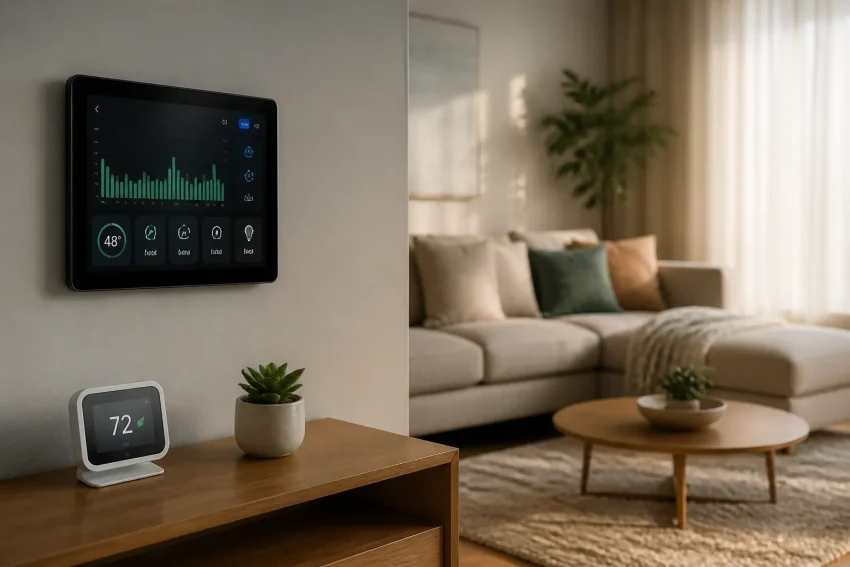
Your home uses energy around the clock, but most of it slips through the cracks without you noticing. Home energy management systems give you visibility and control over every watt, turning invisible waste into measurable savings. Lifee, a French leader in AI-powered home automation, builds intelligent systems that learn your routines and optimize energy use automatically, whether you’re a homeowner looking to cut bills or a business managing multiple properties.
This guide walks you through the essentials: what these systems actually do, how to choose the right setup for your space, and the first practical steps to take control of your energy footprint.
What Is a Home Energy Management System?
A home energy management system, or HEMS, combines monitoring, connected devices, software, and automated controls to help a household understand and optimize its energy use. Unlike a basic energy monitor that only displays consumption, a HEMS can respond to data by adjusting heating, scheduling appliances, coordinating electric vehicle charging, or directing solar energy toward a battery or household load.
The definition varies across the industry. Some providers use HEMS to describe a broad smart-home platform, while others reserve the term for a system built around solar photovoltaic generation, battery storage, and an app or web portal. In practice, beginners should focus less on the label and more on the system’s ability to measure consumption, control equipment, and make decisions that match household priorities.
Why HEMS Matter in 2026
Home energy management is moving from a niche technology to part of the wider shift toward electrified, connected homes. Market estimates differ because research firms use different definitions, but recent forecasts consistently indicate strong growth. One 2025 estimate valued the global HEMS market at $5.8 billion in 2024 and projected $21.7 billion by 2034, representing a 13.8% compound annual growth rate. Another estimate placed the market at $3.8 billion in 2025 and forecast $9.54 billion by 2031, with a 16.58% compound annual growth rate.
Those figures do not mean every home needs a complex installation. They show that energy management is increasingly connected to solar panels, batteries, heat pumps, dynamic electricity tariffs, and electric vehicles. Lifee’s role is to make that complexity practical through AI-powered automation, custom energy-efficiency solutions, and interfaces designed around everyday users.
Energy Efficiency Without Sacrificing Comfort
A HEMS can identify when a water heater, heat pump, or electric vehicle charger is using the most power and then coordinate operation with household routines, energy prices, weather conditions, or solar production. For example, a system may preheat a home before residents return, pause nonessential loads during an expensive tariff period, and resume them when lower-cost electricity becomes available.
The goal is not simply to use less energy at any cost. Effective management reduces waste while preserving comfort, safety, and convenience.
Smart Home Technology Basics
A HEMS connects equipment that can measure or influence energy use. Depending on the installation, this may include a smart meter, circuit-level sensors, thermostats, smart plugs, heat pumps, appliances, solar inverters, batteries, EV chargers, occupancy sensors, and weather services.
- One dashboard: A central app or web interface brings consumption, production, storage, and equipment status together. This makes it easier to spot an unusual load, compare days, and verify whether an automation rule is working.
- Rules and schedules: The system can run devices at selected times or under selected conditions. A dishwasher might start after a solar production threshold is reached, while an EV charger waits for a cheaper tariff.
- Adaptive control: More advanced platforms learn patterns instead of relying only on fixed schedules. Lifee can combine user preferences, sensor data, weather information, and operational goals to support contextual automation.
How Home Energy Management Systems Work
A HEMS follows a continuous loop: measure what is happening, interpret the information, choose an action, and check the result. The quality of the outcome depends on accurate data, compatible equipment, sensible priorities, and safeguards that prevent automation from reducing comfort or creating unsafe conditions.
Core Components of a HEMS
- Energy meter and sensors: Whole-home meters show total electricity use, while circuit-level sensors can reveal the contribution of heating, hot water, cooking, or charging. More detailed measurement helps identify persistent loads that a monthly bill cannot explain.
- Connected equipment: Smart thermostats, heat pumps, plugs, appliances, batteries, solar inverters, and EV chargers provide the control points. Compatibility should be checked before purchase because a device that can be monitored may not be capable of automated control.
- Communication layer: Wi-Fi, Zigbee, Z-Wave, Bluetooth, Ethernet, Thread, and other protocols allow devices to exchange information. Wi-Fi represented the largest technology share in one 2025 market analysis, while other standards may be preferable where reliability, low power use, or local control is more important.
- Management platform: The software presents dashboards, alerts, schedules, reports, and automation settings. A good platform should explain why an action occurred rather than making the user guess which rule changed a device.
- Optional energy assets: Solar generation, batteries, backup power, and EV charging add more opportunities for optimization. They also increase the need for careful commissioning because energy flows become bidirectional and more complex.
The Role of AI and Intelligent Automation
AI can identify patterns that are difficult to manage manually. It may learn when occupants usually arrive, estimate heating needs from weather conditions, recognize an abnormal consumption pattern, or select a charging period that balances cost, battery health, solar availability, and departure time.
- Forecasting: The system can estimate future demand from historical consumption, weather, occupancy signals, and planned activities. Forecasting helps prevent unnecessary heating or cooling while ensuring the home reaches a comfortable temperature on time.
- Load shifting: Flexible appliances can operate when electricity is cheaper or when renewable production is available. This is particularly useful for water heating, laundry, dishwashing, battery charging, and EV charging.
- Solar and battery coordination: When solar panels generate electricity, a HEMS can prioritize immediate household use, charge a battery, heat water, or charge an EV according to the owner’s goals. The system can also reduce grid imports during high-cost periods.
- Anomaly detection: A sudden increase in baseload consumption may indicate a faulty appliance, a device left running, or an unexpected operating condition. Early alerts can help prevent wasted energy and reveal maintenance needs.
| HEMS capability | What it measures or controls | Beginner example |
|---|---|---|
| Monitoring | Total or circuit-level electricity use | Identify whether heating or hot water drives the evening peak |
| Scheduling | Time-based operation of compatible devices | Run a dishwasher during a lower-cost period |
| Demand response | Automatic adjustment during price or grid events | Temporarily reduce flexible loads without affecting essential services |
| Energy coordination | Solar, battery, EV, heating, and household demand | Use midday solar production to charge an EV or heat water |
What Benefits Can You Expect?
Lower Bills Through Visibility and Timing
A HEMS does not guarantee a fixed percentage of savings because results depend on the home, tariff, climate, equipment, and user behavior. It can, however, make savings opportunities visible and repeatable. A household may discover that a storage heater runs during an expensive period, that a second refrigerator creates a constant load, or that an EV is charging before cheaper electricity begins.
Claims such as universal 10% to 20% savings or double-digit reductions should therefore be treated as scenarios rather than promises. A credible assessment should establish a baseline, measure results over comparable periods, and separate HEMS savings from changes caused by weather, occupancy, tariffs, or insulation work.
More Comfort With Less Manual Control
Automation can coordinate heating, cooling, ventilation, lighting, and hot water around occupancy and preferences. Instead of asking residents to remember every schedule, the system can maintain comfort while reducing operation during periods when rooms are empty.
Lifee’s AI-powered approach is intended to support this kind of contextual automation. A system can learn that a household usually wakes early on weekdays, then prepare the home close to the required time rather than heating it at full comfort level throughout the night.
Better Use of Renewable Energy
Solar panels produce energy according to weather and daylight, not household demand. A HEMS helps align flexible loads with production so more locally generated energy can be consumed on site. This can be valuable for households with solar panels, batteries, heat pumps, or EVs, particularly when export payments are lower than the value of avoiding grid purchases.
Operational Insight for Property Professionals
For landlords, property managers, and businesses, aggregated dashboards can reveal recurring issues across multiple homes or buildings. A portfolio manager might identify properties with unusually high overnight baseloads, inconsistent heating schedules, or equipment that needs inspection. Lifee’s custom project design can support both individual homes and larger property-management requirements.
- Households: Use the system to understand bills, automate comfort, and coordinate flexible appliances.
- Businesses: Track operational patterns, prioritize high-impact loads, and standardize energy routines across sites.
- Real estate professionals: Combine energy data with maintenance and occupancy insights to improve property performance and tenant experience.
Recent Adoption Signals and Market Context
Recent industry data helps put the technology’s momentum into perspective, although market estimates should not be treated as directly comparable because definitions and measurement methods vary.
- $5.8 billion in 2024: One 2025 industry forecast estimated the global HEMS market at $5.8 billion in 2024 and projected $21.7 billion by 2034. The forecast linked growth to smart-home adoption, electrification, and sustainability priorities.
- 16.58% projected annual growth: Another market analysis estimated a $3.8 billion market in 2025 and forecast a 16.58% compound annual growth rate through 2031. Its segmentation included hardware, software, services, residential users, commercial users, and cloud or local deployment.
- 6 million systems in Europe and North America: A 2026 report summarizing Berg Insight research estimated approximately 5.1 million HEMS installed in European homes and 850,000 in North American homes at the end of 2025.
- 1.3 million European additions in 2025: The same report estimated that about 1.3 million systems were added to the European installed base during 2025, including new solar-and-battery installations and batteries added to existing solar systems.
- 19.4% European growth outlook: European HEMS installations were projected to reach 12.5 million by the end of 2030, representing an estimated 19.4% compound annual growth rate under that report’s definition.
- 0.7% North American household penetration: The report estimated that about 0.7% of North American houses and multi-dwelling units had a HEMS installed at the end of 2025, indicating substantial room for adoption but also showing that the technology remains early-stage in many homes.
- Hardware remains central: A separate 2025 market estimate reported that hardware represented about 56.6% of HEMS revenue, while other analyses identified hardware as the largest component and software as one of the fastest-growing segments.
For a beginner, the practical conclusion is straightforward: the market is expanding, but product definitions differ. Compare the actual functions, integrations, privacy controls, and support model instead of choosing a system based only on a market-size claim.
Getting Started: A Practical Beginner’s Roadmap
Step 1: Establish an Energy Baseline
Collect at least several months of bills and note seasonal changes, occupancy, heating type, major appliances, solar production, and EV charging. Look for the highest-cost periods and the largest controllable loads rather than trying to optimize every small device.
- Start with bills: Record total consumption, billing periods, tariff structure, and fixed charges. This prevents confusion between lower energy use and a bill that changed because of pricing or fees.
- Identify flexible loads: Heating, hot water, laundry, dishwashing, batteries, and EV charging usually offer more practical control than always-on electronics. Prioritize loads that can move in time without affecting safety or essential comfort.
- Define success: Choose measurable goals such as reducing peak-period consumption, increasing solar self-consumption, maintaining a temperature range, or receiving an alert when baseload rises unexpectedly.
Step 2: Choose the Right System Scope
A basic monitoring setup may be enough for a small apartment, while a home with solar, a battery, a heat pump, or an EV may benefit from coordinated control. Ask whether the platform supports the equipment already installed and whether it can expand as new assets are added.
| System type | Best starting point | Questions to ask |
|---|---|---|
| Monitoring-focused | Households that need visibility before automating | Does it provide whole-home data, circuit detail, alerts, and exportable reports? |
| Device automation | Homes with compatible thermostats, plugs, or appliances | Can schedules be overridden easily, and does the platform confirm actions? |
| Solar and battery coordination | Homes generating or storing electricity | Can it prioritize self-consumption, backup reserves, tariffs, and battery limits? |
| AI-powered custom system | Complex homes, portfolios, or users seeking managed optimization | How are data, models, cybersecurity, support, and custom rules handled? |
Lifee is positioned for households, businesses, and real estate professionals that need more than isolated smart devices. Its offering combines AI-powered automation, intelligent energy audits, predictive management, contextual control, custom project design, and cybersecurity considerations.
Step 3: Confirm Compatibility and Installation Requirements
Before purchasing, list the brand and model of your meter, inverter, battery, heat pump, thermostat, EV charger, and other devices you want to control. Check whether the integration is official, whether it supports two-way control, and whether it requires a cloud account, gateway, electrician, or subscription.
Electrical work involving distribution boards, high-current circuits, batteries, or EV chargers should be assessed by a qualified professional. A guided app setup can be beginner-friendly, but safe installation and correct commissioning remain essential.
Step 4: Configure Conservative Automations
Begin with one or two low-risk rules. For example, schedule an EV to charge within a preferred price window or set a smart plug to switch off a nonessential device after a defined period. Keep manual overrides available and avoid automating essential medical, safety, refrigeration, or heating functions without appropriate safeguards.
Step 5: Review Results Monthly
After four to eight weeks, compare consumption with a weather- and occupancy-adjusted baseline where possible. Check whether comfort changed, whether devices responded reliably, and whether savings came from automation or from unrelated factors. Then refine one setting at a time.
Lifee’s Approach to Intelligent Energy Management
Lifee is a French company specializing in intelligent technology for energy efficiency and home automation. Its approach combines sustainable innovation, intuitive automation, AI-powered systems, custom energy-efficiency solutions, and technology designed to serve people rather than overwhelm them.
From Energy Audit to Contextual Automation
A useful project begins with understanding the building, equipment, occupants, tariff, and energy objectives. Lifee can use intelligent audits and connected data to identify opportunities, then design automation around the property’s actual needs. This matters because a rule that works in a well-insulated family home may not suit a multi-unit property, a holiday rental, or a business site.
Supporting Homes, Businesses, and Property Portfolios
For a homeowner, the priority may be comfort and lower bills. For a business, it may be operational cost control and reporting. For a real estate professional, it may be consistent performance across properties and better visibility into maintenance needs. Lifee’s custom project design allows the energy-management strategy to reflect those different goals rather than forcing every user into the same configuration.
Specific savings should be validated on a property-by-property basis. The original claim that Lifee households can save up to 25% within the first year should be treated as a potential project outcome, not a universal guarantee, unless it is supported by a documented baseline, methodology, and independently verifiable results.
Security, Privacy, and Resilience
Energy Data Can Reveal Household Routines
Consumption patterns may indicate occupancy, sleeping hours, travel, or the use of particular appliances. A provider should explain what information is collected, why it is needed, where it is processed, how long it is retained, and whether it is shared with third parties.
Use Local Control Where Appropriate
Cloud services can support remote access and advanced analytics, but local processing may reduce dependence on an external connection and keep selected automations running during an internet outage. Ask which features continue to work offline and how the system behaves if a service is unavailable.
Check Basic Cybersecurity Practices
- Account protection: Use unique passwords and multi-factor authentication where available. Separate household accounts from installer or property-manager access so permissions match each person’s role.
- Software maintenance: Confirm that the provider delivers security updates for the gateway, app, integrations, and connected devices. An unsupported device can become the weakest point in an otherwise well-designed system.
- Data governance: Review consent, deletion, export, and access controls before connecting occupancy sensors or detailed circuit monitoring. Lifee’s cybersecurity positioning should be evaluated through its specific technical documentation and contractual privacy terms.
- Safe failure modes: Make sure heating, refrigeration, alarms, medical equipment, and other essential services continue safely if automation fails. Energy savings should never depend on disabling necessary protection.
Frequently Asked Questions
How Much Does a HEMS Cost?
There is no single reliable price because a HEMS may mean a monitoring device, a connected-home controller, or a larger solar-and-battery system. The total depends on sensors, gateways, compatible devices, electrical work, software services, and professional design. Request a complete quote that separates hardware, installation, subscriptions, maintenance, and optional integrations.
Can a HEMS Work With Existing Devices?
Often, but compatibility must be verified by model rather than assumed from a general reference to Wi-Fi, Zigbee, Z-Wave, Bluetooth, or another protocol. A device may be visible in an app without supporting the control functions required for automation.
Does a HEMS Require Solar Panels or a Battery?
No. A HEMS can begin with monitoring, heating control, smart plugs, or appliance scheduling. Solar panels and batteries create additional optimization opportunities, but they are not prerequisites for learning how a home uses energy.
Will a HEMS Guarantee Energy Savings?
No system can guarantee a fixed result for every property. Savings depend on baseline consumption, equipment, weather, tariffs, automation settings, and household behavior. Use a measured baseline and review results over time rather than relying only on advertised percentages.
Is Professional Installation Necessary?
Simple monitoring devices and compatible smart plugs may be suitable for guided installation. Work involving electrical panels, batteries, heat pumps, or EV chargers should be assessed and installed according to local requirements by qualified professionals.
What Happens If the Internet Goes Down?
The answer depends on the architecture. Some systems can continue local schedules and safety controls, while cloud-dependent functions may pause. Confirm offline behavior before installation, especially if the HEMS controls heating, charging, storage, or other important equipment.
Taking the First Step Toward Smarter Energy Management
A home energy management system can turn an opaque electricity bill into a practical set of decisions. Begin with a baseline, identify one high-impact controllable load, confirm compatibility, and select a platform that balances automation with transparency, safety, privacy, and human support.
Lifee offers a relevant path for households, businesses, and real estate professionals seeking AI-powered automation, intelligent energy audits, predictive management, custom project design, and cybersecurity-conscious home technology. The strongest result will come from matching those capabilities to a clearly defined property goal rather than adopting automation for its own sake.
With the right setup and measured follow-through, HEMS can help reduce waste, improve comfort, coordinate renewable energy, and make everyday energy decisions easier to manage.