
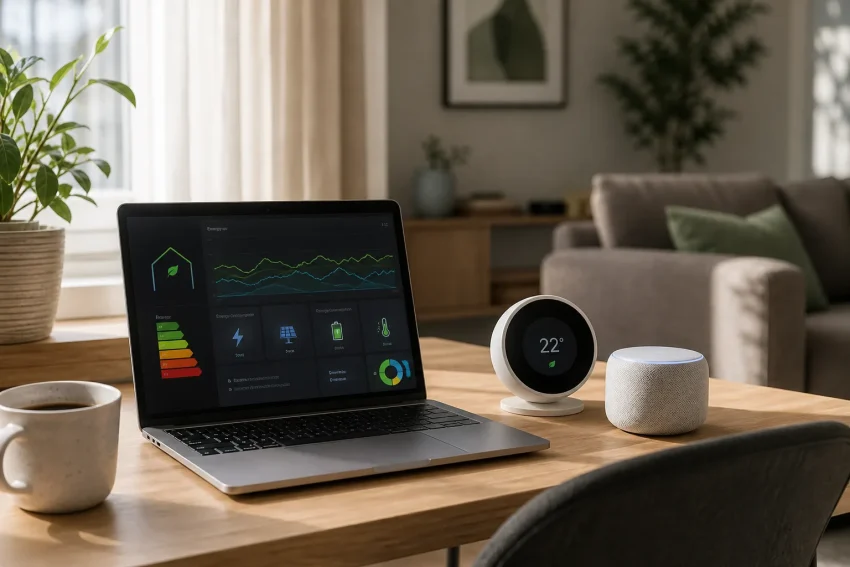
Your energy bills keep climbing while smart home promises gather dust in half-configured apps. The gap between what automation could do and what it actually delivers has never been wider, and most solutions either overwhelm you with complexity or underwhelm with results that don’t justify the investment.
Lifee bridges that divide with AI-powered systems that learn your patterns and optimize energy use automatically, whether you’re managing a single home or an entire commercial portfolio. This guide walks you through how intelligent automation transforms energy efficiency from a manual chore into a seamless background process, delivering measurable savings without constant tinkering.
Introduction to Artificial Intelligence Solutions
Artificial intelligence solutions use advanced algorithms, sensor data, software integrations, and automated controls to perform tasks that traditionally require human judgment. In an energy setting, the system can compare occupancy, weather, indoor temperature, equipment performance, and electricity prices before deciding how to operate heating, cooling, lighting, or appliances.
In 2026, the most valuable solutions are not simply chatbots or isolated smart devices. They connect data to specific outcomes, such as reducing peak demand, maintaining comfort, identifying abnormal consumption, or warning about equipment that may fail. The International Energy Agency identifies building applications including HVAC optimization, adaptive lighting, predictive maintenance, and demand response as important areas where AI can improve energy efficiency.
- From rules to learning: Traditional automation follows fixed instructions, while AI can identify recurring patterns and adjust its recommendations as conditions change. A heating schedule can therefore respond to actual occupancy instead of assuming that every weekday follows the same routine.
- From isolated devices to connected systems: The greatest gains often come from coordinating thermostats, blinds, meters, lighting, ventilation, batteries, and security sensors. Lifee’s custom approach is designed to connect these layers so that one decision supports several objectives at once.
- From activity to outcomes: A solution should be judged by measurable results, including kilowatt-hours avoided, peak demand reduced, comfort maintained, alerts resolved, and maintenance costs prevented. Clear baselines make it possible to distinguish genuine improvement from normal seasonal variation.
What Are Artificial Intelligence Solutions?
At their core, artificial intelligence solutions combine machine learning, data analysis, predictive models, and automated controls to recognize patterns, detect anomalies, and recommend or perform actions. A smart thermostat may learn when occupants usually arrive, while a building platform may compare weather forecasts with occupancy data to precondition only the spaces that need it.
Why AI Matters in 2026
AI now has a dual relationship with energy. It can increase electricity demand through data centers, but it can also help buildings and energy systems use power more efficiently. The IEA projects that global data-center electricity demand could more than double by 2030 to approximately 945 terawatt-hours, making efficiency, flexible demand, and responsible system design increasingly important.
This makes energy-aware AI especially relevant. A well-designed platform does not merely automate more devices. It balances comfort, cost, carbon intensity, equipment health, and grid conditions, while preserving human control when decisions involve safety or unusual circumstances.
Key Applications: Energy Efficiency and Home Automation
AI-driven automation is making practical improvements in homes, workplaces, retail sites, and real estate portfolios. The strongest applications combine reliable data with carefully limited automation, allowing systems to respond quickly without turning every decision into a technical project.
AI-Powered Home Automation
Lifee’s AI-powered home automation goes beyond timers and programmable thermostats. It can coordinate temperature, lighting, blinds, ventilation, appliances, and security according to routines, indoor conditions, weather, and user preferences. When afternoon sunlight warms a living room, for example, the system can close blinds before cooling demand rises, then restore the preferred setting when the space becomes occupied.
- Comfort-aware climate control: The system can use occupancy, temperature, humidity, and weather information to avoid heating or cooling empty rooms while protecting comfort when people are present. Users should define acceptable temperature ranges rather than forcing the system to chase a single fixed number.
- Adaptive lighting and shading: Occupancy sensors and daylight readings can reduce unnecessary lighting and coordinate blinds with cooling demand. This is particularly useful in rooms where sunlight changes rapidly throughout the day and manual adjustments are often forgotten.
- Relevant security alerts: Pattern recognition can help distinguish normal movement, such as a pet or a regular arrival, from an unusual event. Lifee can combine security data with home context so that users receive fewer low-value notifications and can focus on situations that genuinely require attention.
The original article cites potential Lifee savings of 15 to 30 percent in some homes. That figure should be treated as a project-specific range rather than a universal guarantee, because results depend on building quality, climate, equipment, occupancy, baseline consumption, and the quality of the installation. A before-and-after measurement plan is essential for validating the result.
Intelligent Energy Audits and Predictive Management
Traditional audits provide valuable snapshots, but AI can analyze consumption continuously. Lifee’s intelligent energy audit approach can compare meter data with equipment schedules, occupancy, weather, and operating hours to reveal waste that may be invisible in a short inspection.
- Load disaggregation: Detailed consumption patterns can help separate heating, cooling, refrigeration, lighting, and plug loads. This gives a facilities manager a practical starting point, such as investigating a refrigeration circuit that continues drawing power overnight.
- Forecasting and scheduling: Predictive models can estimate tomorrow’s demand and prepare spaces before occupancy rather than running systems at full output all day. Businesses can also schedule flexible processes outside expensive peak periods when tariffs or grid signals support that approach.
- Predictive maintenance: Gradual changes in runtime, temperature, vibration, or power draw may signal declining equipment performance. Early intervention can reduce downtime, protect assets, and prevent an inefficient system from quietly increasing energy costs for months.
The IEA notes that AI can use sensor data and weather forecasts to adjust HVAC in real time, improve lighting control, predict equipment failures, and support demand-response programs. These applications work best when meters are accurate, sensor coverage is adequate, and operators can review the reasons behind important recommendations.
Contextual and Custom Automation
Contextual automation adapts to circumstances instead of applying a rigid schedule. If a meeting runs late, a store remains open beyond its normal hours, or an unexpected gathering changes occupancy, the system can maintain comfort and security until the space is genuinely empty.
- Small businesses: A shop can align lighting, ventilation, and temperature with opening hours, customer density, and delivery schedules. Starting with one site makes it easier to quantify savings and refine rules before extending the approach to additional locations.
- Commercial buildings: A building platform can prioritize occupied zones, respond to weather changes, and coordinate HVAC with blinds and ventilation. This avoids the common problem of running an entire floor at the same intensity when only a small area is being used.
- Real estate portfolios: Property managers can compare buildings using normalized metrics such as consumption per square meter, peak demand, comfort complaints, and maintenance events. Lifee’s centralized approach can support site-specific rules while giving decision-makers a consistent portfolio view.
| Application | Useful data | Practical outcome | Success metric |
|---|---|---|---|
| Climate optimization | Occupancy, weather, temperature, HVAC runtime | Comfort with less unnecessary heating or cooling | Energy use, runtime, comfort complaints |
| Adaptive lighting | Occupancy, daylight, schedules | Lower lighting consumption without dark or unsafe areas | Lighting kWh and occupancy-adjusted consumption |
| Predictive maintenance | Power draw, alerts, runtime, equipment readings | Earlier intervention and fewer breakdowns | Fault frequency, downtime, maintenance cost |
| Demand response | Tariffs, grid signals, forecast load, flexible equipment | Reduced peak demand and greater energy flexibility | Peak kW, peak-period cost, shifted load |
Benefits and Challenges of Implementing AI Solutions
Adopting artificial intelligence solutions can reduce waste and improve resilience, but value depends on implementation quality. A system that produces impressive dashboards without accurate data, clear ownership, or measurable targets can create more complexity rather than less.
Key Benefits: Cost, Sustainability, and Security
- Cost reduction: Automatic adjustments can reduce avoidable heating, cooling, lighting, and standby consumption. The financial case becomes stronger when the platform also lowers peak demand or identifies equipment that is operating inefficiently.
- Sustainability: AI can align flexible consumption with renewable generation or lower-carbon periods, helping organizations reduce emissions without relying only on manual behavior changes. The environmental result should be measured using local grid data and transparent calculation methods.
- Operational efficiency: Continuous monitoring gives teams a prioritized list of issues instead of requiring staff to inspect every meter and device manually. Lifee can translate technical signals into practical actions for homeowners, operators, and property managers.
- Security and resilience: Anomaly detection can flag unusual access, water leaks, device behavior, or energy patterns. Cybersecurity should be treated as an ongoing operating requirement, with strong authentication, software updates, network segmentation, access logging, and a clear incident process.
Overcoming Implementation Challenges
- Technical integration: Older buildings often contain equipment from different manufacturers with inconsistent protocols. A provider should document compatibility, identify gateway requirements, and test fail-safe behavior before connecting automation to critical systems.
- Data privacy: Occupancy and behavioral data can reveal sensitive information about residents and employees. Collect only what is necessary, define retention periods, restrict access by role, and explain clearly how data is used.
- Model reliability: AI can produce incorrect predictions when sensors fail, routines change, or unusual events occur. Human override, confidence thresholds, alerts for missing data, and periodic review prevent automation from becoming blindly autonomous.
- Change management: Occupants and staff need to understand what the system controls and how to report problems. Adoption improves when people can see comfort and savings results instead of experiencing unexplained changes to their environment.
Lifee’s custom project design is particularly relevant where integration, privacy, and user expectations must be handled together. The goal is not to automate everything immediately, but to create a dependable system that earns trust through visible performance.
Responsible AI, Cybersecurity, and Energy Transparency
Energy automation increasingly intersects with regulation and responsible technology. In the European Union, the AI Act became applicable on 2 August 2026, with some provisions following separate timelines. The European Commission also states that transparency requirements for certain AI systems begin applying from that date.
Privacy by Design for Connected Spaces
A responsible deployment separates essential energy signals from unnecessary personal information. For example, a system may need room occupancy status without storing identifiable footage or a detailed record of every individual’s movements. Lifee projects should define data ownership, access rights, retention, deletion, and third-party processing before installation.
Human Oversight and Safe Fallbacks
AI should recommend or control energy settings within boundaries established by people. Manual overrides, local controls, emergency modes, and fallback schedules are important when connectivity fails, weather changes sharply, or an automation decision conflicts with health, safety, or business requirements.
Measuring the Energy Cost of AI
AI solutions should be assessed by net benefit, not only by the savings they create in a building. The IEA highlights the growing electricity requirements of data centers and the need to consider AI’s wider energy impact. Efficient models, local processing where appropriate, selective data collection, and transparent reporting help ensure that the automation layer supports rather than undermines sustainability goals.
How to Choose and Customize the Right AI Solution
With many artificial intelligence solutions available in 2026, selection should begin with the operational problem rather than the most fashionable technology. A useful evaluation connects the property’s baseline, desired outcomes, technical environment, security requirements, and long-term support plan.
Evaluating AI Solution Providers
- Evidence and expertise: Ask for comparable use cases, measurement methods, commissioning procedures, and realistic assumptions about savings. A credible provider explains where performance may vary instead of presenting every project as identical.
- Integration and interoperability: Confirm whether the platform supports existing meters, HVAC controls, lighting systems, security devices, and building-management protocols. Open interfaces and documented export options reduce the risk of being locked into one vendor.
- Security and governance: Review authentication, encryption, patching, monitoring, incident response, data residency, and user permissions. For European deployments, ask how the provider approaches applicable AI Act transparency and documentation requirements.
- Measurement and support: Select a provider that defines baseline periods, normalizes for weather and occupancy, and reports results in language decision-makers can use. Lifee’s ongoing support can connect technical performance with practical energy and automation goals.
Personalizing AI for Homes, Businesses, and Real Estate
The same artificial intelligence solution should not behave identically in a family home, a retail location, and a multi-building portfolio. Lifee uses LLM automation and custom project design to align actions with individual routines, operating constraints, comfort preferences, and sustainability objectives.
- Homes: Prioritize comfort, privacy, simple controls, and gradual learning. Residents should be able to approve new behaviors, pause automation, and understand why a temperature or lighting change occurred.
- Businesses: Connect automation to opening hours, production schedules, staffing, tariffs, and safety procedures. A small pilot can reveal whether savings come from better schedules, equipment faults, or changes in occupancy.
- Real estate: Combine portfolio-level benchmarking with site-level customization. Managers can identify underperforming properties while preserving the distinct comfort, tenant, and equipment requirements of each building.
From Pilot to Portfolio: A Practical Deployment Roadmap
Successful AI adoption is usually a process rather than a single installation. A structured rollout limits risk, produces trustworthy evidence, and gives users time to adapt before automation reaches more critical systems.
Establish a Reliable Baseline
Collect energy bills, interval meter data, equipment schedules, occupancy patterns, comfort feedback, and maintenance records before changing controls. The baseline should cover enough operating conditions to distinguish genuine savings from weather, seasonal, or occupancy effects.
Prioritize High-Value, Low-Risk Actions
Begin with actions such as occupancy-based lighting, schedule optimization, abnormal consumption alerts, or recommendations for maintenance. These use cases can demonstrate value without immediately handing full control of critical equipment to an unfamiliar model.
Verify Results and Expand Carefully
Compare performance against the baseline using consistent metrics, then review exceptions with occupants and operators. Once the pilot is stable, Lifee can help extend the system to additional zones, devices, buildings, demand-response functions, or predictive maintenance workflows.
| Deployment stage | Primary question | Deliverable |
|---|---|---|
| Discover | What problem is costing the most or creating the greatest operational burden? | Prioritized use-case and data assessment |
| Baseline | What does normal performance look like? | Energy, comfort, occupancy, and maintenance benchmarks |
| Pilot | Can automation improve the target without creating new risks? | Limited deployment with human oversight |
| Verify | Are the results repeatable and financially meaningful? | Performance report and improvement plan |
| Scale | Which additional locations or systems should be connected? | Phased expansion with governance and support |
The Future of AI Solutions: Sustainable Innovation with Lifee
The next generation of artificial intelligence solutions will be judged by more than how intelligently they automate. They will need to be efficient, explainable, secure, interoperable, and useful to people who do not want to manage technology all day.
Lifee’s Vision for AI-Powered Living
Lifee combines sustainable innovation, intuitive automation, and technology serving humanity. Its French approach focuses on custom energy-efficiency solutions for individuals, businesses, and real estate professionals, with AI-powered systems designed around actual environments rather than generic assumptions.
This human-centered model keeps people involved in goals, boundaries, and decisions while allowing automation to handle repetitive adjustments. The result is a practical balance between lower consumption, everyday comfort, cyber-security, and confidence in how the system operates.
Getting Started: Next Steps for Individuals and Businesses
The first step is a focused assessment of energy use, equipment, routines, data quality, and desired outcomes. Lifee can then design a tailored roadmap, identify suitable integrations, establish a baseline, and recommend a pilot that can be measured before wider deployment.
- For homeowners: Begin with comfort, energy visibility, and privacy requirements, then select automation that can be paused or adjusted easily. A clear explanation of system behavior is as important as the hardware itself.
- For businesses: Link the project to operating costs, peak demand, maintenance, and staff workload. Define who owns the results and who is authorized to override controls before the pilot begins.
- For property professionals: Standardize portfolio metrics while allowing each building to retain its own schedules, equipment logic, tenant expectations, and regulatory requirements.
Frequently Asked Questions
What are artificial intelligence solutions in energy management?
They are systems that use data, predictive models, and automated controls to improve how energy equipment operates. Examples include occupancy-aware HVAC, adaptive lighting, demand forecasting, anomaly detection, and predictive maintenance.
Can AI reduce energy consumption without reducing comfort?
It can, when the system uses reliable occupancy and environmental data, defines acceptable comfort ranges, and includes human override. Results vary by building condition, equipment, climate, behavior, and implementation quality, so savings should be verified against a baseline.
Are AI-powered home automation systems secure?
Security depends on the full solution, not simply on the presence of AI. Strong authentication, encrypted communications, timely updates, segmented networks, least-privilege access, monitoring, and a tested incident response process are essential.
Is AI suitable for older buildings?
Many older buildings can benefit from retrofit solutions using meters, gateways, sensors, and compatible controls. A technical survey should identify communication protocols, equipment condition, wiring constraints, and safe fallback options before deployment.
How should an organization measure an AI project?
Track energy consumption, peak demand, cost, carbon impact, comfort, alerts, equipment runtime, maintenance events, and user satisfaction. Normalize results for weather, occupancy, and operating hours so that the comparison reflects actual performance.
Artificial intelligence solutions are no longer a futuristic dream. In 2026, they are practical tools for smarter energy use, predictive maintenance, security, and seamless everyday automation when they are deployed with reliable data and clear human oversight.
Lifee brings these capabilities together through sustainable, human-centric systems for homes, businesses, and real estate portfolios. Explore Lifee’s AI-powered offerings or connect with a specialist to develop a measured automation roadmap that improves energy performance, comfort, and long-term resilience.