
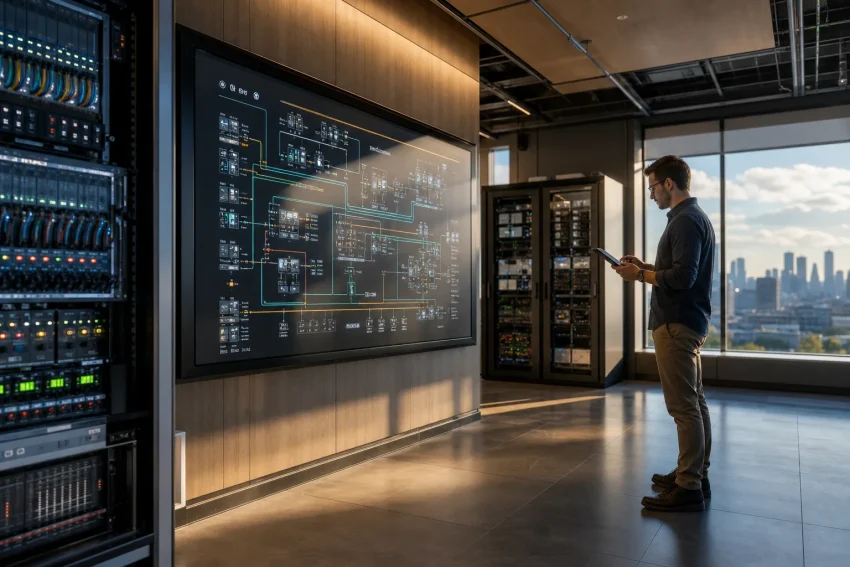
You’ve invested in top-tier HVAC, lighting, and security systems, but they refuse to talk to each other. Multi-vendor building automation creates silos that drain efficiency, inflate costs, and frustrate your team daily. The promise of smart buildings falls apart when proprietary protocols lock you into fragmented control.
Lifee tackles this exact challenge by designing AI-powered automation systems that unify equipment from different suppliers into one intelligent ecosystem, delivering real energy efficiency without ripping out your existing infrastructure. This guide walks you through proven interoperability strategies, protocol translation methods, and integration frameworks that turn incompatible devices into a cohesive, high-performing building automation network.
Understanding Building Automation Interoperability in 2026
Defining Interoperability
Building automation interoperability means that devices, controllers, software platforms, and operational teams can exchange reliable data and act on it consistently, even when the equipment comes from different suppliers. A connected building is not automatically an interoperable building. True interoperability requires compatible communications, consistent data models, usable command structures, synchronized time, and clearly defined responsibilities when one system changes state.
For example, an occupancy signal should do more than appear on a dashboard. It should be usable by the HVAC system to reduce ventilation when appropriate, by lighting controls to switch zones safely, and by access or security systems to provide context without exposing unnecessary personal information. The goal is a coordinated operating model rather than a collection of isolated interfaces.
Why It Matters Now
Interoperability has become a practical investment issue, not merely a technical preference. The global smart building market was estimated at USD 141.8 billion in 2025 and is projected to reach USD 554 billion by 2033, with a forecast compound annual growth rate of 18.9 percent from 2026 to 2033. As more buildings add connected controls, owners need architectures that can absorb new equipment without repeating costly integration work.
Adoption is already widespread, but deployment does not guarantee useful coordination. A recent industry survey found that 91 percent of respondents had smart devices, systems, or software in their facilities, while HVAC and climate-control systems led adoption at 68 percent. This creates a familiar situation: a building may have connected equipment everywhere, yet lack the shared data and control logic needed to optimize the whole site.
- Measure functional interoperability. Confirm that systems can exchange validated data and execute coordinated actions, rather than merely confirming that devices are visible on a network.
- Design for change. Use documented interfaces, portable data models, and replaceable gateways so future upgrades do not depend on one supplier.
- Define operational ownership. Decide who approves control sequences, manages credentials, validates alarms, and maintains integrations after commissioning.
Just plugging devices together will not deliver reliable automation. The integration must also resolve units, naming conventions, time zones, command priorities, alarm meanings, device states, and failure behavior. Once these details are designed deliberately, building automation can operate as a coordinated system while preserving the equipment already in place.
Key Standards and Protocols: BACnet, KNX, Modbus, and Beyond
Overview of Major Protocols
BACnet, KNX, and Modbus remain central to multi-vendor building automation, but they serve different layers and use cases. Selecting a protocol is less important than defining where each protocol belongs and how the integration layer will preserve meaning as data moves between them.
| Protocol | Typical role | Strengths | Integration considerations |
|---|---|---|---|
| BACnet | HVAC, plant systems, supervisory control, alarms, and schedules | Vendor-neutral object model, broad building-services support, and strong suitability for multi-vendor BMS environments | Check device profiles, object properties, writable points, alarm behavior, and BACnet Testing Laboratories certification where applicable |
| KNX | Room automation, lighting, blinds, fan-coil control, and distributed devices | Open multi-manufacturer ecosystem and decentralized field control | Map group addresses, datapoint types, priorities, and gateway behavior before exposing values to a supervisory platform |
| Modbus | Meters, drives, plant equipment, generators, and legacy controllers | Simple, widely deployed, and practical for industrial and retrofit applications | Document register meaning, scaling, signed values, byte order, polling limits, and read-only versus writable access |
| DALI and lighting interfaces | Digital lighting control, scenes, dimming, and emergency-lighting functions | Purpose-built control for lighting devices and room-level experiences | Coordinate scenes and occupancy logic with the BMS while preserving local safety and manual override behavior |
BACnet Requires More Than a Network Connection
BACnet can provide an effective foundation for multi-vendor HVAC integration, but compatibility depends on implementation details. A device may communicate successfully while exposing incomplete objects, inconsistent units, limited write access, or proprietary alarm behavior. During procurement, request the protocol implementation statement, supported services, object lists, point schedules, and a clear description of which commands the integrator may safely issue.
Gateway Design for KNX and Modbus
In a layered architecture, KNX and Modbus devices can connect through dedicated gateways to a BACnet/IP or broader integration platform. The gateway should not simply copy values. It should translate units, retain quality and timestamp information, map command priorities, generate meaningful object names, and define what happens when communication is interrupted.
A useful test is to follow one point from the field device to the analytics platform and back again. If a temperature value loses its unit, timestamp, quality state, or writable status during translation, the connection may be technically active but operationally unreliable.
The Shift Toward Open and Semantic Standards
Open protocols address communication, while semantic models address meaning. Project Haystack and Brick Schema can describe relationships such as the connection between a room, its occupancy sensor, its air-handling unit, and its lighting zone. This additional context allows analytics and AI systems to understand that differently named points represent related assets and functions.
Semantic tagging also reduces the cost of future projects. Instead of manually interpreting every new point, an integration platform can identify equipment types, locations, relationships, units, and control capabilities. Lifee can use this harmonized information to support contextual automation, intelligent energy audits, and more consistent optimization across mixed equipment estates.
Integration Challenges: Navigating Multi-Vendor and Legacy Systems
Common Obstacles and Pitfalls
Multi-vendor integration usually fails at the boundaries between systems rather than inside the individual products. The most difficult problems involve incomplete documentation, ambiguous data, unsafe control permissions, and assumptions that were never recorded during installation.
- Legacy hardware and undocumented points. Older controllers may expose limited protocols, obsolete software, or registers whose meaning exists only in an engineer’s notes. Begin with a physical and digital inventory, capture controller models and firmware, and validate critical points against real measurements before building automation sequences.
- Proprietary interfaces. Closed systems can restrict access to data, commands, or schedules. Require documented APIs, exportable point lists, and written ownership of integration data before purchasing; otherwise, a seemingly inexpensive system may create long-term dependence on one vendor.
- Inconsistent data quality. A point labelled as “temperature” may have the wrong unit, stale values, reversed sign conventions, or no indication of sensor failure. Add validation rules for range, freshness, plausibility, and quality so automation does not react to corrupted data.
- Conflicting control authority. A BMS schedule, local controller, energy-management platform, and manual override may all attempt to command the same actuator. Define a priority hierarchy, fallback mode, and operator override procedure before enabling cross-system control.
Consider a mixed-use building in which legacy Modbus HVAC equipment must coordinate with BACnet supervisory controls and KNX lighting. A reliable design may use separate protocol gateways, a normalized data layer, explicit point ownership, and staged commissioning. The objective is not simply to make every value visible, but to prove that each automated action is safe, reversible, and useful.
Cybersecurity and Data Integrity
Interoperability expands the attack surface because gateways, controllers, engineering workstations, cloud services, and operational networks become connected. Recent federal building-technology guidance has emphasized open-protocol BAS architectures alongside cybersecurity, networked-device security, and supply-chain risk management. These principles apply equally to commercial and residential projects: connectivity should be accompanied by segmentation, identity controls, patch management, monitoring, and an exit plan for unsupported devices.
- Segment operational networks. Separate building-control traffic from corporate IT and guest networks, restrict routes between zones, and avoid exposing controllers directly to the public internet.
- Protect identities and privileges. Use unique accounts, strong authentication, least-privilege permissions, and separate read and write access wherever the equipment supports it.
- Control gateways and remote access. Maintain an inventory of gateway firmware, disable unused services, log administrative actions, and require time-limited, approved remote sessions for suppliers.
- Test recovery, not only prevention. Keep configuration backups, document manual operating procedures, and verify that HVAC, lighting, access, and life-safety functions fail to safe states when communications are lost.
- Use formal change control for firmware, point mappings, schedules, and automation logic so every modification can be traced and reversed.
- Ask integration partners to document vulnerabilities, update responsibilities, support lifetimes, and incident-notification procedures.
- Keep safety-critical functions locally resilient. A central platform should enhance coordination without becoming the sole dependency for essential operation.
Integration is therefore an operating discipline, not a one-time installation. Documentation, testing, security review, and performance verification must continue throughout the life of the building.
AI-Powered Automation: The Lifee Advantage
How AI Bridges Interoperability Gaps
AI can reduce the manual effort involved in interpreting diverse systems, but it should operate within governed boundaries. A platform can compare point names, infer likely equipment relationships, identify unusual values, and propose mappings for human approval. It can then coordinate actions such as reducing ventilation and lighting after a validated occupancy change, while respecting comfort limits, schedules, local overrides, and safety constraints.
The most valuable AI capability is not simply translating one protocol into another. It is connecting technical data with operational context. A temperature reading becomes more useful when the platform knows the room, zone, equipment relationship, occupancy condition, setpoint limits, and current system mode.
Lifee’s Approach to Intelligent Automation
Lifee combines AI-powered LLM automation with custom energy-efficiency solutions for homes, businesses, and real-estate environments. Its approach can support point discovery, naming alignment, contextual rules, energy analysis, and coordinated control without requiring an unnecessary replacement of functioning equipment.
Lifee’s role is especially relevant when a project needs to combine retrofit constraints with modern intelligence. The platform can help teams move from raw protocol connectivity to practical outcomes such as clearer energy audits, predictive energy management, improved comfort, and more responsive automation.
- AI-powered home and business automation. Lifee can connect building conditions to useful actions, such as adapting heating, cooling, or lighting to occupancy and operating schedules. This reduces repetitive manual intervention while keeping occupants and operators in control.
- Intelligent energy audits. Harmonized data makes it easier to compare consumption with schedules, weather, occupancy, and equipment operation. Facility teams can investigate abnormal patterns instead of relying on periodic readings or isolated meter values.
- Predictive energy management. The system can identify recurring waste, drift, and inefficient operating sequences before they become expensive. Recommendations should be tested against comfort requirements and validated through measured results.
- Contextual automation. Occupancy, weather, room use, equipment status, and user preferences can be considered together. This produces more precise responses than a fixed timetable applied identically to every zone.
- Cybersecurity-conscious integration. AI should not receive unrestricted control over every device. Lifee projects should use defined permissions, audit trails, human approval for sensitive actions, and fallback logic appropriate to each building.
- Begin with read-only discovery and analytics, then introduce automated writes after point quality and control sequences have been verified.
- Set measurable targets such as energy use intensity, peak demand, comfort complaints, alarm response time, and percentage of validated points.
- Keep a human approval path for new mappings and high-impact control actions, especially in occupied, healthcare, industrial, or safety-sensitive environments.
AI is not limited to new construction. Existing buildings can gain advanced automation when gateways, semantic mapping, secure network design, and careful commissioning are combined with a platform such as Lifee.
Making Interoperability Measurable: From Connection to Performance
Define Success Before Selecting Technology
An interoperability project should begin with outcomes rather than a protocol shopping list. A building owner may want lower energy use, fewer comfort complaints, faster fault detection, reduced vendor dependence, or a single operational view. Each objective should have a baseline, a target, a measurement period, and an owner.
| Project objective | Useful metric | Evidence to collect |
|---|---|---|
| Reduce energy waste | Weather-normalized energy use, peak demand, and operating-hour consumption | Meter data, schedules, weather, occupancy, and equipment runtime |
| Improve comfort | Temperature and humidity compliance, complaints, and override frequency | Zone sensors, occupant feedback, setpoints, and alarm histories |
| Increase integration reliability | Point freshness, gateway uptime, failed commands, and stale-data duration | Network logs, gateway diagnostics, command acknowledgements, and quality flags |
| Reduce operational effort | Time spent investigating alarms, configuring points, and producing reports | Work orders, operator logs, and commissioning records |
Commission the Data Path and the Control Path
Testing should cover both directions of integration. First, verify that field measurements reach the platform accurately and retain their units, timestamps, quality status, and relationships. Then verify that commands reach the correct device, produce the expected physical response, respect priorities, and return to a safe state when the connection or data source fails.
Use representative scenarios rather than testing only isolated points. For example, simulate an occupied office becoming vacant, a sensor becoming stale, a gateway losing communication, and a manually changed setpoint. The result should demonstrate that HVAC, lighting, alarms, dashboards, and operator notifications behave consistently.
Practical Steps and Best Practices for Achieving Interoperability
Interoperability Checklist for 2026
- Inventory the installed estate. Record equipment, firmware, protocols, network paths, points, control ownership, licenses, and unsupported components. Include physical devices that are not currently connected because they may become valuable data sources during a later phase.
- Set measurable objectives. Establish baselines for energy, comfort, maintenance, alarms, and operator workload. This prevents a visually impressive dashboard from being mistaken for a successful integration.
- Choose open and documented interfaces. Prefer widely supported protocols, accessible data exports, published APIs, certification evidence, and contractual rights to retrieve operational data. Open connectivity is useful only when documentation and access remain available after commissioning.
- Create a canonical data model. Standardize names, units, timestamps, locations, equipment relationships, quality flags, and writable states. Use semantic tagging where appropriate so future analytics and AI tools can interpret the building consistently.
- Design the gateway and security architecture. Place protocol translators deliberately, segment networks, control remote access, manage credentials, and document how each gateway is patched and backed up.
- Stage automation safely. Start with discovery, visualization, and fault detection before enabling automated commands. Introduce control by zone or system, validate results, and retain manual override and fallback modes.
- Plan lifecycle governance. Define who maintains mappings, reviews vendor updates, tests changes, renews certificates, and verifies performance. A system remains interoperable only when its documentation and software are maintained.
Case Example: Successful Multi-Vendor Integration
In a representative modern office project, BACnet HVAC equipment and KNX lighting controls are connected through a secured integration layer and organized with shared naming, location, and occupancy metadata. Lifee can use this normalized context to present a unified operational view, identify opportunities for schedule optimization, and coordinate responses while preserving local controls.
The original article referenced a 20 percent energy reduction for a similar scenario, but no independently verifiable project documentation was provided for that figure. It should therefore be treated as an illustrative target rather than a guaranteed result. Actual savings depend on baseline conditions, climate, equipment efficiency, operating schedules, commissioning quality, and occupant behavior.
- Bring an experienced integration partner into design and procurement, not only after equipment has been purchased.
- Require a point list, network diagram, sequence of operations, test scripts, cybersecurity plan, and training package as project deliverables.
- Document every mapping and control dependency so another qualified team can maintain the building without reverse engineering the original installation.
Achieving reliable building automation interoperability takes thoughtful planning, strong partnerships, secure architecture, and continuous measurement. With the right approach, owners can extend the useful life of existing equipment while creating a more efficient and adaptable operating environment.
Frequently Asked Questions About Building Automation Interoperability
Can BACnet, KNX, and Modbus work together?
Yes. They can work together through suitable gateways or integration platforms that translate communication and preserve data meaning. The project must still define units, point names, command priorities, timestamps, quality states, and failure behavior because a gateway alone does not guarantee reliable control.
Does interoperability require replacing legacy equipment?
Not necessarily. Legacy equipment can often be integrated through protocol converters, serial or IP gateways, meters, sensors, or supervisory interfaces. Replacement becomes more appropriate when hardware is unsafe, unsupported, inaccurate, insecure, or unable to expose the data and commands required for the intended automation.
How can building owners avoid vendor lock-in?
Specify open protocols, documented APIs, exportable data, accessible point lists, independent credentials, and clear ownership of configuration and historical data. Procurement documents should also require interoperability testing with third-party systems and define support obligations for gateways and software.
Is AI safe for building automation control?
AI can support automation safely when it operates within defined permissions, validated data, engineering rules, and fallback modes. Begin with analytics and recommendations, introduce control gradually, log decisions and commands, and retain human approval for high-impact actions or safety-sensitive systems.
How does Lifee help with multi-vendor buildings?
Lifee designs AI-powered automation and energy-efficiency solutions that can harmonize data from different suppliers, support contextual automation, and connect existing infrastructure with modern analytics. The appropriate architecture depends on the building’s equipment, protocols, security requirements, operating goals, and available documentation.
Unlocking the full potential of a smart building starts with reliable building automation interoperability. With Lifee, connecting equipment becomes part of a broader strategy for secure data, intelligent energy management, improved comfort, and future-ready operations. A carefully designed integration can preserve existing investments while giving owners and occupants a clearer, more responsive, and more efficient building environment.