
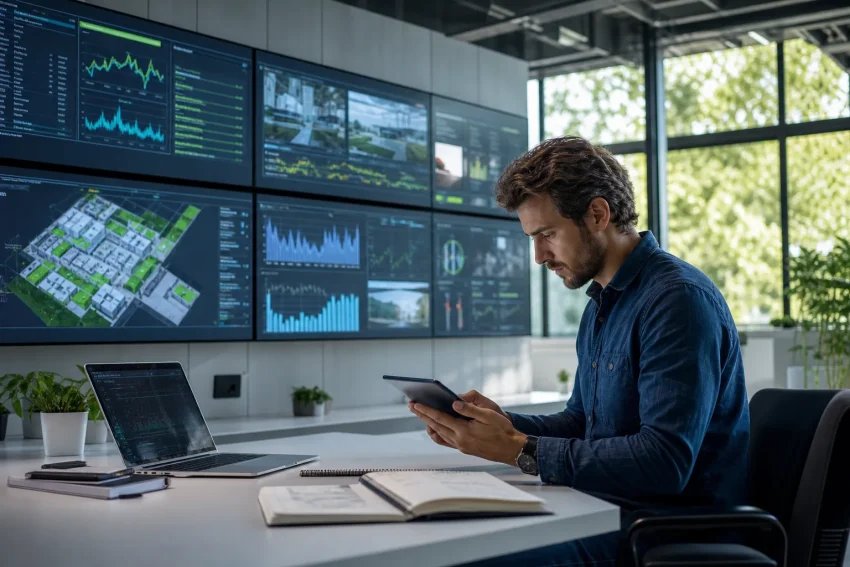
Looking at your energy bills tells you what happened yesterday. Predicting what you’ll consume tomorrow? That’s where things get messy. Unlike static historical data, forecasting energy use means wrestling with weather shifts, behavioral unpredictability, and equipment quirks that change by the hour. For businesses and homeowners alike, this gap between hindsight and foresight can mean wasted energy, inflated costs, and missed efficiency targets.
Lifee bridges that gap with AI-powered automation systems that don’t just track consumption, they anticipate it, turning real-time patterns into actionable insights. This guide unpacks why forecasting is so complex and how intelligent systems are Lastly making it reliable.
Introduction to AI Energy Consumption Forecasting
Why Accurate Forecasting Matters
Accurate forecasts help utilities schedule generation, limit expensive reserve capacity, and manage peaks without compromising reliability. For homes and businesses, they support better equipment scheduling, demand-response participation, and budgeting. The value is growing as electrification, rooftop solar, batteries, heat pumps, and flexible tariffs make both consumption and generation more variable.
The scale of the challenge is also changing. The International Energy Agency estimates that global data-centre electricity consumption will rise from about 485 TWh in 2025 to 950 TWh in 2030, with AI-focused data centres growing roughly threefold over the same period. That trend makes forecasting relevant not only for household bills and building operations, but also for the infrastructure required to train and run AI systems.
The Evolution from Traditional to AI-Based Forecasting
Traditional forecasting relied on spreadsheets, historical averages, seasonal factors, and limited weather inputs. Those methods remain useful as transparent baselines, but they can struggle when occupancy changes, equipment is replaced, tariffs shift, or behind-the-meter solar alters the relationship between demand and grid imports.
AI-based systems combine historical readings with live meter data, weather conditions, occupancy signals, device status, tariffs, and distributed generation. They can update predictions when a heatwave arrives, a building closes unexpectedly, or an appliance begins consuming more power than usual. The result is not perfect certainty, but a faster and more useful response to changing conditions.
- Forecasting is a decision tool, not just a prediction. Its value comes from connecting expected demand to actions such as pre-cooling, battery charging, load shifting, or maintenance.
- AI does not eliminate uncertainty. It estimates likely outcomes, identifies risk ranges, and helps people respond before an energy spike becomes expensive.
- The best systems remain measurable. Forecast accuracy should be tracked against a simple baseline so users can verify whether automation is producing practical benefits.
How AI Models Forecast Energy Consumption
AI energy consumption forecasting uses machine learning to transform time-series data into predictions for the next hour, day, week, or season. The forecast horizon determines the design: short-term models may support HVAC control, while longer-term models help with procurement, capacity planning, and investment decisions.
Data Sources: From Smart Meters to IoT Devices
Modern platforms combine several signals rather than relying on a single historical series. Smart meters provide consumption intervals, while thermostats, building-management systems, occupancy sensors, weather services, solar inverters, batteries, and equipment controllers explain why demand is changing.
- Historical load data. Interval readings reveal daily, weekly, and seasonal patterns. The data should be time-synchronized, checked for missing intervals, and separated into meaningful operating periods such as occupied, closed, holiday, and maintenance schedules.
- Weather and environmental conditions. Temperature, humidity, solar radiation, wind, and forecasts help explain heating and cooling demand. A model that receives only yesterday’s consumption may miss the effect of tomorrow’s heatwave or an unusually mild night.
- Operational and behavioral signals. Occupancy, opening hours, production schedules, appliance status, and tariff periods add context. This is especially important in homes and offices where two days with similar weather can have very different usage patterns.
- Generation and storage data. Solar production, battery state of charge, electric-vehicle charging, and export limits determine whether a site’s demand becomes grid demand. Forecasting net load prevents a system from optimizing consumption while ignoring local generation.
Key Algorithms: Neural Networks, Regression, and Hybrid Models
Regression models establish interpretable relationships between demand and variables such as temperature or occupancy. Recurrent neural networks, including LSTM architectures, can capture temporal dependencies, while newer transformer and graph-based approaches are being studied for longer sequences and interconnected assets. Recent reviews covering research published through 2025 describe a field that includes regression, support-vector methods, LSTM, convolutional networks, transformers, graph neural networks, and hybrid ensembles.
In practice, a hybrid model can be more useful than choosing one fashionable algorithm. A statistical baseline may provide stability, a neural network may capture complex patterns, and rule-based controls may prevent unsafe or uncomfortable actions. Lifee can use this kind of layered approach to connect predictive analytics with practical automation rather than treating the forecast as an isolated number.
Comparing Traditional and AI-Based Forecasting
| Capability | Traditional approach | AI-enabled approach | Practical implication |
|---|---|---|---|
| Inputs | Historical usage and seasonal averages | Meter, weather, occupancy, equipment, tariff, generation, and storage data | More context for unusual conditions |
| Adaptation | Periodic manual recalibration | Continuous or scheduled updating with drift monitoring | Better response to changing routines and assets |
| Transparency | Usually easy to explain | May require feature attribution and confidence reporting | Trust depends on understandable recommendations |
| Actionability | Often produces a planning estimate | Can trigger automated load shifting and control decisions | Forecasts can become immediate energy savings |
- Start with a baseline. Comparing AI with yesterday’s usage, a seasonal average, or a weather-adjusted model shows whether added complexity is justified.
- Use confidence intervals. A forecast range is more useful than a single precise-looking value when weather or occupancy is uncertain.
- Keep a human override. Residents, facilities teams, and operators need to suspend automation during exceptional events or comfort-sensitive periods.
Challenges and Limitations of AI in Energy Forecasting
AI energy consumption forecasting has advanced rapidly, but reliable performance depends on data engineering, system integration, governance, and continuous evaluation. A high-performing model in a laboratory or one building may not transfer directly to another site with different equipment, climate, or routines.
Data Quality and Availability
Missing readings, duplicated timestamps, meter replacements, sensor drift, and inconsistent units can create patterns that look meaningful but are not real. A model may also become less accurate when a building changes its operating schedule or installs a heat pump. Data validation, anomaly detection, imputation rules, and retraining triggers are therefore part of the forecasting system, not optional maintenance tasks.
Forecast Drift and Rare Events
Energy demand is affected by events that may be rare in the training data: extreme weather, outages, large gatherings, sudden business closures, or equipment failure. Monitoring error over time can reveal when the relationship between inputs and demand has changed. A resilient platform should fall back to conservative rules or simpler models when live data becomes unreliable.
Integration with Legacy Systems
Many buildings still use controllers and meters that were not designed for modern data pipelines. Integration may require gateways, protocol translation, permissions, and staged testing. Lifee’s custom project design can connect predictive insights with existing home-automation and building-management infrastructure while preserving manual control and operational safety.
Privacy and Security Risks
Energy profiles can reveal occupancy routines, production schedules, and sensitive business activity. Secure authentication, encryption, least-privilege access, network segmentation, software updates, and clear retention policies reduce exposure. Lifee’s focus on cyber-security is particularly relevant when forecasting is linked to devices that can change heating, lighting, charging, or other physical systems.
Accuracy Is Not the Same as Savings
A forecast can be statistically accurate without producing lower bills if the resulting actions are poorly timed or uncomfortable. Evaluation should therefore combine forecast metrics such as MAE and RMSE with operational outcomes, including peak-demand reduction, energy cost, carbon intensity, comfort complaints, and equipment cycling. This distinction keeps automation focused on useful results rather than impressive model scores.
- Measure the forecast and the intervention. Track whether a prediction led to a beneficial action and whether that action delivered the intended result.
- Test gradually. Begin with recommendations, then automate low-risk actions before allowing the system to control critical equipment.
- Review exceptional days. The largest errors often reveal missing inputs, faulty sensors, or operating changes that should inform the next model update.
From Prediction to Control: The Missing Link in Energy AI
Forecasting Net Load, Not Just Consumption
Sites with solar panels, batteries, electric vehicles, or heat pumps need forecasts for both gross consumption and net grid demand. Separating these signals helps determine whether to charge a battery, delay vehicle charging, export solar power, or reduce flexible loads without compromising essential services.
Turning Forecasts into Flexible Actions
The most valuable workflow connects a forecast to a ranked set of actions with limits for comfort, safety, and equipment health. A Lifee system could identify an approaching peak, shift selected loads to a lower-cost period, and leave critical appliances untouched. This makes predictive energy management practical for homeowners, businesses, and real-estate operators.
Edge Intelligence and Resilient Operation
Processing selected data locally can reduce latency and limit the amount of household or building information sent to external services. Edge operation also provides a fallback when connectivity is interrupted, while cloud systems can support broader model training and fleet-level analysis. A balanced architecture improves responsiveness without treating every control decision as a remote transaction.
Real-World Applications and Case Studies
AI energy consumption forecasting becomes easier to evaluate when it is tied to a clear operational problem, such as reducing peak demand, maintaining comfort, detecting abnormal equipment use, or coordinating renewable generation.
Smart Home Energy Forecasting
Lifee’s AI-powered home automation can learn recurring routines and combine them with weather and tariff information. It may pre-condition a home before a hot period, reduce lighting in unoccupied rooms, or delay flexible appliance use when prices are high. The system should preserve resident preferences and allow immediate overrides, ensuring that efficiency does not come at the expense of comfort.
Business and Grid-Level Forecasting
Commercial buildings can forecast HVAC, refrigeration, lighting, and process loads separately before coordinating them around occupancy and tariff constraints. Utilities and aggregators use related methods to estimate peak demand and manage distributed energy resources. At grid scale, better forecasts support generation scheduling and resilience, especially as electrification increases the number of weather-sensitive loads.
Evaluating Claimed Savings
Reported savings should be interpreted carefully. A claimed reduction, such as 14% in a warehouse or 20% in office lighting, is meaningful only when the baseline, weather, occupancy, operating hours, and measurement period are documented. The original article does not provide publicly verifiable case-study documentation for those figures, so they should be treated as illustrative examples rather than independently confirmed Lifee results.
Lifee’s AI Solutions in Action
Lifee combines predictive analytics, intelligent energy audits, contextual automation, and custom project design for individuals, businesses, and real-estate professionals. A deployment might connect occupancy sensors, lighting, HVAC, and energy meters, then use forecast information to recommend or automate changes. The appropriate configuration depends on the site’s equipment, goals, cybersecurity requirements, and tolerance for automated control.
| Setting | Forecasting objective | Possible Lifee-enabled action | Success metric |
|---|---|---|---|
| Home | Anticipate comfort-related demand | Pre-condition rooms and shift flexible appliances | Cost, comfort, and peak-use reduction |
| Office | Align HVAC and lighting with occupancy | Adjust schedules and dim unused areas | Energy intensity and comfort feedback |
| Warehouse | Detect abnormal overnight consumption | Investigate refrigeration and equipment schedules | Verified savings and fewer anomalies |
| Portfolio or grid | Estimate coincident peaks and flexibility | Coordinate distributed loads and storage | Peak reduction and reliability |
Lifee’s Approach to AI Energy Consumption Forecasting
Lifee’s approach combines intelligent technology with practical deployment. The objective is not simply to produce a sophisticated forecast, but to create secure, understandable, and useful automation that fits the way a home, business, or property portfolio actually operates.
Proprietary AI Technologies
Hybrid statistical, machine-learning, and rule-based methods can provide a balance between adaptability and control. Models can be recalibrated as new meters, devices, weather patterns, or operating schedules change. Clear inputs, confidence ranges, and explanations help users understand why the system recommends a particular action.
Integration with Home Automation
Lifee’s custom solutions can connect forecasting with thermostats, lighting, appliances, batteries, electric-vehicle charging, and building-management systems. Automation can be introduced in stages, beginning with recommendations and progressing toward approved low-risk controls. This approach supports efficiency while respecting comfort, operational priorities, and existing infrastructure.
Security and Sustainability Focus
Cybersecurity is part of energy efficiency because a compromised control system can create financial, safety, and privacy risks. Strong access controls, secure communications, monitoring, update procedures, and careful data governance should accompany every connected deployment. Sustainability also requires measuring actual outcomes, including energy use, peak demand, carbon intensity, and equipment longevity.
- Personalized forecasting beats generic averages. A model trained on a site’s real equipment and routines can support more relevant decisions.
- Automation should be explainable. Users need to know which signals influenced a recommendation and how to override it.
- Efficiency should remain human-centered. The best system reduces waste while preserving comfort, safety, privacy, and control.
Looking Ahead in AI Energy Consumption Forecasting
Recent energy-system projections show why forecasting will become more important. The IEA reported that data-centre electricity demand increased by 17% in 2025, while AI-focused facilities grew faster than the wider data-centre sector. Its updated outlook expects data-centre consumption to reach about 950 TWh by 2030, even as electricity use per individual AI task declines through efficiency improvements.
This creates a central tension: better algorithms can reduce energy per task, but wider adoption and more demanding AI applications can increase total demand. Forecasting will need to account for flexible computing loads, renewable availability, grid congestion, cooling requirements, and the location and timing of new facilities. The same principle applies at building level, where electrification may lower direct fossil-fuel use while increasing electricity peaks.
Emerging Trends and Innovations
- Probabilistic forecasting. Instead of presenting one supposedly certain number, models increasingly need to show likely ranges and risk levels. Operators can then reserve flexibility in proportion to forecast uncertainty rather than overreacting to every possible peak.
- Federated and privacy-aware learning. Homes and businesses may contribute model improvements without exposing raw consumption histories. This can support broader learning while reducing unnecessary sharing of sensitive behavioral data.
- Forecast-aware automation. The next step is tighter coordination between prediction, optimization, and control. Systems will increasingly decide not only how much energy may be used, but when flexible demand can move with the least cost, carbon, or comfort impact.
Reinforcing Lifee’s Commitment
Lifee is positioned to support this transition through AI-powered intelligent automation, energy-efficiency solutions, custom project design, and cyber-security-conscious integration. For households, the focus is comfort and convenience; for businesses and property professionals, it is measurable performance, resilience, and scalable control. The strongest results will come from combining reliable data, transparent models, and carefully governed automation.
Frequently Asked Questions
How accurate can AI energy consumption forecasting be?
Accuracy varies with the forecast horizon, data quality, weather volatility, equipment diversity, and how often the system is updated. A responsible deployment compares AI with a transparent baseline, reports error ranges, and evaluates performance separately for ordinary and exceptional days.
Can AI forecasting reduce household energy bills?
It can support lower bills by shifting flexible consumption, avoiding unnecessary heating or cooling, detecting abnormal usage, and aligning demand with tariffs or on-site solar. Actual savings depend on the tariff, equipment, household behavior, comfort settings, and whether recommended actions are implemented.
What data does an AI energy forecasting system need?
A useful system may combine interval meter readings with weather, occupancy, schedules, device status, tariffs, solar production, battery state, and electric-vehicle charging. The minimum viable dataset depends on the application, but clean timestamps and reliable historical measurements are essential.
Is AI energy forecasting safe for connected homes and buildings?
It can be safe when cybersecurity and operational safeguards are designed into the deployment. Secure authentication, encrypted communications, least-privilege access, monitoring, manual overrides, staged automation, and clear data-retention policies should be treated as core requirements rather than optional features.
What should businesses ask before choosing a forecasting platform?
They should ask how accuracy is measured, how missing data and model drift are handled, which systems can be integrated, where data is processed, how users can override controls, and whether savings claims use a documented baseline. Lifee’s custom project approach is intended to align these technical questions with the site’s operational and sustainability goals.
- AI energy forecasting turns historical readings into forward-looking decisions, but it remains dependent on reliable data and realistic uncertainty estimates.
- Modern forecasting must include context, from weather and occupancy to solar, batteries, tariffs, equipment condition, and user preferences.
- Successful projects connect prediction to action, measuring cost, comfort, peak demand, carbon impact, and cybersecurity rather than model accuracy alone.
With AI at the heart of modern energy management, turning yesterday’s data into tomorrow’s savings and sustainability is no longer out of reach. Lifee helps individuals, businesses, and real-estate professionals move from passive monitoring to predictive, secure, and practical automation. Contact Lifee to explore an energy forecasting solution designed around your equipment, priorities, and future energy needs.