
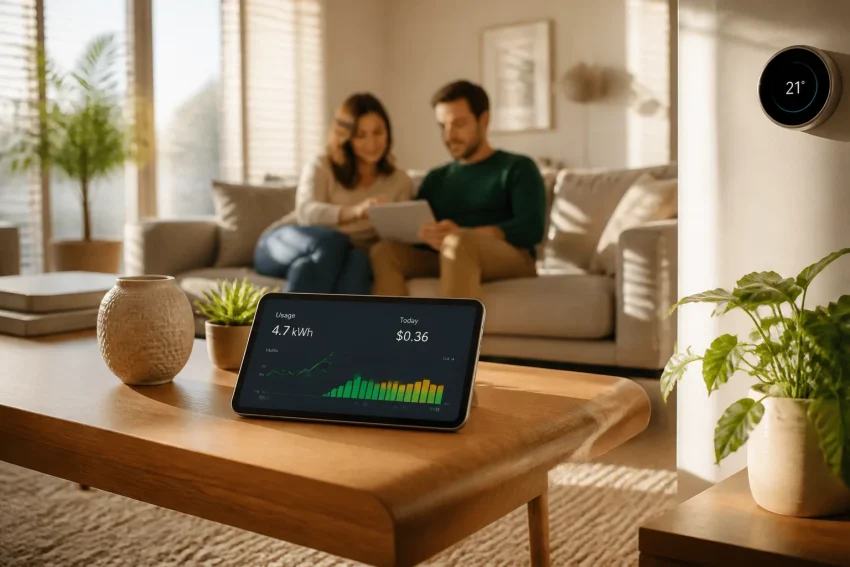
Energy prices that shift by the hour sound liberating until your heating kicks in at peak cost or your EV charges when rates spike. Dynamic tariffs promise savings, but without the right controls, they can just as easily drain your wallet and leave you second-guessing every appliance. The good news? You don’t need to micromanage your home to win.
Lifee’s AI-powered automation systems handle the heavy lifting, syncing your consumption with off-peak windows while keeping your comfort non-negotiable. This guide walks you through practical strategies to harness dynamic pricing confidently, protect your budget, and let intelligent technology do the thinking for you.
Introduction to Dynamic Electricity Tariffs
Why Dynamic Tariffs Matter Now
Dynamic electricity tariffs link the retail price of electricity to wholesale market conditions, usually through day-ahead or intraday prices. Unlike a fixed-rate plan, the amount paid per kilowatt-hour can vary by hour, allowing customers to respond to periods of abundant renewable generation or tight supply.
This model is becoming more practical as smart meters, connected appliances, electric vehicles, heat pumps, and home batteries become more common. The European Commission reports that around 60% of European households had an electricity smart meter by the end of 2024, with penetration above 80% in 15 EU countries. Smart meters provide the measurement and data access needed for time-based billing, near real-time feedback, and automated demand response.
Dynamic pricing can help absorb excess wind and solar generation, reduce demand during stressed periods, and give households a financial reason to shift flexible consumption. However, the benefit depends on the tariff design, the household’s flexibility, and the safeguards applied when prices rise sharply.
- Prices follow market conditions: A windy or sunny period can create lower-cost electricity, while cold evenings or supply shortages can produce higher prices. Automation can use these signals without requiring residents to monitor a market dashboard.
- Flexibility determines the opportunity: EV charging, hot-water heating, laundry, dishwashing, batteries, and some heating loads can often move by several hours. Lighting, medical equipment, refrigeration, and basic cooking usually need to remain available regardless of price.
- Consumer protection still matters: A dynamic plan should be compared with fixed-price alternatives, standing charges, taxes, network fees, supplier margins, and exit conditions. Wholesale prices do not always represent the final bill price.
How Dynamic Tariffs Work: Mechanisms and Models
Key Technologies Behind Dynamic Tariffs
Smart meters measure consumption in defined intervals and transmit the data needed for settlement and feedback. In the European Union, smart-meter functionality is being strengthened for dynamic pricing, and meters installed from 1 January 2025 must be capable of measuring in at least 15-minute intervals under the relevant framework. The exact interval used for billing still depends on the supplier and national market.
The tariff structure determines how much control the customer has and how much risk is exposed:
- Time-of-use tariffs: Prices are published in blocks such as peak, shoulder, and off-peak periods. They are easier to understand because the schedule is known in advance, but they may not capture a particularly windy afternoon or an unexpected evening shortage.
- Real-time pricing: Prices change hourly or at another defined interval according to wholesale market values. This creates the greatest potential for load shifting, but it also requires clear alerts, reliable automation, and a budget limit to manage volatility.
- Critical-peak pricing: The supplier designates a limited number of high-stress periods when prices rise substantially. Customers can reduce usage during those events, although contracts should explain notification periods, event limits, and any protections against bill shocks.
The final price may include more than the wholesale component. Network charges, taxes, levies, supplier fees, and capacity charges can remain fixed or vary according to local rules. A household should therefore calculate the complete delivered cost rather than judging a plan by the wholesale price alone.
| Tariff model | Price visibility | Best suited to | Main control needed |
|---|---|---|---|
| Time-of-use | Published time blocks | Households with predictable routines | Basic scheduling and appliance timers |
| Real-time pricing | Hourly or sub-hourly updates | Users with flexible loads and automation | Price ceilings, alerts, and automatic optimisation |
| Critical-peak pricing | Normal prices plus announced events | Customers able to reduce demand quickly | Event notifications and emergency override rules |
Benefits and Challenges for Consumers and Businesses
Addressing Price Volatility and Consumer Concerns
Dynamic pricing can reward flexibility, but the outcome is not uniform across households. The OECD reported in 2025 that roughly three quarters of European Union households did not adjust their electricity consumption in response to price changes. This highlights the central issue: a tariff cannot deliver meaningful savings if customers lack the equipment, information, time, or flexibility to change when they use electricity.
- Potential cost savings: Customers with controllable heating, hot water, EV charging, or battery storage can move consumption away from expensive periods. The value comes from the difference between the avoided high-price interval and the replacement interval, after accounting for efficiency losses and all non-energy charges.
- Better renewable integration: Shifting demand toward periods of high wind or solar output can reduce curtailment and make better use of existing grid capacity. A smart charger, for example, can prioritise solar electricity while still ensuring that an EV reaches its required charge before departure.
- Greater market participation: Flexible customers can contribute to demand-response programmes that support system reliability. Businesses may coordinate refrigeration, ventilation, pumping, or battery loads, provided operational, safety, and product-quality requirements remain protected.
The risks deserve equal attention. A customer who cannot shift consumption may pay more during a price spike without gaining an offsetting benefit. A poorly configured heating system may preheat too aggressively, cancel expected savings, or reduce comfort. Automation also introduces digital risks if accounts, gateways, or connected devices are not secured.
| Household or business profile | Likely flexibility | Practical approach |
|---|---|---|
| Apartment with fixed heating | Low to moderate | Start with laundry, hot water, and appliance scheduling while retaining a fixed-price fallback if needed. |
| Detached home with heat pump and EV | Moderate to high | Use comfort limits, departure deadlines, weather forecasts, and automated charging priorities. |
| Small business | Variable | Audit flexible loads and protect working hours, refrigeration, safety systems, and customer-facing operations. |
Hidden Variables That Decide Whether Dynamic Pricing Works
Comfort Is a Constraint, Not a Variable to Sacrifice
The lowest-price hour is not automatically the best operating hour. Heating a building too early can increase heat loss, while delaying hot water or cooling may create an uncomfortable rebound period. Comfort targets should therefore be defined before cost optimisation begins, including minimum and maximum temperatures, hot-water availability, indoor-air-quality requirements, and user-specific exceptions.
Calculate Savings After Efficiency and Equipment Costs
Price shifting can involve conversion losses, battery degradation, additional network charges, or an equipment upgrade. Compare the avoided cost with the full operating cost of the alternative schedule. A lower hourly price is useful only when the appliance still performs efficiently and the shift does not create a more expensive peak later.
Protect Personal Data and Connected Energy Assets
Smart meters and automation platforms process detailed information about occupancy, routines, and device behaviour. Use strong authentication, unique passwords, encrypted connections, software updates, least-privilege permissions, and a separate network for smart devices where practical. Lifee’s intelligent energy solutions should be assessed not only for optimisation features but also for data governance, device compatibility, access controls, and cybersecurity procedures.
Keep a Human Override and a Reliable Fallback
Automation should pause when a resident is ill, an unexpected guest arrives, weather conditions change, or a device behaves abnormally. A manual override, offline operating mode, supplier support route, and fixed-price comparison give customers control when forecasts or connectivity fail.
Leveraging Smart Home Automation and AI for Dynamic Tariffs
How Lifee Can Turn Price Signals Into Practical Decisions
Lifee is a French company specialising in intelligent energy-efficiency and home-automation solutions for individuals, businesses, and real estate professionals. Its approach combines sustainable innovation, contextual automation, intelligent energy audits, custom project design, predictive energy management, and cybersecurity considerations.
In a dynamic-tariff setting, an intelligent system should optimise several objectives at once: energy cost, comfort, equipment constraints, emissions, user routines, and operational safety. Lifee’s AI-powered automation concept can connect relevant data sources and coordinate flexible devices, while allowing users to define the limits that automation must never cross.
- Automated scheduling: Flexible tasks such as EV charging, dishwashing, laundry, and selected hot-water cycles can be assigned to lower-cost windows. The system should also respect deadlines, such as an EV departure time or a business opening hour, rather than selecting the cheapest interval blindly.
- Predictive management: Weather, occupancy patterns, building performance, renewable generation, and expected prices can inform earlier decisions. Preheating or precooling works best when it is limited by a comfort band and checked against the building’s thermal response.
- Contextual automation: Rules can change when residents are away, a meeting begins, an EV needs an urgent charge, or a business enters a critical production period. This is more useful than a single static schedule because it reflects the purpose of the energy use.
- Cybersecure control: Access permissions, device inventories, software updates, and clear data policies reduce the risk that an energy-management system becomes an entry point for wider digital attacks. Essential devices should retain safe local behaviour if cloud connectivity is interrupted.
The customer remains in control by setting comfort ranges, protected appliances, price ceilings, maximum postponement times, and emergency overrides. Automation then handles repetitive decisions within those boundaries instead of asking residents to watch prices throughout the day.
Practical Tips: Making the Most of Dynamic Tariffs
Step-by-Step Guide to Adapting Your Energy Use
- Read the contract in full: Identify the wholesale reference, update interval, supplier margin, standing charges, network fees, taxes, price caps, notice periods, and rules for unusually high or negative prices. Compare the complete annual cost with a fixed-price plan using your own consumption profile.
- Establish a baseline: Review at least several months of interval consumption if available, then separate essential loads from flexible ones. Heating, cooling, hot water, EV charging, and batteries usually deserve attention first because small timing changes can affect many kilowatt-hours.
- Set comfort and safety boundaries: Define temperature bands, hot-water minimums, medical-device exclusions, refrigeration protections, business operating hours, and EV departure requirements. These boundaries prevent a cost-saving algorithm from treating essential services as postponable.
- Automate gradually: Start with one or two devices and use conservative schedules. Lifee can help coordinate connected systems and tailor controls to a home, commercial site, or real-estate portfolio, but every automation rule should have an understandable purpose and a manual override.
- Review delivered costs: Measure the full bill, not only the energy component. Track consumption shifted, average price paid, peak-price exposure, comfort incidents, equipment cycling, and any added maintenance or subscription cost.
- Recalibrate seasonally: A strategy that works in a mild spring may fail during a cold winter or heatwave. Update temperature limits, charging deadlines, occupancy assumptions, and price thresholds as weather and routines change.
Electric vehicles are a useful example because charging can often be delayed without affecting mobility. Smart charging can respond to photovoltaic availability, grid conditions, and user preferences while avoiding grid overload. The correct setting is not simply “charge at the cheapest time”; it is “reach the required state of charge by departure while avoiding unnecessary high-cost periods.”
Small businesses can apply the same principle to HVAC, refrigeration, compressed air, pumping, and battery systems. Pre-cooling an office may help before a predicted peak, but refrigeration and safety loads need stricter limits. An energy audit can identify which processes are genuinely flexible and which should remain protected.
| Metric | Why it matters | Target question |
|---|---|---|
| Average delivered price | Shows the outcome after wholesale costs, fees, taxes, and network charges. | Did the tariff beat the realistic fixed-price alternative? |
| Flexible energy shifted | Measures whether controllable consumption actually moved. | How many kilowatt-hours moved away from expensive periods? |
| Peak exposure | Reveals vulnerability to price spikes. | What happened on the most expensive days? |
| Comfort and service quality | Prevents savings from being achieved through unacceptable conditions. | Were temperature, hot water, mobility, and operations maintained? |
What Recent Adoption Data Reveals
Smart Meters Are Expanding, but Behaviour Is the Missing Link
Recent evidence shows a widening gap between technical availability and active participation. The European Commission estimates that about 60% of European households had smart meters at the end of 2024, while the OECD found that approximately three quarters of EU households still did not adjust consumption in response to price changes. This suggests that metering alone is insufficient: customers also need understandable contracts, timely data, suitable devices, automation, and confidence that savings will outweigh risk.
Dynamic Contracts Can Grow Quickly From a Small Base
Poland’s Energy Regulatory Office reported that household customers on dynamic-pricing contracts rose from 135 to 4,836 during 2025, an increase of nearly 3,500%. Despite the striking growth rate, the absolute number remained small relative to the total household market. The example demonstrates why adoption percentages should always be read alongside the starting base, supplier availability, smart-meter coverage, and consumer protections.
Businesses Often Have More Flexible Loads
The same Polish regulator reported approximately 27,000 dynamic-pricing contracts among small and micro-business tariff groups by the end of 2025, with a 12.5% increase during the year. Businesses may have more measurable flexibility, but they must evaluate production schedules, employee comfort, refrigeration, service-level commitments, and the cost of interruptions before shifting demand.
- Smart-meter coverage: Around 60% of European households had electricity smart meters by the end of 2024, and 15 EU countries exceeded 80% coverage. This creates a substantial technical foundation for dynamic pricing, although coverage differs significantly by country.
- Household adoption: Poland recorded 4,836 household dynamic-pricing contracts at the end of 2025, compared with 135 one year earlier. The growth is notable, but the small base shows that consumer adoption is still developing.
- Business participation: Around 27,000 small and micro-business dynamic-pricing contracts were reported in Poland at the end of 2025. Commercial users may benefit from stronger flexibility, provided operational risks are assessed.
- Behavioural participation: Roughly three quarters of EU households were not adjusting consumption in response to price signals according to the OECD’s 2025 survey of electricity-market conditions. Better automation and clearer customer education are therefore central to wider adoption.
- Metering resolution: European policy is moving toward at least 15-minute measurement capability for new smart meters from 2025. More granular data can support more accurate billing and control, but it does not by itself guarantee lower costs.
Frequently Asked Questions About Dynamic Electricity Tariffs
Can a dynamic electricity tariff make my bill higher?
Yes. Customers with inflexible demand can be exposed to expensive periods, and wholesale prices can rise during extreme weather or supply shortages. A price ceiling, automated load control, and a comparison with a fixed-price contract can reduce the risk.
Do I need a smart meter?
Usually, yes, because the supplier needs interval consumption data to calculate or verify a dynamic bill. The precise technical and legal requirements vary by country, so confirm whether the meter supports the required interval, communications, data access, and device integrations.
Which appliances should be automated first?
Start with loads that are energy-intensive, flexible, and safe to delay: EV chargers, hot-water systems, batteries, dishwashers, washing machines, and selected heating or cooling functions. Do not automatically delay medical equipment, refrigeration, security systems, or any appliance whose interruption could create a safety or operational problem.
Will automation remove control over my home?
A well-designed system should do the opposite. Lifee’s approach can be configured around user-defined comfort bands, deadlines, protected devices, price limits, and manual overrides, allowing automation to manage routine decisions without taking control away from the resident or business operator.
Are dynamic tariffs suitable for every household?
No. They are most attractive when a household or business has flexible loads, suitable metering, transparent supplier terms, and a way to respond to price signals. Customers with low flexibility or a strong need for predictable bills may prefer a fixed or hybrid plan.
The Road Ahead for Dynamic Electricity Tariffs
Dynamic electricity tariffs are becoming more closely connected with smart meters, renewable generation, electric vehicles, heat pumps, batteries, and automated demand response. European policy requires markets to support dynamic contracts for customers with suitable smart meters while preserving access to fixed-price options. The direction is clear, but responsible adoption depends on transparent pricing, secure data, reliable automation, and meaningful customer protections.
- Flexibility will become more valuable: As electrification increases demand for heating, cooling, and transport, the ability to move consumption can reduce both bills and pressure on local networks. Devices should optimise around real needs, not simply react to every price change.
- AI will coordinate more systems: Predictive management can combine weather, occupancy, building performance, tariffs, renewable output, and user priorities. Lifee can support this transition through custom energy-efficiency solutions designed for homes, businesses, and real-estate projects.
- Security will remain essential: Connected energy assets are part of critical household and commercial infrastructure. Cybersecurity, permission management, safe fallback modes, and clear handling of consumption data should be treated as core product requirements.
The safest way to begin is to measure first, automate one flexible load, define non-negotiable comfort and safety limits, and review the complete bill after several cycles. With those safeguards in place, Lifee’s intelligent automation can help turn changing electricity prices into practical decisions that protect comfort, improve efficiency, and support a cleaner, more resilient energy system.