
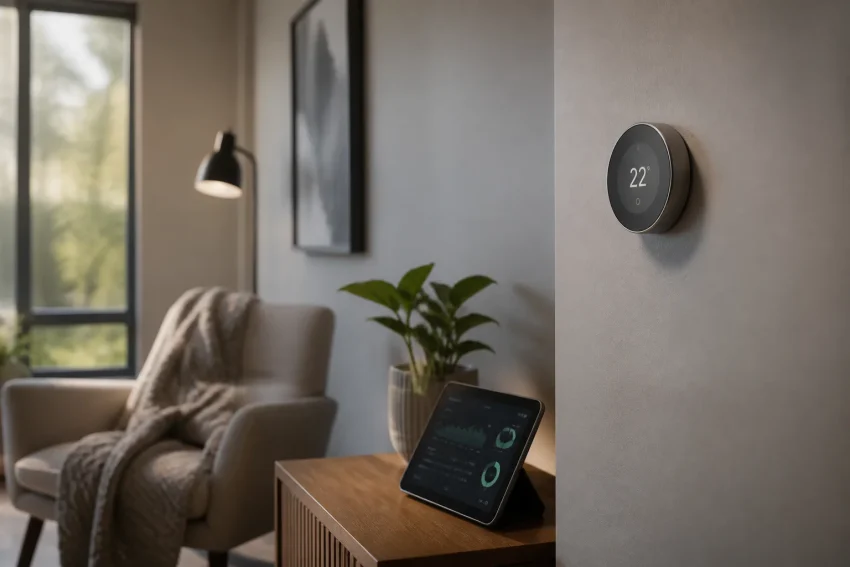
Your heating and cooling bills don’t have to feel like a mystery you solve every month. Smart thermostats with AI have moved beyond simple scheduling to actually learn your habits, predict energy waste, and adapt in real time, cutting costs without sacrificing comfort. Lifee, a French leader in AI-powered home automation, has been at the forefront of this shift, designing intelligent systems that blend energy efficiency with intuitive control for homeowners and businesses alike.
This guide breaks down seven top AI-enabled thermostats, comparing their learning capabilities, automation depth, and real-world savings so you can choose the one that fits your home and budget.
The Rise of AI in Smart Thermostats: Why It Matters in 2026
AI-powered smart thermostats have transformed how we manage heating and cooling in both homes and businesses. With real-time data and advanced predictive algorithms, these devices make adjustments on the fly, using far more than just a preset schedule. Instead of relying on timers or basic programs, they constantly adapt to your daily patterns and the environment, squeezing every bit of efficiency from your system.
How AI Transforms Energy Management
Modern smart thermostats with AI features can sense occupancy, pull in local weather reports, and learn from your habits. Think about your home empty during work hours, your thermostat notices and automatically reduces heating or cooling, saving energy. As soon as someone is on their way back, it anticipates their arrival and restores comfort. Families in 2026 are seeing up to 25 percent reductions in their energy bills simply by letting these intelligent systems handle the details. This is proactive, predictive energy management in action, and it is changing expectations for comfort and efficiency.
The Importance of Automation in Modern Living
AI-driven automation is not just about convenience, it is about smarter living. These systems can automatically align your energy use with lower utility rates or community efficiency goals, especially when connected to smart grids. In larger buildings, property managers now rely on AI thermostats for automated energy audits and whole-zone optimization, making it easier to keep costs low and comfort high. Think about a business that never has to worry about an empty conference room being heated or cooled unnecessarily, the system simply knows and reacts.
- AI integration leads to smarter climate control and reduced energy waste. By continuously learning when and how spaces are used, learning thermostats adjust setpoints in real time, cutting unnecessary run times for boilers, heat pumps, and air conditioners. This steady optimization is why documented savings typically fall between 10 and 23 percent on heating and cooling costs for average households.
- Both homeowners and businesses experience noticeable savings and improved comfort. Industry analyses show that most households recoup the purchase cost of a quality smart thermostat within 18 to 24 months, with average annual savings often cited in the 120 to 180 dollar range. For small businesses with larger HVAC loads, payback can be even faster as AI systems smooth peaks and prevent costly over-conditioning.
- AI supports long term sustainability and regulatory goals. Global market reports highlight that learning smart thermostats already account for more than 40 percent of the segment, reflecting demand driven by building efficiency regulations and corporate decarbonization commitments. As cities tighten energy performance standards, connected controls become a practical way to avoid penalties while demonstrating measurable carbon reductions.
Key AI Features in 2026’s Leading Smart Thermostats
The best smart thermostats with AI features in 2026 stand out because they do more than just follow a schedule. They adapt, learn, and create a personalized climate experience while keeping energy usage in check. Here are the standout capabilities you will find in top models this year.
Adaptive Learning and Predictive Scheduling
AI-powered thermostats like the Google Nest Learning Thermostat 4th Gen observe how you live, what time you wake up, when you leave, and your favorite temperature at different times of day. The result is that after just a few weeks, the thermostat builds a custom schedule and keeps tweaking it as your life shifts. If you work from home some days and not others, it adapts. If a cold front moves in, it gets ahead of the weather. This level of predictive energy management means less fiddling and more comfort, all while cutting energy use.
Occupancy Detection and Contextual Automation
Products like the Honeywell Home T9 use room sensors to track occupancy and temperature, making it possible to heat or cool only the spaces in use. If no movement is detected in a room, the system slides into eco mode to save energy. These thermostats can even connect with other smart devices, so if a window sensor detects that a window is open, your system pauses climate control in that room, preventing waste. This contextual automation takes the guesswork out of saving energy and makes your home or business smarter at every turn.
- Adaptive learning shapes temperature schedules around your life. Machine learning models digest months of on off cycles, setpoint changes, and occupancy patterns to build a profile that reflects how your household or office actually behaves. In practice, this means fewer manual overrides, smoother temperature transitions, and less time spent thinking about the thermostat because it feels like it is reading the room.
- Contextual automation uses sensors and data for smarter, more efficient control. When motion detectors, window contacts, air quality sensors, and even EV chargers feed data into your thermostat, the system can adjust in a more holistic way. For example, pausing heating during a sunny afternoon when south facing rooms naturally warm up or lowering cooling when indoor air quality sensors indicate lower occupancy, all without requiring you to build complex rules.
- Cloud analytics and remote optimization unlock portfolio level benefits. For multi site businesses and real estate portfolios, AI thermostats are increasingly managed through cloud platforms that analyze performance across dozens or hundreds of units. Lifee’s intelligent LLM automation systems, for instance, can benchmark each property against peers, surface outliers, and propose specific schedule or setpoint changes to align buildings with corporate efficiency targets.
2026 Comparison: 7 Best Smart Thermostats With AI Features
In 2026, the market for AI-powered thermostats is broader and smarter than ever. Here is how the best smart thermostats with AI features stack up, from advanced learning to seamless integration and real-world energy savings.
| Model | AI Learning Depth | Smart Home Compatibility | Best Use Case | Typical Savings |
|---|---|---|---|---|
| Ecobee Smart Thermostat Premium | Advanced multi room learning with occupancy sensors and air quality data | Alexa, Apple HomeKit, Google Assistant | Energy conscious homes and small commercial projects | Often cited at roughly 10 to 20 percent on heating and cooling bills |
| Google Nest Learning Thermostat 4th Gen | Mature predictive scheduling and pattern recognition | Google Home, Alexa, many third party platforms | Retrofits in apartments and older properties | Frequently documented at 12 to 15 percent annual savings |
| Honeywell Home T9 | Room based zoning and presence detection intelligence | Alexa, SmartThings, Apple HomeKit | Larger homes or offices with shifting occupancy | Particularly strong in cutting after hours and unused zone usage |
| Amazon Smart Thermostat | Essential learning tailored around Alexa routines | Alexa ecosystem | Budget focused households seeking core automation | Economic entry point to roughly 8 to 10 percent savings |
| Sensi Lite Smart | Focused on reliable schedules and remote access insights | Major voice assistants and smart home hubs | Simple systems needing remote control more than deep AI | Improves comfort and control, with moderate but steady savings |
| Copeland Sensi Touch | Responsive controls with consistent learning over time | Broad HVAC and platform compatibility | Mixed use buildings where touch control and visibility matter | Helps avoid extremes and wasted run times across seasons |
| Ecobee Smart Essential | Streamlined AI targeting core efficiency needs | Main smart home ecosystems | Projects needing essential intelligence at lower upfront cost | Delivers a substantial portion of Premium level savings at reduced price |
- Ecobee Smart Thermostat Premium. This model delivers adaptive learning, detailed energy reports, and built in air quality monitoring, making it a strong choice for those who want both comfort and health metrics in one interface. Its wide compatibility with Alexa, Apple HomeKit, and Google Assistant means it drops neatly into most connected homes, and Lifee often uses it as a cornerstone for residential projects that require granular insights into energy performance.
- Google Nest Learning Thermostat 4th Gen. Nest’s latest generation continues the brand’s focus on refined scheduling and predictive algorithms that demand very little user input once the initial learning phase is complete. A clear, circular interface makes it approachable for occupants of all ages, while intuitive energy reports translate complex data into simple “good, better, best” guidance that facility teams and homeowners can act on quickly.
- Honeywell Home T9. The T9 shines where spaces vary in usage from hour to hour, thanks to its room sensors and zoning logic that can prioritize busy areas and relax conditioning in unused ones. When integrated into Lifee led office or co working projects, these features help avoid the classic problem of corridor and meeting room over conditioning, turning what used to be manual walk through checks into automated, data driven adjustments.
- Amazon Smart Thermostat. Positioned as a budget friendly gateway to AI climate control, this thermostat focuses on core learning and automation while leveraging deep integration with Alexa routines. For households already comfortable with voice commands and simple routines, it provides a cost effective path to measurable savings, especially when paired with Lifee’s advisory on sensible setpoints and occupancy aware schedules.
- Other noteworthy models. Sensi Lite Smart offers affordable access to remote monitoring and efficient core functions, an appealing option in rental properties where simplicity and price matter. Copeland Sensi Touch adds a responsive touch interface and robust scheduling, ideal for environments where manual overrides must be easy but still guided by smart defaults. Ecobee Smart Essential distills the Premium experience into a more accessible package, giving projects with tight budgets a way to tap into AI features without overinvesting in extras they may not need.
Real users are seeing energy bill drops of 15 to 30 percent with these models, especially when they connect multiple devices and take full advantage of automation. The best smart thermostats with AI features do not just save money, they simplify life, providing peace of mind that your energy use is always optimized.
- Comparing AI features and compatibility up front helps ensure you get the right fit. Before committing to a thermostat, it pays to map your HVAC system, preferred voice assistant, and any existing sensors or hubs so you can confirm that the device will integrate smoothly. Lifee’s custom project design services often begin with this compatibility audit, preventing mismatches that could limit automation or require costly retrofits later.
- User feedback offers a window into how these systems perform in diverse environments. Reviews from apartment dwellers, suburban homeowners, and office managers often highlight details that spec sheets miss, such as how quickly a thermostat recovers after a manual override or how clear its alerts are. By combining this bottom up perspective with Lifee’s top down energy audits, you gain a richer picture of how each model behaves in real buildings.
- Summarizing key metrics clarifies tradeoffs between cost and intelligence. When you compare upfront price, typical savings, and integration depth side by side, it becomes easier to see which thermostat offers the best return on investment for your specific scenario. Many projects In the end balance a mid range device with strong AI features against a premium model, deciding based on building size, occupancy patterns, and long term automation ambitions.
| Thermostat | Approx. Price Tier | Integration Depth | Energy Insight Quality |
|---|---|---|---|
| Ecobee Premium | High | Extensive, multi platform | Rich reports and air quality metrics |
| Nest Learning 4th Gen | Medium to high | Strong in Google ecosystem | Clear savings summaries and trend views |
| Honeywell T9 | Medium | Broad platform support | Room level detail via sensors |
| Amazon Smart Thermostat | Low | Deep Alexa integration | Essential but sufficient analytics |
| Ecobee Smart Essential | Low to medium | Targeted compatibility | Focused on core efficiency indicators |
Expert Insights and Real-World Experiences
Stories from homeowners and businesses highlight just how practical and effective AI-powered thermostats have become. Take, for instance, a property manager in Lyon who upgraded a 12 unit apartment building with Ecobee Smart Thermostat Premium units. Not only did energy costs drop by over 20 percent in the first year, but tenants also noticed more consistent room temperatures and fewer complaints.
Homeowner and Business Case Studies
One family in Berlin, for example, saw their monthly energy usage fall from 820 kilowatt hours to 610 kilowatt hours after adopting a Nest Learning Thermostat. The secret was that the AI learned their irregular work from home schedules and synchronized with window sensors to prevent heating when windows were open. Meanwhile, a Paris based small business installed Honeywell Home T9 thermostats in its offices. With AI driven presence detection, the system automatically dialed back heating and cooling after hours, trimming after hours HVAC use by 28 percent.
For both homeowners and business owners, the result is the same, less time spent adjusting thermostats and more time enjoying comfortable, efficient spaces. These testimonials show just how much of a difference the best smart thermostats with AI features can make when matched to the right environment, especially when Lifee supports the design and monitoring of the project from day one.
Expert Recommendations
Experts suggest starting your search by evaluating your current heating and cooling needs. Prioritize systems that offer AI-powered home automation and can connect with your existing smart devices. If you are new to smart home tech, you can be reassured that most leading thermostats now offer step by step onboarding and dedicated customer support, making installation and setup a breeze for any skill level.
- Real-world feedback highlights tangible savings and comfort improvements. When occupants report fewer hot and cold spots, less tinkering with manual controls, and more predictable bills, it indicates that the AI is successfully aligning equipment operation with real demand. Lifee’s projects often capture these qualitative improvements alongside quantitative data, giving a fuller view of comfort and satisfaction.
- Expert advice helps you focus on features that matter most for your lifestyle or business. Energy engineers and automation specialists tend to emphasize interoperability, long term support, and data access, because these aspects determine how well a thermostat can evolve with your building. Consulting Lifee early on allows you to prioritize features that will sustain value over the next five to ten years, not just during the initial novelty phase.
- Portfolio managers benefit from central oversight and benchmarking. For real estate professionals, the ability to compare performance between properties and identify underperforming units is as important as the thermostat hardware itself. AI controls combined with Lifee’s dashboards make it possible to track energy use per square meter, per tenant type, or per climate zone, then adjust settings or invest in upgrades where they will have the greatest impact.
How to Choose and Integrate the Right AI-Powered Thermostat
Getting the most from your AI thermostat starts with choosing the right model and setting it up for your space. Here is a straightforward roadmap for finding and integrating the best smart thermostats with AI features, whether you are outfitting a single family home, an apartment building, or a business.
Smart Thermostat Buying Guide 2026
- Check compatibility. Make sure the thermostat works with your HVAC system and preferred smart home platforms such as Alexa, Google Home, or Apple HomeKit. For heat pumps, multi stage systems, or legacy boilers, confirm support for the correct wiring configurations and control strategies. Lifee’s engineers often review equipment schematics and platform requirements during the design phase to eliminate surprises on installation day.
- Clarify your automation goals. Decide if you want room by room temperature control, remote access, integration with sensors and energy monitors, or portfolio level analytics. A single family home may focus on comfort and simple schedules, while a mixed use building might prioritize zoning and occupancy response. Writing these goals down helps you and Lifee align hardware choices with the outcomes you care most about.
- Review feature sets. Look for adaptive learning, predictive scheduling, contextual automation, and clear reporting, as these features have the biggest impact on your comfort and energy bills. Evaluate whether the thermostat provides insights you can act on, such as recommended schedule changes or alerts when usage deviates from typical patterns, rather than just raw data.
- Consider installation. Many models are DIY friendly, but for complex systems or large buildings, professional installation might be the smarter choice. Electric backup strips, multi zone ducted systems, and radiant heating loops can all require careful commissioning to avoid inefficiencies. Lifee frequently coordinates with certified installers and facility teams to ensure AI capabilities are configured correctly from the start.
- Factor in ongoing costs. Some advanced features may require a subscription, including expanded analytics, cloud integrations, or utility program participation. Include this in your cost analysis to get the full picture of your investment, and explore whether Lifee can integrate thermostats into existing platforms or energy management systems to avoid duplicate fees.
Integration Tips for Maximum Efficiency
- Link your thermostat with all compatible platforms for unified control and smarter routines. Connecting thermostats to voice assistants, building management systems, and Lifee’s automation layer allows you to orchestrate lighting, shading, and climate control together. For example, closing blinds automatically during peak sun hours can reduce cooling load, which the thermostat then reflects in shortened compressor cycles.
- Take advantage of routines that sync occupancy sensors, window sensors, and weather data to eliminate energy waste. Creating scenes that respond to people leaving, windows opening, or outdoor temperature swings ensures that your HVAC system operates only when it adds real value. Lifee’s intelligent LLM automation can refine these routines over time, spotting patterns that manual configuration might miss.
- Stay up to date with software updates and regularly review AI-generated energy reports. Updates often introduce new optimization algorithms, better integrations, or enhanced security, all of which strengthen your system. Setting a quarterly review cadence for energy reports with Lifee’s team helps you identify new savings opportunities, such as slightly wider temperature bands or adjusted occupancy assumptions.
- Think through your space’s needs and automation goals before deciding on a thermostat. A compact urban apartment, a sprawling suburban house, and a multi tenant office all present very different control challenges. By mapping zones, occupancy profiles, and comfort expectations up front, Lifee can recommend hardware and AI strategies that match the reality of your building rather than a generic template.
- Pairing your thermostat with other smart devices multiplies your comfort and energy savings. Integrating thermostats with smart radiators, fan coil units, or motorized dampers allows for finer grained control than a single central setpoint can provide. Over time, this orchestration can shift your building’s energy profile, smoothing peaks and lowering Generally consumption without sacrificing comfort.
- Use summary tables to keep project decisions clear. Large projects often involve multiple thermostat models or configurations, and documenting their roles helps avoid confusion. Lifee typically prepares decision matrices that compare hardware options, AI capabilities, and integration paths, ensuring stakeholders share a common understanding before installation begins.
| Decision Factor | Homeowners | Businesses | Real Estate Professionals |
|---|---|---|---|
| Primary Goal | Comfort and bill reduction | Operational cost control | Portfolio efficiency and tenant satisfaction |
| Key Feature | Adaptive schedules | Zoning and occupancy response | Central monitoring and reporting |
| Lifee’s Role | Custom home automation design | Intelligent energy audits and system integration | Portfolio strategy, benchmarking, and project orchestration |
Data-backed Market Trends Shaping AI Thermostat Adoption
Fast-growing Market and Adoption Metrics
Behind individual products, the smart thermostat market itself has expanded rapidly, reflecting how mainstream AI climate control has become by 2026. Recent industry reports estimate global market sizes in the mid single digit to mid teen billions of dollars for 2025, with projections for 2026 rising toward 16 billion dollars and beyond, depending on the methodology used. This growth, often described through compound annual rates between roughly 8 and 24 percent, indicates strong confidence that connected, learning controls will be standard in both new builds and retrofits over the coming decade.
- Global market growth illustrates sustained demand. Several independent analyses converge on the idea that smart thermostats are moving from early adopter technology to a core building component. One long term forecast suggests that the market could more than double between 2026 and the mid 2030s, reaching well above 30 billion dollars in value. When you translate these figures into buildings, it means millions of homes and thousands of commercial sites adding AI controls, creating a rich ecosystem for Lifee to design and support cross site automation strategies.
- Learning thermostats dominate product mix. Studies breaking down product categories often find that learning smart thermostats hold the largest share, sometimes cited at around 42 percent or more of the total market. This dominance reflects a clear preference for devices that not only connect to the internet but also actively optimize schedules through machine learning, aligning perfectly with Lifee’s focus on predictive energy management and context aware automation.
- Energy savings validate the economic case. While specific numbers vary by climate, building type, and user behavior, many field studies and manufacturer reports point to typical savings between 8 and 23 percent on heating and cooling costs for households using smart thermostats. In practical terms, that can mean 50 dollars a year in modest scenarios or 180 dollars or more in colder or hotter regions with higher baseline consumption, making AI thermostats one of the most straightforward upgrades for people and businesses pursuing efficiency.
User Demographics and Utility Program Support
Adoption is no longer limited to tech enthusiasts. Surveys show strong uptake among middle income households, small businesses, and institutional owners motivated by both cost savings and sustainability targets. Utility rebate programs, which often offer discounts or bill credits for installing qualified smart thermostats, further lower the barrier for first time users.
- Utility and government initiatives accelerate deployment. Many regions now support connected thermostat programs, where participants agree to minor temperature adjustments during peak demand events in exchange for financial incentives. These demand response schemes leverage AI enabled controls to shave peaks on the grid, delivering system wide benefits while keeping individual comfort within agreed boundaries. Lifee can integrate such programs into broader energy strategies, ensuring that participation aligns with business operations and tenant expectations.
- Diverse users seek different outcomes from the same technology. Homeowners often focus on comfort and predictable bills, while businesses prioritize equipment longevity and regulatory compliance, and real estate professionals look for improved asset performance and marketability. AI thermostats cater to each group by pairing core energy savings with features like remote monitoring, data exports, and occupancy insights, which Lifee then weaves into tailored automation and reporting frameworks.
- Data centric decision making changes upgrade cycles. With richer analytics at their fingertips, facility managers and portfolio owners increasingly plan HVAC upgrades based on measured performance rather than fixed timelines. Thermostat data reveals which units are overworking, short cycling, or failing to meet setpoints, giving Lifee and its clients a fact based foundation for capital planning that optimizes both comfort and return on investment.
AI, Security, and Ethics in Smart Climate Control
Data Privacy and Secure Automation
As thermostats become more intelligent and connected, they collect more data about occupancy patterns, temperature preferences, and sometimes location information, raising understandable questions about privacy and security. Leading manufacturers respond by encrypting data transmissions, providing clear consent flows, and allowing users to control which services can access their information.
- Securing building data is central to trustworthy AI. Robust authentication, encrypted communications, and controlled access rights help ensure that only authorized people and services can adjust climate settings or view usage reports. Lifee emphasizes these safeguards in its automation infrastructure, balancing the need for detailed energy insights with strict protocols that protect occupants and businesses from unauthorized access.
- Transparent data practices build user confidence. Explaining what data is collected, how long it is retained, and how it is used to improve performance makes AI thermostats easier to accept in sensitive environments, such as healthcare facilities or educational institutions. Lifee works with clients to codify these practices in policy documents and tenant communications, translating technical concepts into plain language that invites informed consent.
- Ethical automation avoids comfort or equity tradeoffs. When thermostats participate in grid programs or corporate energy targets, it is critical that setpoint changes remain within agreed comfort bands and do not place undue burden on specific occupants. Lifee’s LLM automation engines incorporate these constraints, ensuring that optimizations respect human needs and operational realities while still delivering measurable efficiency gains.
FAQ: Smart Thermostats With AI Features in 2026
How much can an AI-powered smart thermostat realistically save on my energy bills?
Most studies and manufacturer field data suggest that smart thermostats typically reduce heating and cooling costs by around 8 to 23 percent, depending on climate, building insulation, and how aggressively you allow schedules to adapt. In monetary terms, this often translates to roughly 120 to 180 dollars a year for an average household, with the potential for higher savings in larger homes or businesses. Lifee’s energy audits validate these ranges on a project by project basis, using your actual consumption data.
Are smart thermostats with AI worth it for small businesses and real estate portfolios?
For small businesses, AI thermostats help control operating costs by cutting after hours usage and aligning HVAC runtime with real occupancy, which can deliver quick payback when energy is a significant line item. For real estate portfolios, they add value by standardizing comfort, reducing complaints, and providing data to support asset valuations and sustainability certifications. Lifee often builds business cases that show how thermostat upgrades sit alongside lighting and envelope improvements in a holistic efficiency strategy.
Do I need a full smart home setup to benefit from an AI thermostat?
You do not need an advanced smart home to start saving with an AI thermostat. Even as a stand alone device, a learning thermostat can optimize schedules and reduce waste compared with manual or basic programmable models. However, integrating thermostats with other devices through platforms like Lifee’s automation ecosystem unlocks additional benefits, such as coordinated shading, occupancy based lighting, and multi zone control that further enhance comfort and efficiency.
How does Lifee fit into a smart thermostat project?
Lifee acts as a project partner that goes beyond installing hardware. The company designs custom automation scenarios, performs intelligent energy audits, and connects thermostats to broader home or building systems, ensuring that AI features are fully leveraged. For individuals, this can mean tailored routines and easy dashboards, while for businesses and real estate professionals it often involves multi site monitoring, reporting aligned with ESG goals, and ongoing optimization to keep savings on track.
The Future of AI in Smart Thermostats
Smart thermostats with AI features are redefining comfort, efficiency, and sustainability in 2026. By combining adaptive learning, predictive energy management, and seamless integration, these devices deliver real results, lower bills, easier routines, and a more comfortable living or working environment. The best smart thermostats with AI features are not just a tech upgrade, they are a practical step toward a smarter, greener future for any home or business.
With so many strong models available, your best move is to weigh features against your specific needs and invest in a thermostat that will keep up with your life. If you are ready to unlock next level comfort and savings, explore the latest AI-powered options and see how Lifee’s solutions can help you get the most from your energy and automation investments. A smarter, more efficient space is just a few steps away.